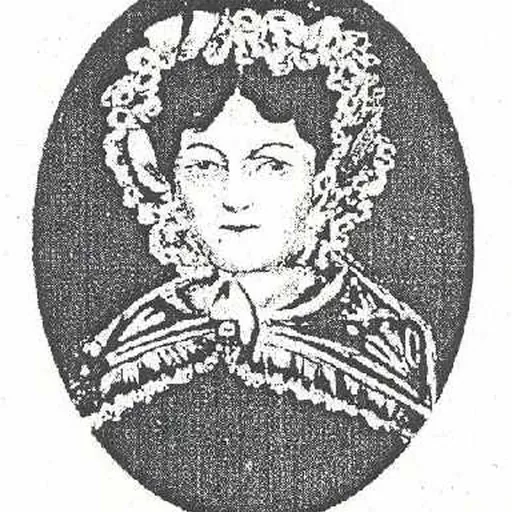
Anne Devlin
Irish republican
About Anne Devlin
Lived 1780 – 1851 (aged 70–71).
Anne Devlin (1780 – 18 September 1851) was an Irish republican who in 1803, while his ostensible housekeeper, conspired with Robert Emmet, and with her cousin, the rebel outlaw Michael Dwyer to renew the United Irish insurrection against the British Crown. When their plans for a rising in Dublin, the Irish capital, misfired, she endured torture and imprisonment. Outrage over her treatment secured her release in 1806, after which she was assisted for a period by the Emmet family. A long working life as a laundress ended in destitution.
Revolutionary involvement
Devlin was born in Cronebeg near Aughrim in County Wicklow to Wynnie Byrne and Bryan Devlin. The family later moved onto a 32-acre farm outside Rathdrum where her father was able to take a sub-lease despite the Protestant-only covenant of the land owner, the earls of Strafford.
Winning the confidence of Lord Strafford, in 1796 her parents secured a position for Anne as a maid in the household of his sister-in-law in Dublin. Reacting to the government's violent suppression of United Irish agitation (in which her mistress's brother-in-law, Edward Heppenstall, a militia lieutenant, was to earn the sobriquet the "Walking Gallows"), her father called her home. When the rebellion commenced in May 1798, Anne was working as a kitchenmaid for the Manning family in nearby Corbalis Castle, and neither she nor her family took any part. Anne, however, remained in contact with her cousin, Michael Dywer who led a guerrilla force in the Wicklow Mountains and, defiantly, she helped re-inter and bury the bodies of executed rebels. In 1799, notwithstanding that he continued throughout the rebellion to farm and pay his rent, her father was arrested and held for two and a half years in Wicklow Gaol dependent on his daughter's bi-weekly visits for food and clothing. She also involved herself the preparations for the insurrection in the city, helping to move arms and supplies from the Dublin headquarters on Butterfield Lane to rebel positions in other parts of the city.
Although the rising in Dublin on the evening of 23 July seemed to have taken the authorities by surprise, the lack of support among the unprepared population and confusion in the rebel ranks led to its collapse and disintegration into a night of bloody street clashes. Shortly after the rising was quashed, a detachment of yeomanry arrived at Butterfield Lane, seizing Anne and her eight-year-old sister. Anne was interrogated, including with the use of half-hanging but, finding out little of consequence, the yeomanry eventually departed. Shortly after returning to live in her family home in Rathfarnham the entire family was seized by government forces, having been informed on by a neighbour.
In the hope of removing her from a list of state prisoners at Kilmainham being considered for release, in 1806 her jailer Trevor Edward had her removed to the tower of Dublin Castle. There, thanks to a persistence of a friend, she was visited by the new Irish Chief Secretary, Charles Long. Appalled at finding Devlin so poorly she was scarcely able to move, he had her released.
Later life and reminiscences
After her release from prison in 1806, Devlin was found starving in a Dublin slum by a Church of Ireland Clergyman, the Reverend Gamble, who brought her to Mrs. Hammond. Anne lived for five years at No. 20 Sir John Rogerson's Quay Mrs. housekeeper and companion to Elizabeth Hammond, until the latter's death in 1810. Mr. John Hammond and Elizabeth Fisher Hammond were friends of the Emmet family. She is likely the Anne Devlin who in 1835 is recorded as being employed by St Patrick's Hospital Dublin as a laundress but, exceptionally, with the status and pay of an "officer" of the institution. She may have been indebted again to the Emmets—Dr Robert Emmet, had served for over thirty years (1770-1803) as governor, physician and treasurer of St Patrick's — or possibly to a connection between her husband from 1811, a drayman William Campbell, and Patrick and Sarah Campbell who were respectively the master and matron of the hospital. His transcriptions, held by the National Library of Ireland, were first edited by John J. Finegan and published in 1968 as The Anne Devlin Jail Journal. When the historian R. R. Madden (who had corresponded with Cullen) found Devlin in 1842 she was taking washing into her home (off Thomas Street) and was in chronically poor health. A collection of £5 raised by the Young Irelander paper The Nation, and doled out to her in half-crowns, did not arrest a slide into destitution. Her husband, with whom she had two children, died in 1845, and her death in a tenement in the Liberties area of Dublin—it is suspected, partly of malnutrition—is recorded six years later The grave was subsequently marked by a large Celtic cross on her grave, and is in the care of the National Graves Association.
There has been a memorial service held for Anne Devlin in St. Catherine's Church, Meath Street, Dublin every year since 2005, on a Sunday near the date of her death, organised by Mícheál Ó Doibhilín originally and now continued by Cuimhní Anne Devlin.
Devlin is today commemorated in Rathfarnham by a statue and a road 'Anne Devlin Park'
In May 2026, members of the Revolutionary Housing League occupied the former Ardee House pub in Dublin's Liberties, renaming it the Anne Devlin Community Centre. Although activists described the building as long-vacant, the site was owned by Black Sheep Investments and was the subject of redevelopment plans, including a proposed apartment development with a community facility. An earlier planning application had been unsuccessful, and a revised application was submitted shortly after the occupation became public.
Literature and Film There are grounds for believing that in his short story in the Dubliners (1914), “A Mother”, Devlin served James Joyce as a model for Mrs Kearney. While scarcely of Anne Devlin's stature or importance, Mrs Kearney (née Devlin) is nonetheless presented as a heroic figure—a woman, committed to the national cause, whose "shabby treatment by other Dubliners serves both to indict them and to evoke the reader's sympathy".
The film starred Bosco Hogan as Robert Emmet and Brid Brennan as Anne Devlin, and was entered into the 14th Moscow International Film Festival.
.
Don’t just read it —
keep it.
Full-length biographies made to live with: read them, listen on the way to work, watch them tonight.
- E-book
- Audio
- Video
Instant download · yours to keep · every purchase keeps this site free
Important facts
People in Anne Devlin's life
Named in this biography and alive at the same time




Contemporaries
People whose lives overlapped Anne Devlin's




Frequently asked questions
Who was Anne Devlin?
Irish republican
When was Anne Devlin born?
Anne Devlin was born in 1780 in County Wicklow.
When did Anne Devlin die?
Anne Devlin died on 1 September 1851 in The Liberties.
What was Anne Devlin known for?
Anne Devlin was known for Society of United Irishmen.
What nationality was Anne Devlin?
Anne Devlin's recorded nationality: Kingdom of Ireland.
Sources & further reading
Cite this page
APA: Biography.guide. (2026). Anne Devlin. https://biography.guide/anne-devlin/
MLA: "Anne Devlin." Biography.guide, https://biography.guide/anne-devlin/.
Chicago: "Anne Devlin." Biography.guide. https://biography.guide/anne-devlin/.
Data last updated: 2026-09-22 · Spot an error? Report a correction.
Portrait: Wikimedia Commons · author & licence
Page generated 2026-09-27 05:00 UTC