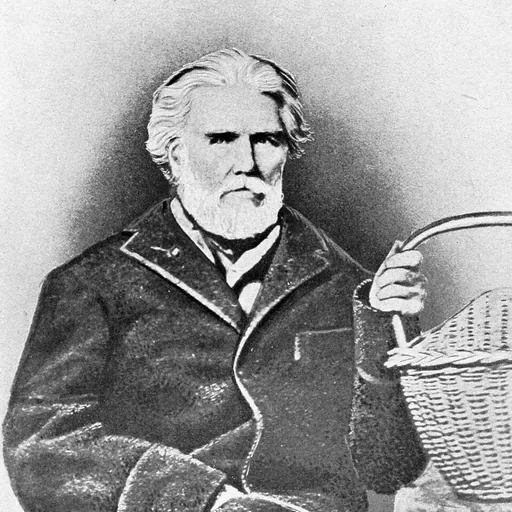
Angus William McDonald
American Military officer, fur trader, lawyer, deputy sheriff
About Angus William McDonald
Lived 1799 – 1864 (aged 65). Angus William McDonald was an American lawyer, fur trade, officer (armed forces) and sheriffs in the United States.
Angus William McDonald (February 14, 1799 – December 1, 1864) was a 19th-century American military officer and lawyer in the U.S. state of Virginia. He also served as a colonel in command of the Confederate States Army's 7th Virginia Cavalry during the American Civil War. McDonald was appointed to serve in a number of prominent political positions including a superintendent overseeing the construction of the Northwestern Turnpike and a commissioner representing Virginia in its boundary dispute with Maryland. McDonald was the grandson of Virginia military officer and frontiersman, Angus McDonald (1727–1778) and the father of United States Fish Commissioner Marshall McDonald (1835–1895).
Early life and education Angus William McDonald was born on February 14, 1799, in Winchester, Virginia. He was the eldest child of prominent local planter Angus McDonald (1769–1814) and his wife, Mary McGuire McDonald (d. 1809) and the grandson of Virginia militiaman, frontiersman, and landowner Angus McDonald (1727–1778). and of French and Irish descent through his mother. In 1809, following the death of his mother, McDonald and his younger brother and sister were sent by their father to "Glengarry" plantation near Winchester to live with their grandmother, Anna Thompson McDonald. McDonald initially gained admission to the academy's fourth class, but after much progress, he was permitted to pass during the middle of his third year from the second class into the first class, thus completing his education there in three years.
McDonald graduated from the academy on July 17, 1817, and was subsequently promoted to the rank of third lieutenant in the 7th Infantry Regiment. McDonald served in garrison at New Orleans in 1817 and at Mobile Bay, Alabama, in 1818. After several attempts at a transfer to a post within the American Frontier were unsuccessful, McDonald resigned his commission on January 31, 1819 and set out for the Western frontier to pursue a career in the fur trade. McDonald became a full partner of the company in his second year, but soon after, it went bankrupt and McDonald continued on by engaging in his own successful trapping and trading business on the Yellowstone River for another three years. McDonald frequently returned to St. Louis with cargoes of furs and skins, which earned him large sums of money.
After about four years on the American frontier, McDonald became attracted by the prospects of settling and developing the southwestern frontier. He and ten of his colleagues crafted a plan to organize "a body of emigrants" on the American frontier and wrest Texas and the southwest from the United Mexican States and establish a sovereign state. McDonald returned to Winchester, Virginia, to recruit participants in his endeavor. In a little over a year, McDonald was admitted to the bar and established his law practice in Romney. and continued to engage in and grow his lucrative law practice for the succeeding 17 years, which allowed him to amass and invest in large tracts of land in the American West. His son, Angus William McDonald Jr., later joined his father in the legal profession. McDonald created many enemies in his role as superintendent due to his attunement to cost efficiency and his "haughty" nature. and served on the board of trustees governing Romney Academy following his appointment by the Virginia General Assembly on March 25, 1839.
Political activities While McDonald did not bear any ambitions for political office, he became an active leader in support of political causes and positions he believed in. His personal political ideologies remained consistently states' rights-oriented despite the ever-shifting platforms of American political parties. McDonald's maneuver made him many enemies in the opposing Democratic Party, and when he requested permission from Democratic United States President James K. Polk to raise a regiment of volunteers to fight in the Mexican–American War, his request was denied. He sold the log dwelling in Romney to William Davis in 1849, In 1853, McDonald and his family relocated to "Wind Lea" in Paddy Town (now known as Keyser), a settlement along the North Branch Potomac River and Baltimore and Ohio Railroad in western Hampshire County (now Mineral County). McDonald's wife, Cornelia, successfully persuaded the United States Post Office Department to change the name of Paddy Town to Wind Lea, after which it was changed again to New Creek Station following the McDonald family's departure.
Shortly after his move to Winchester, McDonald was appointed by Virginia Governor Henry A. Wise as a commissioner representing Virginia in resolving a boundary dispute with Maryland. Maryland appointed Lieutenant N. Michler as its commissioner, and he and McDonald commenced their inquiry at a location along the Scarborough line, where McDonald discovered that Maryland had long been in possession of land that rightfully belonged to Virginia. He returned to the United States via New York in November 1860 The boundary dispute between Virginia and Maryland would not be resolved until the Maryland v. West Virginia, , ruling by the United States Supreme Court, which held that the boundary between Maryland and West Virginia (which had seceded from Virginia in 1863) was the south bank of the Potomac River.
American Civil War Prior to the outbreak of the American Civil War, McDonald sympathized with the secessionist cause, but his feelings softened during his trip abroad, where he found a "united republic" preferable to a cluster of sovereign states like Europe. General Kenton Harper assigned McDonald to the duty of guarding the bridges and fords crossing the Potomac River downstream of Harpers Ferry. In June 1861, McDonald and his cavalry occupied Romney, but were defeated by Union Army forces in their defense of the town by July. McDonald's 7th Virginia Cavalry fought a Union column under the command of Colonel James Cantwell in the Skirmish at Hanging Rock Pass on September 24, 1861. On the evening of September 23, 1861, McDonald received information that Union Army forces planned an attempt to pass through the gap at Hanging Rocks early the next morning. McDonald and his cavalry recaptured Romney from Union Army forces on September 24, thus causing Union Army forces to retreat to Keyser. McDonald and his son, who was then aged 16, were taken prisoner.
Following his release from prison, McDonald was reunited with his children and resided with his daughter at her home in Richmond.
Publications
Don’t just read it —
keep it.
Full-length biographies made to live with: read them, listen on the way to work, watch them tonight.
- E-book
- Audio
- Video
Instant download · yours to keep · every purchase keeps this site free
Important facts
People in Angus William McDonald's life
Named in this biography and alive at the same time




Related people
Same field, nearest in time




Contemporaries
People whose lives overlapped Angus William McDonald's





Frequently asked questions
Who was Angus William McDonald?
American Military officer, fur trader, lawyer, deputy sheriff
When was Angus William McDonald born?
Angus William McDonald was born on 14 February 1799 in Winchester.
When did Angus William McDonald die?
Angus William McDonald died on 1 December 1864 in Richmond.
What was Angus William McDonald's occupation?
Angus William McDonald was a lawyer, fur trade, officer (armed forces) and sheriffs in the United States.
What nationality was Angus William McDonald?
Angus William McDonald was American.
Sources & further reading
· Wikipedia: Angus William McDonald
· DBpedia: Angus William McDonald
Cite this page
APA: Biography.guide. (2026). Angus William McDonald. https://biography.guide/angus-william-mcdonald/
MLA: "Angus William McDonald." Biography.guide, https://biography.guide/angus-william-mcdonald/.
Chicago: "Angus William McDonald." Biography.guide. https://biography.guide/angus-william-mcdonald/.
Data last updated: 2026-09-21 · Spot an error? Report a correction.
Portrait: Wikimedia Commons · author & licence
Page generated 2026-09-27 04:58 UTC