About Angelo Caroselli
Lived 1585 – 1652 (aged 67). Angelo Caroselli was an Italian painter, restorer and copyist.
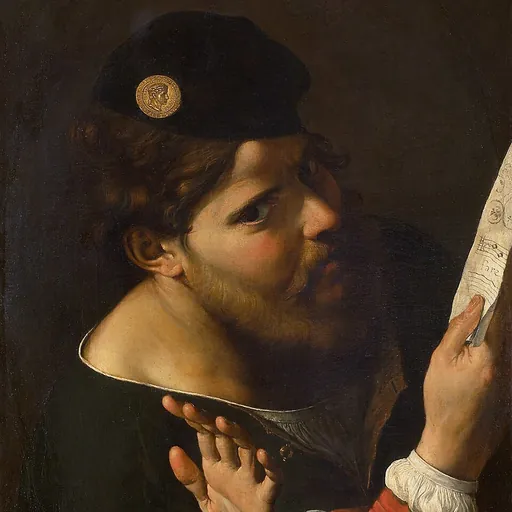
Angelo Caroselli or Carosèlli (11 February 1585 – 8 April 1652) was an Italian painter of the Baroque period, active mainly in his native Rome. He created religious works, allegories, portraits as well as genre scenes in the vein of the Caravaggisti. He also returned regularly to scenes of witchcraft and sorcery. His style is eclectic style and shows influences principally from Caravaggio and the painters of 'low-life' scenes active in Rome called the Bamboccianti. His work is characterised by its search for originality. This is demonstrated in the potent naturalism and chiaroscuro that characterise his compositions and his preference for depicting colorful characters of contemporary Rome and scenes of witchcraft and musicians.
Despite the Caravaggist influences his work is characterised by its search for originality and a certain resistance to the triumphant absolutism of the Baroque style, which is expressed through some 'archaicizing' leanings in his work. Caroselli was also active as an art restorer, copyist, and, possibly, forger. In recent years a corpus of paintings has been attributed to a yet to be identified artist referred to with the notname of Pseudo-Caroselli. The style of the anonymous artist is so close to that of Caroselli that it is believed that this artist must have been in direct contact with Caroselli. The resulting similarity in styles has made it difficult to attribute certain works with certainty to either of the two artists. He grew up in a popular neighborhood of Rome. Angelo did not get a formal training but was self-taught. He learned to paint by working as an art restorer and copyist. He became very skilled at copying older masters such as Annibale Carracci, Titian and Caravaggio. It is said that Poussin could not distinguish Caroselli's copy of a Madonna by Raphael from the original.
The artist spent time in Florence possibly in 1605–6 or 1610.
In 1615 Caroselli married Maria Turca or Turcha (also erroneously called 'Zurca'), whose father was a Sicilian of Palermo who had lived in Rome for many years. Passeri goes on to state that the family lived in dire straits as Caroselli did not get many commissions. For that reason the young couple left Rome in 1616, and after spending possibly some months in Piedimonte Matese in the province of Caserta, they settled in Naples. The family's single daughter and three sons Carlo, Angelo and Francesco were all born in Naples. The first born was the daughter Giacoma who was baptized in Naples on 26 September 1516. The last son was baptized in Naples on 25 February 1623. The Caresolle family moved back to Rome in 1626. Caroselli was an important influence on the style of Paolini's work throughout his career. After becoming a widower in 1637 he lived with the painter Agostino Tassi.
Caroselli married in 1642 Brigitta (or Brigida) Lauwers (Lauri), the daughter of the Flemish landscape painter Balthasar Lauwers who resided and worked in Rome since the early 1600s. He thus became the brother-in-law of the painters Filippo Lauri and Francesco Lauri. Filipo and Francesco became his pupils and collaborators, as evidenced by the altarpiece of 1631 representing Pope Gregory I executed for the church of S. Francesca Romana. The work, which was clearly influenced by Carlo Saraceni, was almost entirely by the hand of Francesco Lauri. Angelo's own son Carlo was his pupil but his oeuvre is not well established.
After his second marriage, Caroselli's family life settled down and he became more diligent in his work. Although suffering from ill health, he continued to paint until his death in Rome on 8 April 1652. Some art historians see an evolution from an initial naturalistic phase which developed in the 1930s towards a more "classicist" style, characterized by a greater elegance and softness in the brushstroke and a smoothness of the flesh that contrasts with the hard and sharp manner of the earlier works. In the latter period he also introduced ancient reliefs in his work.
The style of Caroselli is often described as eclectic. As his follower referred to as the Pseudo-Caroselli also often returned to this subject in a style not very unlike that of Caroselli, it has not always been possible to distinguish the work of the two artists in this area. For instance, the Violinist and Courtesan, an Allegory of Love (Sotheby's New York sale of 31 January 2018 lot 15) has traditionally been attributed to Caroselli but, since it also displays the more physical treatment of similar subjects by Pseudo-Caroselli, it could very well be the work of the latter. A fascinating depiction of the theme of paid love by Caroselli can be seen in the Blind love, a man playing draughts with a courtesan (at Robilant+Voena in 2019). This panel shows four people in a room around a table on which a draughts game board and playing cards are placed. A pretty young woman with a pearl pendant and a low-cut dress holding a game piece in her hand, is turning her head towards an old woman with a wrinkly face to her right. The latter holds something in her right hand which may be another game piece or a coin (i.e. the payment for the courtesan's services?). On the opposite side of the table there is a man blindfolded, with long dark hair and beard who is holding coins in his right hand. Behind him appears the head of a fourth figure, probably the putto who blindfolded him. On the wall hangs a painting with a nude reclining female and a Cupid with a bow and quiver in a landscape. The complex iconography of the painting seems to cite from many of the works of Caravaggio such as that of the Cardsharps, the fortune teller in the Capitoline Museums and the Calling of St. Matthew in the Contarelli Chapel in Rome. The scene has many symbolic meanings including those of gambling, deception and love. The blindfolded man in buying the courtesan's favours represents on the one hand, a form of vile, blind love and, at the same time, all those who get involved in the risky game of love. The contrast between old woman and the young courtesan placed next to each other represents an allegory of vanitas, i.e. the theme of the merciless march of life towards old age and ultimately death.
Various art historians have posited that Caroselli was linked to the circles of the adepts of the secret sciences of magic, occultism and alchemy. There are no written documents to support this suggestion but it is clear from his paintings dealing with themes of the occult that he had a fascination with the subject. Some of the paintings on this topic formerly attributed to him have now been attributed to the anonymous Pseudo-Caroselli.
The subject of the Virgin Mary, usually in the company of the child Jesus and saints, appears to have been particularly dear to the artist. At least 29 works treat this subject. The frequency is likely due to the Catholic Counter-Reformation's insistence on the role of the Virgin in its belief system. Most of Caroselli's Virgins are shown in a serene attitude, and, in some cases, smiling and joyful with the child Jesus. This style of representation seems to go back to ways of representing the Virgin in the 16the century and may indicate a rejection by the artist of the emotionality of the Baroque in favour of the Renaissance iconography.
Don’t just read it —
keep it.
Full-length biographies made to live with: read them, listen on the way to work, watch them tonight.
- E-book
- Audio
- Video
Instant download · yours to keep · every purchase keeps this site free
Important facts
more
Caroselli Vecchio, a. caroselli, Jan Angelo Carroselli, angiolo caroselli, Carosel, CaroselliPeople in Angelo Caroselli's life
Named in this biography and alive at the same time



Related people
Same field, nearest in time

Contemporaries
People whose lives overlapped Angelo Caroselli's




Frequently asked questions
Who was Angelo Caroselli?
Italian painter (1585-1652)
When was Angelo Caroselli born?
Angelo Caroselli was born on 10 February 1585 in Rome.
When did Angelo Caroselli die?
Angelo Caroselli died on 8 April 1652 in Rome.
What was Angelo Caroselli's occupation?
Angelo Caroselli was a painter, restorer and copyist.
What nationality was Angelo Caroselli?
Angelo Caroselli was Italian.
Sources & further reading
Cite this page
APA: Biography.guide. (2026). Angelo Caroselli. https://biography.guide/angelo-caroselli/
MLA: "Angelo Caroselli." Biography.guide, https://biography.guide/angelo-caroselli/.
Chicago: "Angelo Caroselli." Biography.guide. https://biography.guide/angelo-caroselli/.
Data last updated: 2026-09-23 · Spot an error? Report a correction.
Portrait: Wikimedia Commons · author & licence
Page generated 2026-09-27 05:06 UTC