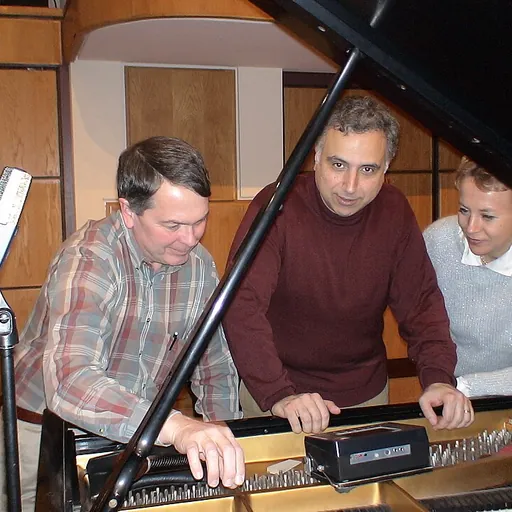
About Andrey Kasparov
Born 1966. Andrey Kasparov is an American and Russian composer, pianist and academic.
Andrey Rafailovich Kasparov (; ; born 6 April 1966) is an Armenian-American pianist, composer, and professor, who holds both American and Russian citizenship.
Biography
Early life and education
Kasparov was born on 6 April 1966 in Baku, Azerbaijan, to a family of Armenian descent. He began his musical studies at the age of six, and he moved to Moscow at fifteen. He later entered the Moscow State Conservatory, graduating with honors in Music Composition and Piano, in 1989 and 1990, respectively. At the Conservatory, he studied harmony and counterpoint were with Yuri Kholopov, a famous Russian musicologist. Among his keyboard instructors were Nina Emelianova, Vladimir Bunin, Sergei Dizhur, Dmitri Sakharov, and Victor Merzhanov. His composition studies began with Tatyana Chudova and Tikhon Khrennikov; he later continued them in the independent studio of Alexandr Chaikovsky. In 1985, he was awarded a Third Prize for his Toccata for piano, and in 1987, was awarded Second Prize for his Six Aphorisms for flute, violin and cello, at the All-USSR Composition Competition.
Kasparov pursued subsequent doctoral studies in composition at the Jacobs School of Music and the Indiana University at Bloomington, with Claude Baker, Wayne Peterson, Harvey Sollberger, and Eugene O'Brien, and conducting instructor, Thomas Baldner. He also participated in Courses for New Music in 1996, in Darmstadt, Germany. In 1997 he was awarded Second Prize at the Prokofiev International Composers Competition for his Piano Sonata No. 2, a work on two contrasting twelve-tone rows. Kasparov earned his D.M. in Music Composition from Indiana University in 1999. at Old Dominion University in Norfolk, Virginia, where he teaches undergraduate and graduate music composition, piano, and all levels of undergraduate music theory, as well as leading the new music ensemble. The group's final performance in March 2008, featured the premiere of Kasparov's composition, Tsitsernakabert, for modern dance and six musicians: alto flute, bass/ contrabass flute, violin, two percussionists, and mezzo-soprano. Among the participating artists were members of the Second Wind Dance Company and mezzo-soprano Lisa Relaford Coston. Co-choreographed by Beverly Cordova Duane and Christina Yoshida, the work opened with eight dancers posed in a circle, inclined toward the circle's centre in a tableau reminiscent of the eponymous memorial to victims of the Armenian Genocide. Kasparov had previously worked with the Second Wind Dance Company in 2005, in collaboration with choreographer Jelon Vieira, on Iao, an original work for dance, mezzo-soprano, and percussion, which incorporated elements of traditional Afro-Brazilian dance and Capoeira, the Brazilian martial art.
Besides his career as a composer and academic, Kasparov is a concert pianist and recording artist, whose discography encompasses several record labels including Albany Records and Naxos Records. Since 2009, he has shared the Artistic Directorship of the Norfolk Chamber Consort with wife and fellow pianist, Oksana Lutsyshyn. Together, they are co-founders of the Invencia Piano Duo.
Work on Béla Bartók Beginning in 1994 and in conjunction with Peter Bartók and Nelson Dellamaggiore, Kasparov began research into editing projects concerning Béla Bartók's Piano Concerto No. 3 and his Viola Concerto.
Bartók's health grew steadily worse as he worked to complete his Third Piano Concerto, and his rapid decline eventually forced him to concede admittance to a hospital. Consequently, the last seventeen measures of the score were left in rough sketch. Before entering the hospital, however, he gave explicit instructions to his son, Peter, to insert seventeen bar-lines and a double-bar at the end; in his haste to finish the work, Béla had noted the precise ending in his native Hungarian. Bartók never returned to oversee the Piano Concerto's completion, having succumbed to leukemia on 26 September 1945. Final orchestration was eventually executed from the composer's notes by his friend, Tibor Serly. The Third Piano Concerto was later published in an edition by Serly and Erwin Stein, an editor for Boosey & Hawkes. The original manuscript, along with numerous others, then became the subject of a protracted legal dispute between a trustee of Bartók's estate, Peter, and Béla's second wife, Ditta Pásztory-Bartók. The trustee asserted the composer had lost title to his own work in his lifetime, a claim disputed by Peter Bartók. The same trustee also denied Ditta's right to any income from music sales, so long as ownership remained in contest. Throughout the forty subsequent years of legal battles, all of the original manuscripts remained inaccessible. Only with the deaths of both the trustee and Ditta was Peter able to regain full possession of his father's documents and begin the long-overdue process of editing them. It was at this time the Viola Concerto, presumed lost, was rediscovered, amongst the possessions of the deceased trustee.
Peter Bartók's intent, in association with Nelson Dellamaggiore, was to reprint and revise past editions of both scores, as well as to eradicate the many printed errors identified but never corrected by his father. in the world premiere of the revised edition of Béla Bartók's Piano Concerto No. 3.
The revised editions of both the two-piano reduction and the orchestral score of the Piano Concerto No. 3 are available from Boosey & Hawkes.
Hommages Musicaux In 1920, in tribute to the late Claude Debussy, the French music journal La Revue musicale commissioned works by contemporary composers and concert artists. The collection was published under the title Tombeau de Claude Debussy, with contributions from Paul Dukas, Albert Roussel, Gian Francesco Malipiero, Eugene Goossens, Béla Bartók, Florent Schmitt, Igor Stravinsky, Maurice Ravel, Manuel de Falla, and Erik Satie. Encouraged by the success of this premiere collaboration, editor Henry Prunières proposed a second dedicatory work. Published in 1922, seven of Gabriel Fauré's students laboured to produce Hommage à Gabriel Fauré. Ravel offered a work for solo violin; Charles Koechlin and Jean Roger-Ducasse composed four hands pieces for the piano; George Enescu, Louis Aubert, Florent Schmitt, and Paul Ladmirault each contributed pieces for solo piano.
Released in 2007 by Albany Records, with violinists Desiree Ruhstrat and Pavel Ilyashov, cellist David Cunliffe, guitarist Timothy Olbrych, and mezzo-soprano Lisa Relaford Coston, the Invencia Piano Duo (Andrey Kasparov and Oksana Lutsyshyn) produced Hommages Musicaux, which contained both Tombeau de Claude Debussy and Hommage à Gabriel Fauré.
Work on Florent Schmitt In the mid 1990s, during production of Hommages Musicaux, the Invencia Piano Duo was introduced to the catalogue of composer Florent Schmitt. Intended as a tribute to Claude Debussy and Gabriel Fauré, the recording featured Tombeau de Claude Debussy and Hommage à Gabriel Fauré. Within each of these cycles was contained one of Schmitt's works for piano. Kasparov and Lutsyshyn were:
“...captivated by the richness of Schmitt’s multi-layered harmonies and textures, as well as the vitality of the rhythmic structures in the music.”
Kasparov's dedication to Florent Schmitt's duo-piano music, in collaboration with Oksana Lutsyshyn, culminated in the release of four CDs by Naxos Records as part of its Grand Piano series.
Issued in 2012, Volume 1 contained Schmitt's Trois rapsodies, Op. 53, and the first-ever recording of Schmitt's Sept pièces, Op. 15, composed in 1899. The album concluded with a previously unpublished work, Rhapsodie parisienne. Composed in 1900, it is one of two unpublished duets by Schmitt. According to Kasparov, pencil notations in the score indicated the composer intended it for later orchestration.
It is unclear whether many of Schmitt's works for piano duet had ever received formal public performances in Europe, prior to the Invencia Piano Duo's revival of his compositions. A number appear to have been composed by Schmitt as piano études, particularly the two premiere recordings, Sur cinq notes, Op. 34 and Eight Easy Pieces, Op. 41, which were included on Volume 2. Kasparov has asserted that Schmitt experimented with a method of composition based on the first five notes of the diatonic scale, an approach later adopted by the likes of Igor Stravinsky in both his Five Easy Pieces for piano duet, published in 1917, and his Les cinq doigts for solo piano, published in 1921.
Volume 3 heralded the debut recordings of a six-movement work composed between 1895 and 1902, Musiques foraines, Op. 22, and the Marche du 163 R.I., Op. 48. Volume 4 featured yet another of Schmitt's compositions derived from the five set notes of the primo part, Trois pièces récréatives, Op. 37. The same album contained the first-ever issue of the Lied et Scherzo, Op. 54, in Schmitt's version for piano four-hands, played on two pianos; composed in 1910 for double woodwind quintet; alternate editions of this piece were also prepared by the composer for horn and piano, as well as cello and piano.
As of November 2016, it was announced all four volumes would be made available in a box set on the Grand Piano label of Naxos Records, with a scheduled release in January 2017.
Work on Paul Bowles Paul Bowles was an American expatriate composer, author, and translator. His musical studies began with Aaron Copland. Subsequently, he pursued further instruction with Virgil Thomson. However, critical success for his first novel, The Sheltering Sky (1949), relegated Bowles' earlier musical efforts to relative obscurity.
Only in the decade before his death was there a revival of interest in Bowles' music. In 2016 the Invencia Piano Duo, once more in partnership with Naxos Records, released two CDs of Bowles' complete works for piano.
Volume one begins with works influenced by Latin American themes, grounded in the composer's affinity for the culture and his fluency in the Spanish language. The second of the two volumes closes with arrangements of Blue Mountain Ballads (1946), arranged for piano duet by Andrey Kasparov, Kasparov restored the original manuscripts which enabled these duets to be recorded for the very first time. Plus Award, ASCAP (1999–2011, 2013, 2015). Prize-Winner, Contemporary Record Society National Competition for Composers.
Compositions
Original works Toccata for piano (1983). Six Aphorisms for flute, violin and cello (1987). Symphony of Three Cycles for symphony orchestra (1988–1989). Piano Sonata No. 2 (1994). Perestroika for orchestra (1998). Nocturne for bassoon, harp, piano and double bass (1998). Michal for solo clarinet (2000). Variations on a Theme by Mark Schultz for horn and piano (2001). Fantasy on Lutheran Chorales for piano four hands (2004). Iao for modern dance, mezzo-soprano and percussion (2005). Situated in Yerevan, capital of Armenia, the monument was designed by the architects Sashur Kalashyan and Arthur Tarkhanyan. Ave Maris Stella for bass recorder, great bass recorder and bass viola da gamba (2010). From 2011, the work is based on the liturgical hymn, Ave Maris Stella (Hail Star of the Sea), by Guillaume Dufay. Cadenza for LvB for solo piano (2010–2011); version for piano duo (2015). Rhapsody on Hassidic Tunes for solo violin (2012). Lorca, operatic cycle in 5 parts; libretto by Christopher Sawyer-Lauçanno. La valse, Maurice Ravel (1875–1937); arranged for piano four hands (2008). Oblivion, Astor Piazzolla (1921–1992); arranged for solo piano (2012). Totentanz, Franz Liszt (1811–1886); arranged for two pianos (2014). Mes de Mayo, Baby, Baby, April Fool Baby, Paul Bowles (1910–1999); arranged for piano duet (2014). Blue Mountain Ballads, Paul Bowles (1910–1999); arranged for piano duet (2014). Main Theme from Darling Lili, Henry Mancini (1924–1994) & Johnny Mercer (1909–1976); arranged for symphonic wind ensemble (2018). Twentieth Century Classics: Music for Piano and Strings, Distinguished Performers Series III (Andrey Kasparov, Toccata for piano) Contemporary Record Society: Four Paintings: Contemporary American Composers (Andrey Kasparov, Toccata for piano) Atlantic Music Artist Agency: New Music in Ukraine, Chamber Ensemble (4) (Andrey Kasparov, Michal for solo clarinet)
As performer Columbus Indiana Philharmonic Rachmaninoff by Kasparov. Sergei Rachmaninoff: Piano Concerto No. 2, Op. 18; Sergei Rachmaninoff/ Franz Behr, Polka de W.R. (Encore)
Albany Records Hommages Musicaux. Two collections of compositions honouring the memories of Claude Debussy and Gabriel Fauré (Invencia Piano Duo): Two Scherzos Trio Sonata Ignis Fatuus Eight Variations on "Shalom chaverim" Piano Sonata No. 2 Sonata for Two Pianos
Naxos Records Paul Bowles: Complete Piano Works – Vol. 1 Trois rapsodies, Op. 53 Sept pièces, Op. 15 Rhapsodie parisienne Florent Schmitt: Complete Original Works for Piano Duet and Duo – Vol. 2 (Invencia Piano Duo) Sur cinq notes, Op. 34 Reflets d'Allemagne, Op. 28 Eight Easy Pieces, Op. 41 Florent Schmitt: Complete Original Works for Piano Duet and Duo – Vol. 3 (Invencia Piano Duo) Marche du 163 R.I., Op. 48, No. 2 Feuillets de voyage, Book 1, Op. 26 Feuillets de voyage, Book 2, Op. 26 Musiques foraines, Op. 22 Florent Schmitt: Complete Original Works for Piano Duet and Duo – Vol. 4 (Invencia Piano Duo) Humoresques, Op. 43 Lied et scherzo, Op. 54 (for piano four hands) Trois pièces récréatives, Op. 37 Le Petit Elfe Ferme-l'œil, Op. 58
Don’t just read it —
keep it.
Full-length biographies made to live with: read them, listen on the way to work, watch them tonight.
- E-book
- Audio
- Video
Instant download · yours to keep · every purchase keeps this site free
Important facts
Family & relationships
People in Andrey Kasparov's life
Named in this biography and alive at the same time






Related people
Same field, nearest in time



Contemporaries
People whose lives overlapped Andrey Kasparov's

Frequently asked questions
Who is Andrey Kasparov?
classical music composer, pianist, and academic
When was Andrey Kasparov born?
Andrey Kasparov was born on 6 April 1966 in Baku.
What is Andrey Kasparov's occupation?
Andrey Kasparov is a composer, pianist and academic.
What nationality is Andrey Kasparov?
Andrey Kasparov is American and Russian.
Sources & further reading
Cite this page
APA: Biography.guide. (2026). Andrey Kasparov. https://biography.guide/andrey-kasparov/
MLA: "Andrey Kasparov." Biography.guide, https://biography.guide/andrey-kasparov/.
Chicago: "Andrey Kasparov." Biography.guide. https://biography.guide/andrey-kasparov/.
Data last updated: 2026-09-22 · Spot an error? Report a correction.
Portrait: Wikimedia Commons · author & licence
Page generated 2026-09-27 04:58 UTC