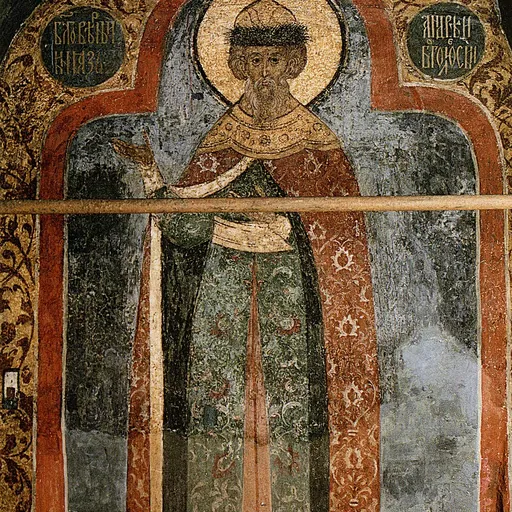
About Andrey Bogolyubsky
Lived 1111 – 1174 (aged 62–63). Andrey Bogolyubsky was a sovereign.
Biography leftAccording to the Primary Chronicle (PVL), Andrey's parents married on 12 January 1108, as part of a peace agreement between the Rus' and the Cumans (Polovtsi). Andrey's father was Yuri Vladimirovich , Prince of Rostov and Suzdal commonly known as Yuri Dolgoruki , a son of Volodimer II Monomakh, progenitor of the Monomakhovichi. Andrey's mother was an unnamed Cuman princess, a daughter of Aepa son of Osen'. From this marriage, Andrey Bogolyubsky was born in 1111. Yuri proclaimed Andrey a prince in Vyshgorod (near Kiev).
Seizing power (1155–1162) Andrey left Vyshgorod in 1155 and moved to Vladimir, a little town on the river Klyazma founded in 1108. In doing so, he removed the Icon of the Blessed Mother of God from Vyshgorod to Vladimir (thereafter known as the "Virgin of Vladimir"), an action condemned as theft by the Kievan Chronicle, while the Suzdalian Chronicle made no judgement on it. In 1153 he was the Prince of Murom-Ryazan. After his father's death in 1157, Andrey ousted his younger brothers Mikhail "Mikhalko" Yurievich and Vsevolod "the Big Nest" from Rostov and Suzdal in 1162, thus uniting his father's patrimony in Vladimir-Suzdal under his sole rule (samovlastets). He expelled his four brothers to the Byzantine Empire together with their mother, Yuri's second wife.
Andrey established for himself the right to receive tribute from the populations of the Northern Dvina lands.
Construction works
He commenced the construction of fortifications around the town of Vladimir in 1158 (completed in 1164), as well as the Dormition Cathedral in Vladimir. In 1162 or 1164, Andrey sent an embassy to Constantinople, lobbying for a separate metropolitan see in Vladimir, but he was overruled by the patriarch of Constantinople. Fortifications around Vladimir were completed in 1164. The same year Andrey attacked the Volga Bolgars; he won a victory, but according to later traditions, a son was killed in battle, to whose memory he supposedly ordered the construction of the Church of the Intercession on the Nerl in 1165.
Sack of Kiev and brief overlordship (1169–1171)
In March 1169 Andrey's troops sacked Kiev, devastating it as never before. Andrey did not take part in the attack; he stayed in Vladimir-Suzdal while his troops sacked the capital. After plundering the city, stealing much religious artwork, many books and valuables and devastating houses and religious buildings alike, Andrew claimed the title of Grand Prince, although he kept his residence at Vladimir, and emphasized the Byzantine religious heritage of Vladimir to assert Vladimir's prestige and ecclesiastical independence from Kiev. Andrey had his brother Gleb appointed as prince of Kiev, in an attempt to create a position of overlordship for himself. This overlordship lasted for less than two years, ending with Gleb's death on 20 January 1171.
Andrey's attempts to control other parts of Kievan Rus' were barely successful either; his Siege of Novgorod (1170) was a failure, and the Suzdalians were defeated. Although he managed to later blackmail the Novgorodians by imposing a blockade on the trade hub, securing the princehood for his son Yury Bogolyubsky in 1171, the Novgorodians immediately expelled him upon Andrey's death in June 1174.
1171–1173 Kievan succession crisis
Gleb's death in 1171 caused another Kievan succession crisis, and Andrey became embroiled in a two-year war to regain control over Kiev. When the Rostislavichi of Smolensk and Iziaslavichi of Volhynia jointly secured the throne of Kiev, Andrey assembled another coalition and marched on Vyshhorod in 1173, where the Yurievichi–Olgovichi forces of Suzdalia and Chernigov were utterly defeated.
Death Andrey had the castle, Bogolyubovo, built near Vladimir, and it would become his favorite residence His victory over the Bulgars is remembered yearly during the Honey Feast of the Saviour.
Don’t just read it —
keep it.
Full-length biographies made to live with: read them, listen on the way to work, watch them tonight.
- E-book
- Audio
- Video
Instant download · yours to keep · every purchase keeps this site free
Important facts
People in Andrey Bogolyubsky's life
Named in this biography and alive at the same time
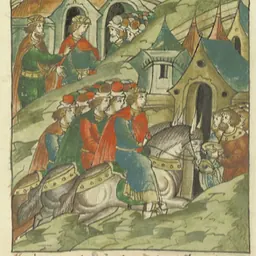
Related people
Same field, nearest in time


Contemporaries
People whose lives overlapped Andrey Bogolyubsky's



Frequently asked questions
Who was Andrey Bogolyubsky?
Russian Grand Prince
When was Andrey Bogolyubsky born?
Andrey Bogolyubsky was born in 1111 in Rostov Veliky.
When did Andrey Bogolyubsky die?
Andrey Bogolyubsky died on 29 June 1174 in Bogolyubovo.
What was Andrey Bogolyubsky's occupation?
Andrey Bogolyubsky was a sovereign.
What nationality was Andrey Bogolyubsky?
Andrey Bogolyubsky's recorded nationality: Grand Principality of Vladimir, Principality of Ryazan, Principality of Dorogobuzh.
Sources & further reading
· Wikipedia: Andrey Bogolyubsky
Cite this page
APA: Biography.guide. (2026). Andrey Bogolyubsky. https://biography.guide/andrey-bogolyubsky/
MLA: "Andrey Bogolyubsky." Biography.guide, https://biography.guide/andrey-bogolyubsky/.
Chicago: "Andrey Bogolyubsky." Biography.guide. https://biography.guide/andrey-bogolyubsky/.
Data last updated: 2026-09-23 · Spot an error? Report a correction.
Portrait: Wikimedia Commons · author & licence
Page generated 2026-09-27 05:05 UTC