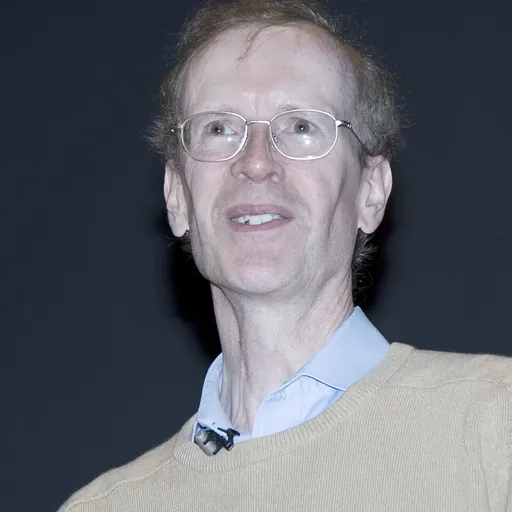
About Andrew Wiles
Born 1953. Andrew Wiles is a British mathematician and university teacher, known for Fermat's Last Theorem, Main conjecture of Iwasawa theory and Taniyama–Shimura conjecture.
thesis_title = Reciprocity Laws and the Conjecture of Birch and Swinnerton-Dyer thesis_year = 1979 thesis_url = http://ethos.bl.uk/OrderDetails.do?uin=uk.bl.ethos.477263 known_for = Proving the Taniyama–Shimura conjecture for semistable elliptic curves, thereby proving Fermat's Last TheoremProving the main conjecture of Iwasawa theory awards = In August 1993, it was discovered that the proof contained a flaw in several areas, related to properties of the Selmer group and use of a tool called an Euler system. Wiles tried and failed for over a year to repair his proof. According to Wiles, the crucial idea for circumventing—rather than closing—this area came to him on 19 September 1994, when he was on the verge of giving up. The circumvention used Galois representations to replace elliptic curves, reduced the problem to a class number formula and solved it, among other matters, all using Victor Kolyvagin's ideas as a basis for fixing Matthias Flach's approach with Iwasawa theory. Together with his former student Richard Taylor, Wiles published a second paper which contained the circumvention and thus completed the proof. Both papers were published in May 1995 in a dedicated issue of the Annals of Mathematics.
Later career In 2011, Wiles rejoined the University of Oxford as Royal Society Research Professor. Wiles's doctoral students have also included Manjul Bhargava (2014 winner of the Fields Medal), Ehud de Shalit, Ritabrata Munshi (winner of the SSB Prize and ICTP Ramanujan Prize), Karl Rubin (son of Vera Rubin), Christopher Skinner, and Vinayak Vatsal (2007 winner of the Coxeter–James Prize).
In 2016, upon receiving the Abel Prize, Wiles said about his proof of Fermat's Last Theorem, "The methods that solved it opened up a new way of attacking one of the big webs of conjectures of contemporary mathematics called the Langlands Program, which as a grand vision tries to unify different branches of mathematics. It’s given us a new way to look at that". about Fermat's Last Theorem. This was broadcast as a 1997 episode of the PBS science television series Nova in Season 25 with the title "The Proof". His work and life are also described in great detail in Simon Singh's popular book Fermat's Last Theorem.
In 1988, Wiles was awarded the Junior Whitehead Prize of the London Mathematical Society (1988). Upon completing his proof of Fermat's Last Theorem in 1995, he was awarded the Schock Prize, the Royal Medal, and the Ostrowski Prize in 1996. He won the American Mathematical Society's Cole Prize, a MacArthur Fellowship, and the Wolfskehl Prize in 1997, and was elected member of the American Philosophical Society that year.
In 1998, Wiles was awarded a silver plaque from the International Mathematical Union recognising his achievements, in place of the Fields Medal, which is restricted to those under the age of 40 (Wiles was 41 when he proved the theorem in 1994). That same year, he was awarded the King Faisal Prize along with the Clay Research Award in 1999,
In 2000, he was awarded Knight Commander of the Order of the British Empire. In 2004, Wiles won the Premio Pitagora. In 2005, he won the Shaw Prize.
The building at the University of Oxford housing the Mathematical Institute was named after Wiles in 2013. Later that year he won the Abel Prize. In 2017, Wiles won the Copley Medal.
Don’t just read it —
keep it.
Full-length biographies made to live with: read them, listen on the way to work, watch them tonight.
- E-book
- Audio
- Video
Instant download · yours to keep · every purchase keeps this site free
Important facts
People in Andrew Wiles's life
Named in this biography and alive at the same time




Related people
Same field, nearest in time

Contemporaries
People whose lives overlapped Andrew Wiles's

Frequently asked questions
Who is Andrew Wiles?
English mathematician (1953–)
When was Andrew Wiles born?
Andrew Wiles was born on 11 April 1953 in Cambridge.
What is Andrew Wiles's occupation?
Andrew Wiles is a mathematician and university teacher.
What is Andrew Wiles known for?
Andrew Wiles is known for Fermat's Last Theorem, Main conjecture of Iwasawa theory and Taniyama–Shimura conjecture.
What nationality is Andrew Wiles?
Andrew Wiles is British.
Sources & further reading
Cite this page
APA: Biography.guide. (2026). Andrew Wiles. https://biography.guide/andrew-wiles/
MLA: "Andrew Wiles." Biography.guide, https://biography.guide/andrew-wiles/.
Chicago: "Andrew Wiles." Biography.guide. https://biography.guide/andrew-wiles/.
Data last updated: 2026-09-22 · Spot an error? Report a correction.
Portrait: Wikimedia Commons · author & licence
Page generated 2026-09-27 05:01 UTC