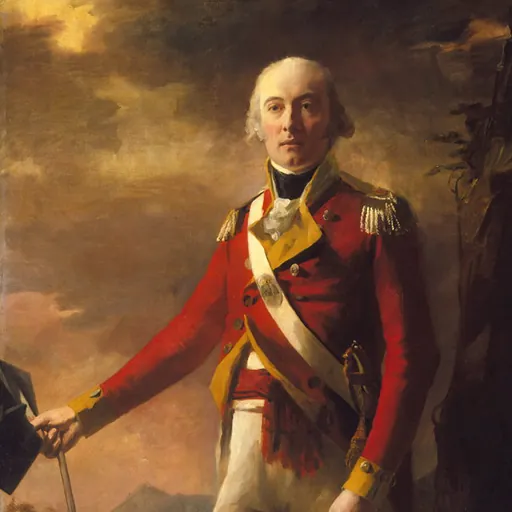
About Andrew Hay
Lived 1762 – 1814 (aged 51–52). Andrew Hay was a British military officer.
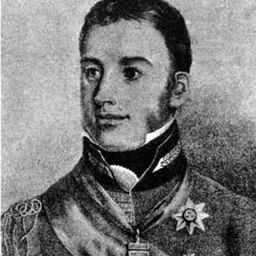
Major-General Andrew Hay (1762 – 14 April 1814) was a British Army officer who served in the American War of Independence and French Revolutionary and Napoleonic Wars. He was mortally wounded at the Battle of Bayonne on 14 April 1814.
Early career Andrew Hay enlisted as an ensign in the 1st regiment of foot, on 6 December 1779. He served in the American Revolutionary War and was promoted to lieutenant on 21 July 1781. He transferred to the 88th Foot as captain on 24 January 1783 but when the regiment was disbanded after the war, Hay returned to the 1st Foot, maintaining the rank of captain, and inheriting seniority on 17 April 1784. The surviving troops were evacuated to Britain, from where Hay was sent to the Netherlands, where he took part in the unsuccessful Walcheren Campaign.
In July 1810, Hay was sent back to the Peninsula with the 3rd battalion, 1st Foot of which he again obtained command on 4 August.
Battle of the Nivelle
After fleeing from the Bidasoa, the French, under Marshal Soult took up a position along the Nivelle between the mountains near Ainhoa, and St Jean-de-Luz. On 10 November 1813, the 5th Division under Hay and the 1st Division under the Earl of Effingham, made a feint along the shore, allowing Wellington's Light Division to fall on the French centre while his 3rd, 4th and 7th Divisions overran the French redoubts. With the loss of the bridge at Amotz, the threat of Soult's army being cut in two forced him to fall back once more, with the loss of 4,400 men.
Battle of the Nive
Soult's army entrenched itself at Bayonne, between the Nive and the Adour. Wellington, restricted in his position between the two rivers and the Pyrenees, crossed the Nive in order to gain some space. Three divisions under Sir John Hope, including the 5th under Hay, advanced towards the Adour on 9 December, whilst generals Beresford and Hill, with five divisions and three further divisions of Spanish and Portuguese soldiers, crossed upstream of Bayonne. Wellington was to use the main bulk of his army to draw Soult away, while Hope was left with the 1st and 5th divisions and a few independent brigades with which to complete the investment. Surrounding the city meant that Hope's troops had to cross the Adour, and to this end, a pontoon bridge was constructed from locally available boats.
Humphrey Hopper. Memorial to Andrew Hay in St Paul's Cathedral, London (1814) On 13 April 1814, news of Napoleon's abdication reached Bayonne. Hay, who was duty officer, spread the news amongst the troops; it was thought that the war would soon be at an end and the soldiers would be returning home. Hay's widow also honoured his memory with a monument in the Church of St Mary the Virgin, near the family home in Fordingbridge.
Don’t just read it —
keep it.
Full-length biographies made to live with: read them, listen on the way to work, watch them tonight.
- E-book
- Audio
- Video
Instant download · yours to keep · every purchase keeps this site free
Important facts
People in Andrew Hay's life
Named in this biography and alive at the same time

Related people
Same field, nearest in time


Contemporaries
People whose lives overlapped Andrew Hay's






Frequently asked questions
Who was Andrew Hay?
British Army officer
When was Andrew Hay born?
Andrew Hay was born in 1762.
When did Andrew Hay die?
Andrew Hay died on 14 April 1814 in Bayonne.
What was Andrew Hay's occupation?
Andrew Hay was a military officer.
What nationality was Andrew Hay?
Andrew Hay was British.
Sources & further reading
· DBpedia: Andrew Hay (British Army officer)
Cite this page
APA: Biography.guide. (2026). Andrew Hay. https://biography.guide/andrew-hay-military-officer/
MLA: "Andrew Hay." Biography.guide, https://biography.guide/andrew-hay-military-officer/.
Chicago: "Andrew Hay." Biography.guide. https://biography.guide/andrew-hay-military-officer/.
Data last updated: 2026-09-23 · Spot an error? Report a correction.
Portrait: Wikimedia Commons · author & licence
Page generated 2026-09-27 05:07 UTC