
About Andrés Aylwin
Lived 1925 – 2018 (aged 93). Andrés Aylwin was a Chilean politician, lawyer and human rights defender.
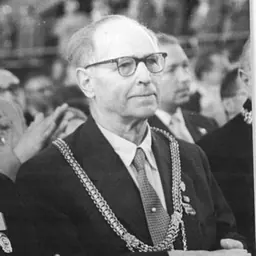
Andrés Aylwin Azócar (20 June 1925 – 20 August 2018) was a Chilean lawyer, activist and politician who served as a Deputy representing the Christian Democratic Party from 1965 to 1973 and from 1990 to 1998. His older brother was Patricio Aylwin.
During the military dictatorship (1973–1990), Aylwin defended many of the victims arrested by the government of Augusto Pinochet.
Early life and education
Aylwin was born on 20 June 1925 in Viña del Mar
Aylwin completed his primary and secondary education at the Liceo de San Bernardo. He studied law at the University of Chile, where he completed his studies in 1953 He wrote a few books, including Simply what i saw (Simplemente lo que vi: 1973-1990 y los imperativos que surgen del dolor) and Eight days of a relegated (Ocho días de un relegado).
Political career
Aylwin began his political involvement during his university years, joining the National Falange in 1949. He was a candidate for the presidency of the University of Chile Student Federation (FECh) and served on the executive council of the Federation of Chilean Students between 1948 and 1949, acting as a student representative before the University Council.
He joined the Christian Democratic Party of Chile at its founding in 1957. During the 1960s, he was elected president of the party at the municipal level in San Bernardo and later in Providencia.
Aylwin was elected to the Chamber of Deputies in 1965, representing the Eighth Departmental Grouping (Melipilla, San Antonio, San Bernardo, and Maipo). He was re-elected for the periods 1969–1973 and 1973–1977, the latter term being left incomplete due to the military coup of 11 September 1973.
During these terms, he served on several permanent committees, including Constitution, Legislation and Justice; Agriculture and Colonization; Labour and Social Security; and Government Affairs. He also participated in special investigative commissions, including those examining violence against peasants and officials of the Agrarian Reform Corporation (CORA) and the Agricultural Development Institute (INDAP).
Opposition to the military dictatorship and human rights work
Aylwin was a member of the so-called Group of Thirteen, composed of Christian Democrats who publicly opposed the 1973 military coup, signing a declaration dissenting from the official position of the party leadership.
Between January and March 1978, he was relegated by the regime to Guallatire, in the present-day Arica and Parinacota Region, which temporarily removed him from political activity. After regaining his freedom, he played a prominent role as a lawyer defending political prisoners and victims of human rights violations.
He participated in the Committee of Cooperation for Peace in Chile and later worked at the Vicariate of Solidarity, providing legal assistance in cases involving detained and disappeared persons. In 1978, he was elected president of the Association of Lawyers for Human Rights and served as a director of the Commission Against Torture, acting as a prosecuting lawyer in cases of enforced disappearance.
Parliamentary service after the return to democracy
Following the restoration of democracy, Aylwin was elected deputy for District No. 30 in the Santiago Metropolitan Region in 1989 and re-elected in 1993, serving from 1990 to 1998. During this period, he was a member of the Permanent Committees on Constitution, Legislation and Justice and on Human Rights, Nationality and Citizenship, serving as president of the former committee.
Personal life
He was married to Mónica Chiorrini Givovich for 68 years, and they had four children: Cecilia, Andrés, Pedro, and Verónica.
In 1988, he was involved in a car accident, as a result of which he lost his right eye.
Death
Andrés Aylwin died on 20 August 2018 in Santiago.
Awards and recognition
Throughout his career, Aylwin received numerous awards for his sustained commitment to the defence of human rights. In 1991, he was awarded the Hugo Tapia Arqueros Prize by the Chilean Bar Association, as well as distinctions from the Latin American Association of Human Rights, the Service of Peace and Justice (SERPAJ), and the Human Rights Commission of the Sixth Region, including the Raúl Silva Henríquez Award.
In 1992, with the support of the Chamber of Deputies and human rights organisations, he was nominated for the Nobel Peace Prize. That same year, he received the "Voz Ciudadana 91" award as the most outstanding political figure of 1991.
Don’t just read it —
keep it.
Full-length biographies made to live with: read them, listen on the way to work, watch them tonight.
- E-book
- Audio
- Video
Instant download · yours to keep · every purchase keeps this site free
Important facts
People in Andrés Aylwin's life
Named in this biography and alive at the same time



Related people
Same field, nearest in time





Contemporaries
People whose lives overlapped Andrés Aylwin's



Frequently asked questions
Who was Andrés Aylwin?
Chilean politician
When was Andrés Aylwin born?
Andrés Aylwin was born on 20 June 1925 in Viña del Mar.
When did Andrés Aylwin die?
Andrés Aylwin died on 20 August 2018 in Santiago.
What was Andrés Aylwin's occupation?
Andrés Aylwin was a politician, lawyer and human rights defender.
What nationality was Andrés Aylwin?
Andrés Aylwin was Chilean.
Sources & further reading
Cite this page
APA: Biography.guide. (2026). Andrés Aylwin. https://biography.guide/andres-aylwin/
MLA: "Andrés Aylwin." Biography.guide, https://biography.guide/andres-aylwin/.
Chicago: "Andrés Aylwin." Biography.guide. https://biography.guide/andres-aylwin/.
Data last updated: 2026-09-20 · Spot an error? Report a correction.
Page generated 2026-09-27 05:27 UTC