
About Raúl Silva Henríquez
Lived 1907 – 1999 (aged 91). Raúl Silva Henríquez was a Chilean catholic priest, lawyer, catholic bishop, archbishop and politician.
Raúl Silva Henríquez SDB (27 September 1907 – 9 April 1999) was a Chilean prelate of the Catholic Church, a cardinal from 1962. He served as Archbishop of Santiago de Chile from 1961 to 1983 and as Bishop of Valparaíso from 1959 to 1961. Both as Archbishop and in retirement, he was an advocate for social justice and democracy and a forthright vocal critic of the military dictatorship of Augusto Pinochet—"a constant thorn in the Government's side".
Biography Born in Talca, Silva Henríquez was the sixteenth of nineteen children. His father, Ricardo Silva Silva, was a farmer and industrialist of Portuguese descent, and his mother was Mercedes Henríquez Encina. After studying at the Catholic University of Chile where he obtained his doctorate in law, Silva joined the Salesians of Don Bosco on 28 January 1930. He studied at the Salesian Pontifical University in Turin and earned a doctorate in theology and in canon law. He was ordained to the priesthood in Turin on 3 July 1938.
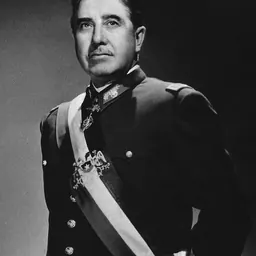
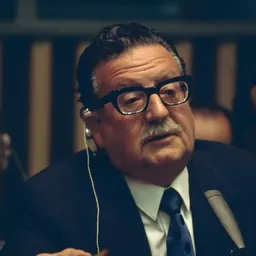
He taught in Chile from 1939 to 1945 and then became director of the Salesian College La Cisterna. He was on good terms with industry leaders and government officials, including both future dictator Augusto Pinochet and the incoming President Salvador Allende, whose Marxist views he opposed but did not find alarming because Allende, he said, "was always prepared to talk". He once said: "There are more of the Gospel's values in socialism than there are in capitalism."
In Santiago he quickly established his reputation as an advocate of far-reaching and immediate social reform. He distributed land on large estates owned by the Church to the peasants who worked on them, saying, "These lands have served God for a long time, but I believe that the needs of the workers on these lands are greater."
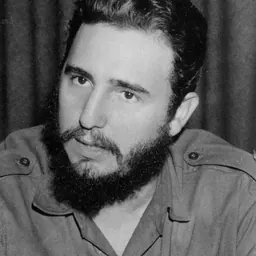
When Fidel Castro visited Chile in 1972, Silva gave him 10,000 Bibles to distribute in Cuba.
He was one of the cardinal electors in the 1963 papal conclave, which elected Pope Paul VI. He participated in the conclaves of August and October 1978, which elected Popes John Paul I and John Paul II respectively.
He was an outspoken opponent of General Augusto Pinochet, the military ruler who came to power in a 1973 coup and ruled until 1990, though he initially imagined he could use his friendship with Pinochet to moderate his policies. He eventually became the regime's chief critic. He called for the restoration of democracy, aid victims of political persecution in finding employment, and provided legal assistance to political prisoners. He compared Pinochet's oppression of the Church to that experienced by the early Christians at the hands of the Roman Emperors. In the absence of political opposition that had been silenced, imprisoned or exile, the church under his leadership became "the effective resistance to the regime". Pinochet's wife Lucía Hiriart greeted his retirement with the words "¡Al fin Dios nos ha escuchado!" (At last God has heard us!"). When Chilean Church officials criticized the Pinochet regime the next month, it defended dissent and called for reconciliation, but dropped Silva's direct criticism of the government and his calls for democracy. In 1986, when U.S. Senator Edward M. Kennedy, who sponsored a 1976 amendment banning military assistance to Chile and a critic of the Chilean government, visited Chile. Silva met with Kennedy while his successor as archbishop refused to.
In December 1978, the Vicariate for Solidaity was awarded the United Nations Prize in the Field of Human Rights. The Bruno Kreisky Prize for Services to Human Rights in 1984.
He founded the Academy of Christian Humanism in 1988, an outgrowth of his effort beginning in 1975 to bring intellectuals together to discuss politics, society, economy and culture in Chile.
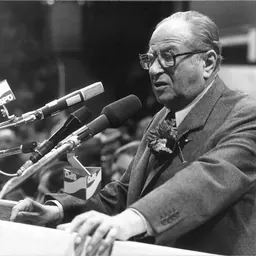
Silva suffered from Alzheimer's disease near the end of his life and died of a heart attack at a Salesian retirement house in La Florida, at age 91, and was buried in the Metropolitan Cathedral of Santiago. His death left Franz Cardinal König as the only surviving cardinal elevated by John XXIII. The government of Chile declared five days of national mourning after his death and President Eduardo Frei said Silva's death was "a deep pain for the entire nation".
Selected writings El Cardenal Raúl Silva Henríquez nos dijo, 2 volumes (Editorial Tiberíades, 2002)
Don’t just read it —
keep it.
Full-length biographies made to live with: read them, listen on the way to work, watch them tonight.
- E-book
- Audio
- Video
Instant download · yours to keep · every purchase keeps this site free
Important facts
People in Raúl Silva Henríquez's life
Named in this biography and alive at the same time




Related people
Same field, nearest in time


Contemporaries
People whose lives overlapped Raúl Silva Henríquez's



Frequently asked questions
Who was Raúl Silva Henríquez?
Catholic cardinal (1907-1999)
When was Raúl Silva Henríquez born?
Raúl Silva Henríquez was born on 27 September 1907 in Talca.
When did Raúl Silva Henríquez die?
Raúl Silva Henríquez died on 9 April 1999 in Santiago.
What was Raúl Silva Henríquez's occupation?
Raúl Silva Henríquez was a catholic priest, lawyer, catholic bishop, archbishop and politician.
What nationality was Raúl Silva Henríquez?
Raúl Silva Henríquez was Chilean.
Sources & further reading
· Wikipedia: Raúl Silva Henríquez
· DBpedia: Raúl Silva Henríquez
Cite this page
APA: Biography.guide. (2026). Raúl Silva Henríquez. https://biography.guide/raul-silva-henriquez/
MLA: "Raúl Silva Henríquez." Biography.guide, https://biography.guide/raul-silva-henriquez/.
Chicago: "Raúl Silva Henríquez." Biography.guide. https://biography.guide/raul-silva-henriquez/.
Data last updated: 2026-09-20 · Spot an error? Report a correction.
Page generated 2026-09-27 05:30 UTC