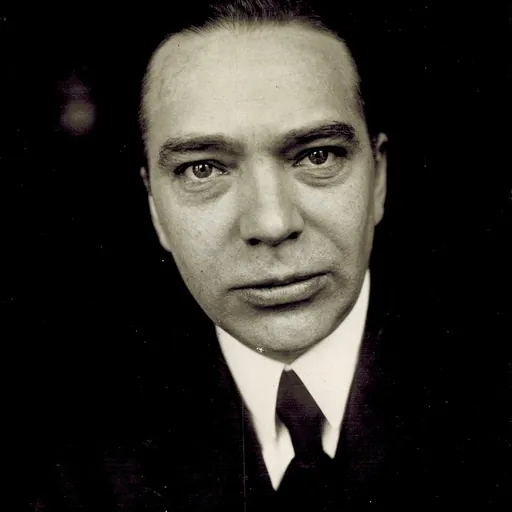
About Andreo Cseh
Lived 1895 – 1979 (aged 83). Andreo Cseh was a Romanian and Hungarian columnist, writer, catholic priest, esperantist, teacher and pedagogue, known for Esperanto.
Andreo Cseh (born András Cseh; 12 September 1895 – 9 March 1979) was a Hungarian-Dutch Roman Catholic priest and Esperantist best known for developing the Cseh method, a direct method of teaching Esperanto that emphasizes oral practice and avoids translation.
Biography Cseh was born on 12 September 1895 in Marosludas, then part of the Kingdom of Hungary within Austria-Hungary. He became an Esperantist in 1910 and was ordained as a Catholic priest in 1919.
In 1920, while in Sibiu, he developed the Cseh method, a simplified, conversation-based approach to learning Esperanto. Due to its success, he was invited to Târgu Mureș and later to Cluj, where he organized Esperanto courses and helped revitalize the Romanian Esperanto movement. In 1922, he moved to Bucharest, where he co-founded the Romanian Esperanto Center with Henriko Fischer-Galați.
Cseh became a chief delegate to the World Esperanto Association in 1921. In 1924, he received permission from his bishop to dedicate himself entirely to promoting Esperanto. He played a role in organizing several Esperanto World Congresses, including those in Geneva (1925), Danzig (1927), and Budapest (1929). His method gained popularity, and he was invited to teach across Europe, including in Sweden, where he led courses in parliament and at the invitation of local authorities.
By 1930, Cseh had settled in the Netherlands, where he co-founded the International Esperanto Institute with Julia Isbrücker and her husband. This led to conflicts with the World Esperanto Association, resulting in his exclusion from the 1931 World Congress in Kraków. Despite this, his influence in Esperanto education remained strong.
In 1932, Cseh founded and became the editor-in-chief of (, an Esperanto magazine that was published until 1970. During the German occupation of the Netherlands, he and Isbrücker held a secret meeting in 1942 to establish , a World Federalist organization advocating for international cooperation.
Cseh remained active in Esperanto education and advocacy throughout his life. He died on 9 March 1979 in The Hague, Netherlands. His teaching method continues to be used in Esperanto instruction today.
Revocation and reinstatement of priesthood While teaching Esperanto in the Netherlands, Cseh encountered opposition from J.D.J. Aengenent, the bishop of Haarlem, who objected to his courses being open to both Catholics and Protestants. Due to these concerns, Aengenent exercised his ecclesiastical authority to prohibit Cseh from continuing his work in the diocese. However, due to language barriers, Cseh misunderstood the order and continued teaching, leading to the revocation of his priesthood.
Decades later, in 1978, efforts were made to restore his status. With the support of local clergy, including Father Genemans, and the approval of Bishop Zwartkruis, Cseh's priesthood was reinstated on 6 January 1978.
Cseh method
The Cseh method consists of: Not using a textbook Not using the students' native language, but instead explaining new words using words that have already been learned Having the students answer in unison Using conversation about current events rather than artificial examples Thoroughly using humor and jokes Allowing the students to discover the rules of the language and construct the grammatical system themselves
Literature about Cseh and his method Esperanto en perspektivo ("Esperanto in perspective"), London, Rotterdam, 1974 Enciklopedio de Esperanto ("Encyclopedia of Esperanto"), Budapest, 1933 Vortoj de Andreo Cseh ("Words of Andreo Cseh"), Artur E. Iltis, Saarbrücken, 1984 / , Hague, 2003 Metodologio de lingvostudado kaj parolproprigo ("Methodology of language study and proper pronunciation"), D-ro I. Szerdahelyi, Budapest, 1975 Memorlibro omaĝe al Andreo Cseh ("Memorial book in homage to Andreo Cseh"), edited with an attached text by Katalin Smidéliusz, Szombathely, 1995 Vortoj de Andreo Cseh ("Words of Andreo Cseh"), , Internacia Esperanto-Instituto, 2003 Vivo de Andreo Cseh ("Life of Andreo Cseh"), Ed Borsboom, Internacia Esperanto-Instituto, 2003
Don’t just read it —
keep it.
Full-length biographies made to live with: read them, listen on the way to work, watch them tonight.
- E-book
- Audio
- Video
Instant download · yours to keep · every purchase keeps this site free
Important facts
People in Andreo Cseh's life
Named in this biography and alive at the same time
Related people
Same field, nearest in time




Contemporaries
People whose lives overlapped Andreo Cseh's


Frequently asked questions
Who was Andreo Cseh?
Romanian priest (1895–1979)
When was Andreo Cseh born?
Andreo Cseh was born on 12 September 1895 in Luduș.
When did Andreo Cseh die?
Andreo Cseh died on 9 March 1979 in The Hague.
What was Andreo Cseh's occupation?
Andreo Cseh was a columnist, writer, catholic priest, esperantist, teacher and pedagogue.
What was Andreo Cseh known for?
Andreo Cseh was known for Esperanto.
What nationality was Andreo Cseh?
Andreo Cseh was Romanian and Hungarian.
Sources & further reading
Cite this page
APA: Biography.guide. (2026). Andreo Cseh. https://biography.guide/andreo-cseh/
MLA: "Andreo Cseh." Biography.guide, https://biography.guide/andreo-cseh/.
Chicago: "Andreo Cseh." Biography.guide. https://biography.guide/andreo-cseh/.
Data last updated: 2026-09-20 · Spot an error? Report a correction.
Portrait: Wikimedia Commons · author & licence
Page generated 2026-09-27 04:58 UTC