
About Andrea di Giusto
Lived 1400 – 1450. Andrea di Giusto was a painter.
Andrea di Giusto (c. 1400- 2 September 1450, Florence), rarely also known as Andrea Manzini or Andrea di Giusto Manzini was a Florentine painter of the late Gothic to early Renaissance style in Florence and its surrounding countryside. Andrea was heavily influenced by masters Lorenzo Monaco, Bicci di Lorenzo, Masaccio, and Fra Angelico, and tended to mix and match the motifs and techniques of these artists in his own work. In 1428, he is listed as a member of the Arte dei Medici e Speziali guild in Florence as "Andrea di Giusto di Giovanni Bugli". His son, Giusto d'Andrea, was also a painter and worked with Neri di Bicci and Benozzo Gozzoli. Andrea died in Florence in 1450.
Training Andrea was trained under Bicci di Lorenzo. Bicci's sizable workshop enjoyed an established relationship, believed to have begun in 1418, with Santa Maria Nuova, a Florentine hospital with an adjoining church that provided a great number of commissions to local artists. Bicci and his associates began with craft work before being commissioned to create sculptures and frescoes in addition to this site. In 1424, Bicci's workshop accomplished relief figures for the interior of the church at Santa Maria Nuova and further decorated and gilded an exterior sculpture attributed to Dello di Niccolò Delli. While completing these more prized commissions, Bicci and his workshop continued to produce lesser craft works in order to sustain the workshop financially, which inadvertently lead to renown in the creation of some of these craft items, such as gilded candlesticks and sculptures. In fact, it appears that Bicci's first commission as an independent master was for a set of gilded candlesticks in 1416. After training with Bicci, Andrea worked under Masaccio in Pisa until 1427.
Major works
Altarpieces Andrea's career is marked by three major altarpieces created in the Florentine contado, or countryside: Sant’Andrea a Ripalta in Figline, Santa Margarita in Cortona, and the Badia degli Olivetani di San Bartolomeo alle Sacce near Prato. A fourth, less significant (low) altarpiece in Florence may also be included in this group.
Prato The Prato altarpiece was created in 1435 and was inspired by Lorenzo Monaco’s Monte Oliveto altarpiece from 1410. Because Andrea had been influenced early in his career by Lorenzo's work, he attempted to replicate Lorenzo's work as accurately as possible, particularly with regard to the altarpiece's figures and drapery. In fact, the altarpiece's patron sought an essential copy of Lorenzo's work and therefore commissioned Andrea to complete it. While the composition, coloring, and drapery of the altarpiece starkly recall Lorenzo's style, the figures more clearly recall Bicci di Lorenzo's style. Andrea employed many different colors in his chiaroscuro technique, which provides depth for the composition while also uniting the panels. The composition reveals the influence of Fra Angelico, particularly in Madonna's face, Lorenzo Monaco, and Gentile Bellini. Moreover, because the work borrowed so much from contemporary major masters, the composition appears much less traditional and conservative than many of Andrea's other works. It is one of Andrea's most complex creations.
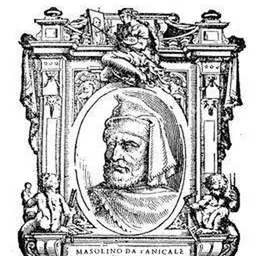
Madonna della Cintola Andrea dated the Madonna della Cintola in the Accademia di Belle Arti di Firenze in 1437. The main panel features a kneeling St. Thomas, while the Death of the Virgin is depicted in the center of the predella; both compositions betray significant influence from Fra Angelico. The St. Catherine is influenced by a lost work by Masolino da Panicale portraying the same character. In a turn away from Lorenzo Monaco’s typical influence on Andrea, the drapery in this altarpiece is subdued rather than animated, as in Lorenzo’s composition, though Lorenzo’s influence on Andrea’s depiction of form remains intact.
Santa Lucia dei Magnoli In 1436, Andrea was received the meaningful sum of 60 florini (Florin) for the completion of a low altarpiece for Santa Lucia dè Magnoli in Florence, created for the altar of Lapa Benozzi or Lapo di Andrea Benozzo. In the same year, he is recorded as a member of the Arte di Calimala, which performed the administrative work surrounding the commission. While the threshold for a major altarpiece in terms of price hovered around 100 florini, this sizable sum suggests a multi-paneled and meaningfully detailed work. In the style of Fra Angelico, Andrea included an elliptical figure composition in the Stoning of St. Stephen that uses alternating heights and actions to convey a rhythm among the figures. and worked with Bicci di Lorenzo on several frescoes in 1423 and 1424 in Florence according to payment records. He completed the final scenes of Paolo Uccello's frescoes in St. Stephen's Chapel of the Assumption (Cappella dell'Assunta) in the Prato Duomo. He is also said to have painted a panel for the Florentine Opera del Duomo, paid for by private citizens. The Opera's reluctance to provide public patronage for Andrea's work reflects the institution's preference for major over minor masters.
Critical reception Art historians tend to take a negative view of Andrea's work, and particularly call into question his artistic inspiration, citing the great deal of imitation pervasive in his works.
"There is a small typical Madonna by Andrea di Giusto from S. Giusto a Montalbino that shows him as inept and threadbare as in his other works."
"The artistic career of Andrea di Giusto...reveals the incredible ease with which he mastered every old and new element, in order to compensate for his lack of imagination."
Sales at auction On 5 June 2008, Andrea's Praying Angel sold for $15,000 at Sotheby's art auction in New York. The painting exemplifies the influence Fra Angelico had on Andrea later in the latter's career.
Andrea's The Madonna and Child with two Angles sold at Christie's art auction in London on the 3 December 2008 for £55,250, vastly outperforming its price estimate of £12,000 - £18,000. Subsequently, it was sold at Koller art auction in Zurich on 23 September 2016 for CHF 55,000, less than it was purchased for at Christie's.
Don’t just read it —
keep it.
Full-length biographies made to live with: read them, listen on the way to work, watch them tonight.
- E-book
- Audio
- Video
Instant download · yours to keep · every purchase keeps this site free
Important facts
more
andrea di giustoPeople in Andrea di Giusto's life
Named in this biography and alive at the same time


Related people
Same field, nearest in time

Contemporaries
People whose lives overlapped Andrea di Giusto's



Frequently asked questions
Who was Andrea di Giusto?
Italian painter (1400-1450)
When was Andrea di Giusto born?
Andrea di Giusto was born in 1400 in Florence.
When did Andrea di Giusto die?
Andrea di Giusto died on 2 September 1450.
What was Andrea di Giusto's occupation?
Andrea di Giusto was a painter.
Sources & further reading
Cite this page
APA: Biography.guide. (2026). Andrea di Giusto. https://biography.guide/andrea-di-giusto/
MLA: "Andrea di Giusto." Biography.guide, https://biography.guide/andrea-di-giusto/.
Chicago: "Andrea di Giusto." Biography.guide. https://biography.guide/andrea-di-giusto/.
Data last updated: 2026-09-20 · Spot an error? Report a correction.
Page generated 2026-09-27 05:23 UTC