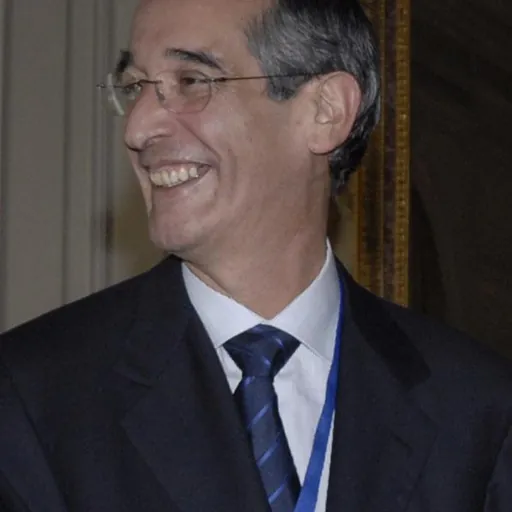
About Álvaro Colom
Lived 1951 – 2023 (aged 71). Álvaro Colom was a Guatemalan politician and entrepreneur.
Álvaro Colom Caballeros (; 15 June 1951 – 23 January 2023) was a Guatemalan engineer, businessman, and politician who served as the 47th president of Guatemala from 2008 to 2012, as well as the General-Secretary of the political party, National Unity of Hope (UNE).
Early years Colom was born in Guatemala City on 15 June 1951 to Antonio Colom Argueta and Yolanda Caballeros Ferraté; he was the fourth of five siblings. His uncle, Manuel Colom, was mayor of Guatemala City between 1970 and 1974 and was killed by the military in 1979. In 1977, Colom became a member of the Chamber of Industry of Guatemala, assuming the leadership of the Apparel and Textile Commission, and the Advisory Council of the Trade Association of Exporters of Non-Traditional Products (AGEXPRONT).
In 1996, the National Council of Mayan Elders named him "bridge man with the Western world," being invested with the attributes of a Mayan priest, one of the most important forms of recognition by the Mayan people. The electoral campaign was rocked by the worst episode of political violence in Guatemala's history, with at least 50 people killed.
He was one of the two candidates to reach the second round of the 2007 presidential election on 9 September 2007, along with Partido Patriota candidate Otto Pérez Molina, after winning 27% of the votes. The second round took place on 4 November with low turnout. At 10:00 p.m. local time on election night, Colom was declared the newly elected president by over five percentage points, 52.7% to 47.3%, with over 96% of polling places counted. He became the first leftist president to be elected in recent Guatemalan history.
Colom's first message called for negotiations so the government could be a "national conciliation." On 12 February of that year, the Congress of the Republic approved the presidential power to pardon death row inmates, recovering the death penalty that was suspended a few years earlier. Colom vetoed this law in March, asserting that this penalty meant "condemning us to another greater death penalty." But Colom stated that he would not pardon those sentenced to death out of respect for the country's laws, although the option to do so was granted in 2008.
On 4 September 2008, Colom ordered the Army to control the National Palace and the National Palace of Culture after finding seven recording devices and two hidden cameras in his private office. On 22 September of that year, he named Marlene Raquel Blanco Lapola as the first woman director of the Policía Nacional Civil. On 22 December 2008, Colom dismissed Minister of Defence Marco Tulio García Franco and the entire military leadership in a reshuffle motivated by his intention to modernize the Army and to strengthen and harmonize the relations between the government and the Armed Forces.
The death on 10 May 2009 of lawyer Rodrigo Rosenberg Marzano put Colom's presidency in check. Rosenberg had made a video public days before in which he warned that if he appeared dead, it was the responsibility of Colom and first lady Sandra Torres. The lawyer began investigating the murders of businessman Khalil Musa and his daughter Marjorie and concluded that he could have been killed because he could uncover a corruption case involving Colom and other authorities.
Protesters erupted in Guatemala City, and opponents urged President Colom to step down from office. President Colom appeared on national television to reject Rosenberg's accusations and called for both the United Nations and the FBI to investigate. Colom also assured the public that he was not going to resign. In an interview with CNN Español, Colom asserted the Rosenberg video was "completely fake," thus challenging early reports from the International Commission against Impunity in Guatemala (CICIG), which validated its authenticity. The International Commission against Impunity in Guatemala ruled in January 2010 that Rosenberg planned his death with the intention of bringing about profound change in Guatemala, thus failing to prove any involvement of Colom.
Amid a food crisis that caused the death of at least 25 children and affected 54,000 families, Colom declared a state of public calamity on 8 September 2009 to address the crisis with government and international aid.
President Colom with US Secretary of State Hillary Clinton in Washington D.C., February 2010.
After the eruption of the Pacaya volcano on 29 May 2010, which caused two deaths, Colom declared a state of emergency around the volcano. The emergency was extended on 30 May to the whole territory after the passage of the devastating tropical storm Agatha the day before.
In 2010, he appointed Helen Mack Chang, a noted human rights activist, to investigate police corruption and make recommendations for changes. She indicated that their low pay and poor working conditions made them open to influence and needed to be addressed.
As president, Colom expanded social programs and access to health, education, and social security. These contributed to a rise in the living standards of the Guatemalan poor.
His presidency ended on 14 January 2012, with the inauguration of Otto Pérez Molina after his victory in the 2011 presidential election and Colom's ineligibility for reelection. Colom left the presidency with a 95.83% disapproval rating of his administration.
Post-presidency On 20 January 2012, Colom became a member of the Central American Parliament, an office he held until 2016.
Colom headed the observation mission of the Organization of American States to the Colombian peace agreement referendum of 2016.
The U.S. government included Álvaro Colom on 1 July 2021 on the Engel List, which would allow the U.S. Congress to sanction him.
Judicial cases On 2 March 2004, after months of accusations, Colom was formally charged by the Prosecutor's Office with the crime of money laundering concerning the case of the "looting" of the Comptroller General of Accounts.
2018 arrest On 13 February 2018, Colom was arrested along with all other members of his former Cabinet "as part of a local corruption investigation".
The judge ruled on 1 March that Colom and the twelve other defendants should be prosecuted because the Colom government defrauded the state by illegally granting US$35 million to the Asociación de Empresas de Autobuses Urbanos to install a prepaid Transurbano system without any collateral. He also ordered Colom to be released on bail.
On 3 August 2018, he was released from prison on a 1 million quetzal bail. He was under house arrest at his home in Guatemala City until his death on 23 January 2023.
Personal life
Colom's first wife, Patricia Szarata, died in 1977 after a car accident. With Patricia, he had two children: Antonio Colom Szarata, the bass player of a Guatemalan pop rock band "Viento en Contra," and Patricia. His second marriage was to Karen Steele, with whom Colom had his son Diego. However that marriage ended in divorce. Even so, in August 2011 the Constitutional Court rejected Torres' registration as a presidential candidate.
Colom's personality was defined by his pragmatism and conciliatory nature, although not particularly firm in leadership, an aspect that was criticized and often considered by his critics to be hesitant and subject to the energetic character of his wife, Sandra Torres.
Colom died from esophageal cancer and pulmonary emphysema on 23 January 2023, at age 71 at home in Guatemala City during house arrest. The government decreed three days of mourning, beginning on 24 January. That day the funeral took place in the chapel of the Las Flores cemetery in Guatemala City, where he was later buried.
Honors
Don’t just read it —
keep it.
Full-length biographies made to live with: read them, listen on the way to work, watch them tonight.
- E-book
- Audio
- Video
Instant download · yours to keep · every purchase keeps this site free
Important facts
Family & relationships
People in Álvaro Colom's life
Named in this biography and alive at the same time




Related people
Same field, nearest in time






Contemporaries
People whose lives overlapped Álvaro Colom's


Frequently asked questions
Who was Álvaro Colom?
President of Guatemala (2008-2012)
When was Álvaro Colom born?
Álvaro Colom was born on 15 June 1951 in Guatemala City.
When did Álvaro Colom die?
Álvaro Colom died on 23 January 2023 in Guatemala City.
What was Álvaro Colom's occupation?
Álvaro Colom was a politician and entrepreneur.
What nationality was Álvaro Colom?
Álvaro Colom was Guatemalan.
Sources & further reading
Cite this page
APA: Biography.guide. (2026). Álvaro Colom. https://biography.guide/alvaro-colom/
MLA: "Álvaro Colom." Biography.guide, https://biography.guide/alvaro-colom/.
Chicago: "Álvaro Colom." Biography.guide. https://biography.guide/alvaro-colom/.
Data last updated: 2026-09-20 · Spot an error? Report a correction.
Page generated 2026-09-27 05:09 UTC