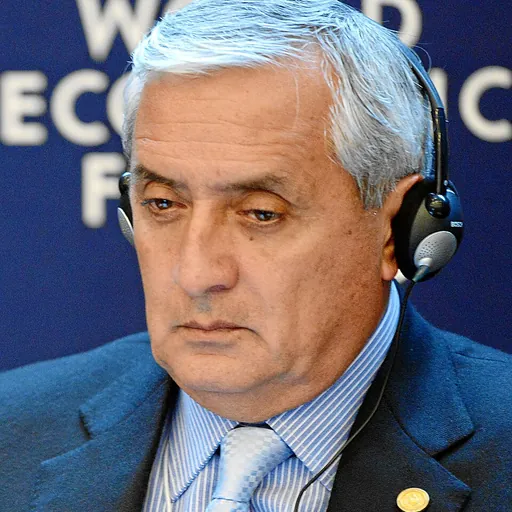
About Otto Pérez Molina
Born 1950. Otto Pérez Molina is a Guatemalan politician.
Otto Fernando Pérez Molina (born December 1, 1950) is a Guatemalan politician and retired general who served as the 48th president of Guatemala from 2012 to 2015. Standing as the Patriotic Party (Partido Patriota) candidate, he lost the 2007 presidential election but prevailed in the 2011 presidential election. During the 1990s, before entering politics, he served as Director of Military Intelligence, Presidential Chief of Staff under President Ramiro de León Carpio, and as the chief representative of the military for the Guatemalan Peace Accords. On being elected President, he called for the legalization of drugs. He was arrested on September 3, 2015. Following his arrest, Pérez remained in prison until he was released on bond in January 2024; prior to his release, Pérez received convictions and jail sentences in 2022 and 2023.
Military career Pérez is a graduate of Guatemala's National Military Academy (Escuela Politécnica), the School of the Americas, and of the Inter-American Defense College.
He has served as Guatemala's Director of Military Intelligence and as inspector-general of the army. In 1983, he was a member of the group of army officers who backed Defence Minister Óscar Mejía's coup d'état against de facto president Efraín Ríos Montt.
While serving as chief of military intelligence in 1993, he was instrumental in forcing the departure of President Jorge Serrano. The president had attempted a "self-coup" by dissolving Congress and appointing new members to the Supreme Court (Corte Suprema de Justicia). (See 1993 Guatemalan constitutional crisis.)
In the wake of that event, Guatemala's human rights ombudsman, Ramiro de León Carpio, succeeded as president, according to the constitution. He appointed Pérez as his presidential chief of staff, a position he held until 1995. Considered a leader of the Guatemalan Army faction that favored a negotiated resolution of the 30-year-long Guatemalan Civil War, Pérez represented the military in the negotiations with guerrilla forces. They achieved the 1996 Peace Accords.
Between 1998 and 2000, Pérez represented Guatemala on the Inter-American Defense Board. In the 2003 general election on 9 November 2003, Pérez was elected to Congress.
He was the candidate of the Patriotic Party in the 2007 presidential election, campaigning under the slogan "Mano dura, cabeza y corazón" ("Firm hand, head and heart"), advocating a hard-line approach to rising crime in the country. After receiving the second-largest number of votes in the initial contest on 9 September, he lost the election to Álvaro Colom of the National Unity of Hope in the second round on 4 November 2007.
During the 2007 presidential campaign, several members of the Patriotic Party were killed by armed assailants. Victims included Aura Marina Salazar Cutzal, an indigenous woman who was secretary to the party's congressional delegation and an assistant to Pérez.
Presidency (2012–2015) Pérez was finally elected in the November 2011 presidential election with 54% of the vote and took office on 14 January 2012. Pérez was the first former military official to be elected to the presidency since Guatemala's return to democratic elections in 1986.
He proposed the legalization of drugs when he first became president while attending the United Nations General Assembly, as he said that the war on drugs has proven to be a failure.
Corruption charges, arrest and trial
In April 2015, international prosecutors, with help from the UN, presented evidence of a customs corruption ring ("La Línea") in which discounted tariffs were exchanged for bribes from importers; prosecutors learned of the call through wiretaps and financial statements. Vice President Roxana Baldetti resigned on 8 May and was arrested for her involvement on 21 August. On 21 August, Guatemalan prosecutors presented evidence of Pérez's participation in the corruption ring.
On 27 October 2017, Judge Miguel Ángel Gálvez of Guatemala City ordered Pérez, Baldetti, and another 26 people, including former senior officials from Guatemala's customs duty system, to stand trial on charges related to bribes channeled to officials helping businesses evade customs duties and Pérez has remained in custody since his 2015 arrest. Baldetti, who was previously convicted in another "La Linea" related trial, was named as his co-defendant.
On 7 September 2023, Perez was sentenced to an additional sentence of eight years in prison after pleading guilty to charges in a separate corruption case.
Accusations of human rights abuses
Civil war atrocities In 2011, reports were made, based on the United States' National Security Archives, that Pérez was involved in the scorched earth campaigns of the 1980s under the military dictator Efraín Ríos Montt. Pérez commanded a counterinsurgency team in the Ixil Community in 1982-3 and is accused of ordering the mass murder of civilians, destruction of villages, and resettlement of the remaining population in army-controlled areas. Investigative journalist Allan Nairn interviewed Pérez Molina in Ixil in 1982 and reported that Pérez Molina had been involved in the torture and murder of four suspected guerrillas.
In July 2011, the indigenous organization Waqib Kej presented a letter to the United Nations accusing Pérez of involvement in genocide and torture committed in Quiché during the civil war. Among other evidence, they cited a 1982 documentary in which a military officer whom they claim is Pérez is seen near four dead bodies. In the following scene, a subordinate says that those four were captured alive and taken "to the Major" (allegedly Pérez) and that "they wouldn't talk, not when we asked nicely and not when we were mean [ni por las buenas ni por las malas]."
Although it is clear that Pérez Molina actively participated in a foul counterinsurgency campaign, he has denied any involvement in atrocities. Declassified US documents present him as one of the more progressive Guatemalan military officers who had a hand in the downfall of General Ríos Montt.
Allegations of involvement in the killing of Efraín Bámaca In 1992, the guerrilla leader Efraín Bámaca Velásquez disappeared. His wife, American lawyer Jennifer Harbury, has presented evidence that Pérez, who was Director of Military Intelligence at the time, probably issued the orders to detain and torture the commandant.
In 2011, he became the subject of a new investigation into the disappearance of Bámaca.
Allegations of involvement in the murder of Catholic bishop Gerardi In his book The Art of Political Murder: Who Killed the Bishop? American journalist Francisco Goldman argues that Pérez Molina may have been present, along with two other high officials, a few blocks from the April 1998 murder of Juan José Gerardi Conedera, a Roman Catholic bishop. Prosecutors in the subsequent trial said that Pérez and the other two men were there to supervise the assassination. Gerardi was murdered two days after the release of a human rights report he helped prepare for the United Nations' Historical Clarification Commission.
Personal life Pérez was married to Rosa María Leal.
On 21 February 2000, shortly before Pérez planned to launch his new political party, his daughter Lissette was attacked by a gunman.
Don’t just read it —
keep it.
Full-length biographies made to live with: read them, listen on the way to work, watch them tonight.
- E-book
- Audio
- Video
Instant download · yours to keep · every purchase keeps this site free
Important facts
Family & relationships
People in Otto Pérez Molina's life
Named in this biography and alive at the same time


Related people
Same field, nearest in time






Contemporaries
People whose lives overlapped Otto Pérez Molina's


Frequently asked questions
Who is Otto Pérez Molina?
President of Guatemala (2012-2015)
When was Otto Pérez Molina born?
Otto Pérez Molina was born on 1 December 1950 in Guatemala City.
What is Otto Pérez Molina's occupation?
Otto Pérez Molina is a politician.
What nationality is Otto Pérez Molina?
Otto Pérez Molina is Guatemalan.
Sources & further reading
· Wikipedia: Otto Pérez Molina
Cite this page
APA: Biography.guide. (2026). Otto Pérez Molina. https://biography.guide/otto-perez-molina/
MLA: "Otto Pérez Molina." Biography.guide, https://biography.guide/otto-perez-molina/.
Chicago: "Otto Pérez Molina." Biography.guide. https://biography.guide/otto-perez-molina/.
Data last updated: 2026-09-21 · Spot an error? Report a correction.
Portrait: Wikimedia Commons · author & licence
Page generated 2026-09-27 05:01 UTC