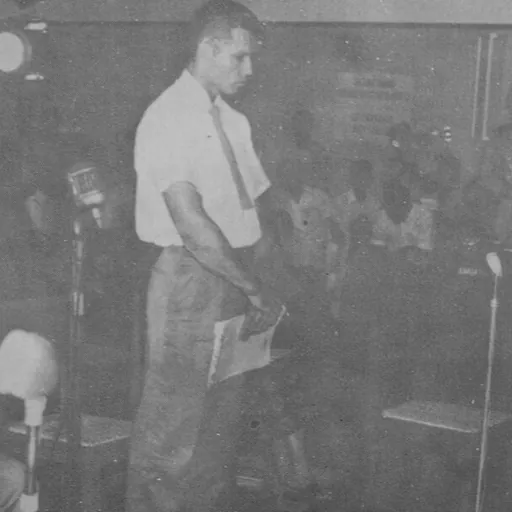
About Allen Lawrence Pope
Lived 1928 – 2020 (aged 91). Allen Lawrence Pope was an American military officer and flight instructor.
Allen Lawrence Pope (October 20, 1928 – April 4, 2020) was an American military and paramilitary aviator. He rose to international attention as the subject of a diplomatic dispute between the United States and Indonesia after the B-26 Invader aircraft he was piloting in a Central Intelligence Agency (CIA) covert operation was shot down over Ambon on May 18, 1958, during the "Indonesian Crisis".
Pope's aviation career began with the United States Air Force, serving with distinction flying bombing missions in the Korean War. He transferred to the CIA in 1954, which he also served with distinction flying transport missions in the First Indochina War.
In the Permesta rebellion in Indonesia in 1958, Pope again flew bombing missions for the CIA. Shot down by government forces, he was captured and held under house arrest for just over four years. In 1960, an Indonesian court condemned him to death, but considerable back-channel negotiations led to his release by President Sukarno in 1962. Pope returned to the United States and subsequently flew CIA covert missions in other theaters.
In 2005, France made Pope a Chevalier de la Légion d'honneur for his service in Indochina.
Biography Pope was born in Miami, Florida on October 20, 1928. Pope "was the son of a moderately prosperous fruit grower in Perrine, Florida, just south of Miami.... [he spent time busting] broncos in Texas." He graduated from the University of Florida, After university, Pope entered the U.S. Air Force and served as a first lieutenant in the Korean War. He flew a Douglas B-26 Invader in combat, receiving three Air Medals and a Distinguished Flying Cross. After the war, the U.S. Air Force returned Pope to the United States as an Air Force instructor.
Điện Biên Phủ In March 1954, Pope left the U.S. Air Force and joined a CIA front organization, Civil Air Transport (CAT), flying one of its Fairchild C-119 Flying Boxcars to supply French forces besieged in the Battle of Điện Biên Phủ in French Indochina. On March 13, Việt Minh artillery disabled Điện Biên Phủ's airstrip, forcing the French garrison there to be supplied by air drop. CAT pilots flew hundreds of sorties from Cat Bi to Điện Biên Phủ. Another source suggests that Aquila was bombed not on April 28 but on May 1 or 2.
On April 29, Pope attacked the government-held province of South East Sulawesi. He struck the Indonesian Air Force base at Kendari, the provincial capital, with bombs and machine-gun fire. He then strafed an Indonesian Navy patrol boat, KRI Intana, killing five crew and wounding another 23. On April 30, Pope again attacked Palu and Donggala; sinking a ship, destroying a warehouse and demolishing a bridge. On May 1, Pope attacked the city of Ambon, the provincial capital of Maluku. His four 500 lb bombs missed his waterfront targets and fell in the sea. He then tried a strafing run, but his starboard engine suffered an explosion. Pope aborted the attack and returned to Mapanget.
It took several days for the B-26 to be given a replacement starboard engine. Pope's next sortie was on May 7, when he again attacked the government airbase at Ambon. He seriously damaged a Douglas C-47 Skytrain and a North American P-51 Mustang and caused other damage on the airbase. On May 8, he attacked the Palu area in the morning and Ambon in the afternoon. On Ambon, he bombed and machine-gunned the government-held Liang airbase in the northeast of the island, damaging the runway and destroying a Consolidated PBY Catalina. He then continued to Ambon city where he attacked an Indonesian Navy gunboat at anchor. His bomb missed, but he then attacked with machine-guns, wounding two crew and damaging the gunboat. Since May 1, Beale and his B-26 had been resting at Clark Air Base, leaving Pope's aircraft as AUREV's only active bomber. On May 9, Beale returned to Mapanget, releasing Pope who then took his turn to fly to Clark for several days' leave.
On May 15, Pope attacked a small transport ship, the Naiko, in Ambon Bay. She was a merchant ship that the Indonesian Government had pressed into military service, and was bringing a company of Ambonese troops home from East Java. Pope's bomb hit the Naikos engine room, killing one crew member and 16 infantrymen and setting the ship on fire. He then attacked Ambon city, aiming for the barracks. His first bomb missed and exploded in a market-place next door. His next landed in the barracks compound, but bounced and exploded near an ice factory. He then returned to Mapanget to find that in his absence, the Indonesian Air Force had bombed the rebel air base, destroying a CIA/AUREV PBY Catalina and damaging a CIA/AUREV P-51 Mustang.
The Indonesian government reported that Pope's bombing of a marketplace in Ambon city had killed a large number of civilians. The U.S. Embassy in Jakarta protested to the United States Department of State, which then warned the CIA team in Manado. The CIA tightened its AUREV pilots' rules of engagement to attacking only airfields and boats. Even military buildings were prohibited.
Capture By mid-May, Indonesian government forces were planning amphibious counter-attacks on the islands of Morotai and Halmahera that Permesta had captured toward the end of April. This involved assembling a naval and transport fleet in Ambon bay, where ships started to arrive from Java on May 16. At 0300 on May 18, Pope took off from Mapanget to attack Ambon again. He first attacked the airfield, destroying the C-47 and P-51 that he had damaged on May 7. A short distance west of Ambon Bay, he found the invasion fleet, which included two 7,000-ton merchant ships being used as troop transports. One of the transports, the Sawega, was trying to take evasive maneuvers as Pope attacked it; his bomb fell in the sea short of its target.
The Indonesian Air Force had one serviceable P-51 Mustang on Ambon, at Liang airbase. When Pope attacked Ambon airfield on May 18, the P-51 flown by Ignatius Dewanto at Liang was scrambled to repel him. Dewanto closed on the B-26 just as Pope was attacking the Sawega. The convoy took both aircraft to be AUREV and fired on both of them. Dewanto also hit the B-26, damaging its starboard wing and the bomber caught fire. Pope and his Permesta radio operator, Jan Harry Rantung, bailed out. As they jumped, the B-26 was entering a sharp dive and the slipstream threw Pope against the tail fin, fracturing his right leg. They landed on the coast of Pulau Hatala, a small island west of Ambon, where a small Indonesian Navy landing party from one of the invasion fleet's minesweepers was put ashore and captured them.
Some 20 other AUREV insurgent aircraft were reported to have been seen with Nationalist Chinese markings obscured by hasty coats of paint. Their pilots were Nationalist Chinese and Americans from CAT.
The execution was not carried out, but Pope remained under house arrest. He was used as a bargaining chip in Indonesian negotiations with the United States for arms. He was eventually exchanged with 10 Lockheed C-130 Hercules transport planes. In February 1962, U.S. Attorney General Robert F. Kennedy paid President Sukarno a goodwill visit and pleaded for Pope's release. Sukarno also received a visit from Pope's wife, mother and sister, who all tearfully pleaded for his pardon. On July 2, 1962, Pope was quietly driven to the airport and put on a U.S. plane out of Indonesia. Sukarno told Pope:
Southern Air Transport After his release from Indonesian imprisonment in 1962 Pope returned to Miami, where he joined Southern Air Transport (SAT). Like CAT, SAT was a CIA front organization flying covert missions in regions including southeast Asia.
Recognition On February 24, 2005, France's ambassador to the US, Jean-David Levitte, made the then 76-year-old Pope and six other CAT pilots Chevaliers de la Légion d'Honneur for their service in the Battle of Điện Biên Phủ.
Of his Indonesian experience in 1958 he had elsewhere observed:
Death Pope died on April 4, 2020, at the age of 91. He was buried at Arlington National Cemetery.
Don’t just read it —
keep it.
Full-length biographies made to live with: read them, listen on the way to work, watch them tonight.
- E-book
- Audio
- Video
Instant download · yours to keep · every purchase keeps this site free
Important facts
People in Allen Lawrence Pope's life
Named in this biography and alive at the same time



Related people
Same field, nearest in time



Contemporaries
People whose lives overlapped Allen Lawrence Pope's



Frequently asked questions
Who was Allen Lawrence Pope?
Military aviator (1928–2020)
When was Allen Lawrence Pope born?
Allen Lawrence Pope was born on 20 October 1928.
When did Allen Lawrence Pope die?
Allen Lawrence Pope died on 4 April 2020.
What was Allen Lawrence Pope's occupation?
Allen Lawrence Pope was a military officer and flight instructor.
What nationality was Allen Lawrence Pope?
Allen Lawrence Pope was American.
Sources & further reading
· Wikipedia: Allen Lawrence Pope
· DBpedia: Allen Lawrence Pope
Cite this page
APA: Biography.guide. (2026). Allen Lawrence Pope. https://biography.guide/allen-lawrence-pope/
MLA: "Allen Lawrence Pope." Biography.guide, https://biography.guide/allen-lawrence-pope/.
Chicago: "Allen Lawrence Pope." Biography.guide. https://biography.guide/allen-lawrence-pope/.
Data last updated: 2026-09-21 · Spot an error? Report a correction.
Portrait: Wikimedia Commons · author & licence
Page generated 2026-09-27 05:00 UTC