
About Alister Hardy
Lived 1896 – 1985 (aged 89). Alister Hardy was a British zoologist, marine biologist, writer, biologist, university teacher and essayist, known for Aquatic ape hypothesis, Continuous Plankton Recorder and RRS Discovery.
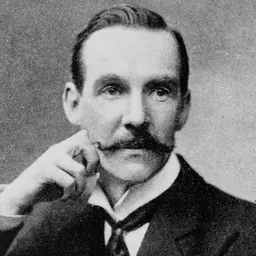
Sir Alister Clavering Hardy (10 February 1896 – 22 May 1985) was a British marine biologist, an expert on marine ecosystems spanning organisms from zooplankton to whales. He had the artistic skill to illustrate his books with his own drawings, maps, diagrams, and paintings.
Hardy served as zoologist on the RRS Discoverys voyage to explore the Antarctic between 1925 and 1927. On the voyage he invented the Continuous Plankton Recorder; it enabled any ship to collect plankton samples during an ordinary voyage.
After retiring from his academic work, Hardy founded the Religious Experience Research Centre in 1969; he won the Templeton Prize for this in 1985.
Camoufleur and artist
Hardy's artistry in the service of science:Rare and Unusual Fish in British Waters.
Hardy was born in Nottingham, the son of Richard Hardy, an architect, and his wife, Elizabeth Hannah Clavering. He was educated not far away at Oundle School. He had intended to go to Oxford University in 1914, but on the outbreak of war he instead volunteered for the army, and was made a camoufleur, a camouflage officer. Hardy wrote that he had been
equally drawn to science and art, and if the truth be known, I must confess that it is the latter that has the greater appeal. I am lucky in not having been torn between the two; I have managed to combine them. Hardy however did have sufficient artistic skill to serve his military and scientific work. He illustrated his New Naturalist books with his own line drawings, maps, diagrams, photographs, and paintings. For example, plate 2 of Fish and Fisheries illustrates the depicted "Rare and Unusual Fish in British Waters" both accurately and vividly. Hardy described the camoufleurs as including artists and "scientists with artistic inclinations", himself perhaps among them.
Zoology
Hardy was the zoologist on the RRS Discovery voyage to explore the Antarctic between 1925 and 1927, as part of the Discovery Investigations. Through his studies of zooplankton and its relationship with predators, he became expert in marine mammals such as whales. Whilst on board the Discovery he designed and later built a mechanism called the Continuous Plankton Recorder or CPR. The CPR collects plankton samples and stores them on a moving band of silk, preserving them in formalin. His pioneering research into plankton distribution and abundance is continued by the Continuous Plankton Recorder Survey (CPR Survey).
Hardy was the first Professor of Zoology at the University of Hull from 1928 – 1942. In 1942, he was then appointed Professor of Natural History at the University of Aberdeen, where he remained until 1946, when he became Linacre Professor of Zoology in the University of Oxford and Fellow of Merton College, a position he held until 1963. In 1940, Hardy was made a Fellow of the Royal Society.
Aquatic ape hypothesis
In 1930, while reading Wood Jones' Man's Place among the Mammals, which included the question of why humans, unlike all other land mammals, had fat attached to their skin, Hardy realized that this trait sounded like the blubber of marine mammals, and began to suspect that humans had ancestors that were more aquatic than previously imagined. Fearing a backlash against such a radical idea, he kept this hypothesis secret until 1960, when he spoke and later wrote on the subject, which subsequently became known as the aquatic ape hypothesis in academic circles, and has been promoted in particular by Elaine Morgan, who acknowledged her debt to Hardy in her book The Scars of Evolution, and elsewhere.
Study of religion Dating from his boyhood at Oundle School, Hardy had a lifelong interest in spiritual phenomena, but aware that his interests were likely to be considered unorthodox in the scientific community, apart from occasional lectures he kept his opinions to himself until his retirement from his Oxford Chair. During the academic sessions of 1963–4 and 1964–5, he gave the Gifford Lectures at Aberdeen University on 'Evolution and the spirit of Man', later published as The Living Stream and The Divine Flame. These lectures signalled his wholehearted return to his religious interests. In 1969 he founded the Religious Experience Research Unit in Manchester College, Oxford. The Unit began its work by compiling a database of religious experiences and continues to investigate the nature and function of spiritual and religious experience at the University of Wales, Lampeter. In 1973 he met with A. C. Bhaktivedanta Swami Prabhupada and other devotees of the Hare Krishna movement and discussed Vedic literature, the divine flame and Rabindranath Tagore.
Hardy's biological approach to the roots of religion is non-reductionist, seeing religious awareness as having evolved in response to a genuine dimension of reality. For his work in founding the Religious Experience Research Centre, Hardy received the Templeton Prize shortly before his death in 1985.
Family
He was married to Sylvia Garstang (alumna of Somerville College, Oxford) in 1927.
Works
Hardy wrote numerous scientific papers on plankton, fish and whales. He wrote two popular books in the New Naturalist series, and in later life he also wrote on religion.
Books The Open Sea. Its Natural History (Part I) The World of Plankton. New Naturalist No. 34, Collins, 1956. The Open Sea. Its Natural History (Part II) Fish & Fisheries. New Naturalist No. 37, Collins, 1959.
The Divine Flame: An Essay Towards A Natural History of Religion. Collins, 1966. The Spiritual Nature of Man: Study of Contemporary Religious Experience. Oxford University Press, 1979. Papers The Herring in Relation to its Animate Environment. Fish. Invest. Lond., II, 7:3. 1951. (with E.R. Gunther) The Plankton of the South Georgia Whaling Grounds and Adjacent Waters, 1926-7. 'Discovery' Report, II, 1–146.
Recognition
Hardy's "pioneering work" was recognised by South Georgia & South Sandwich Islands in 2011 with a set of four commemorative stamps bearing his image.
The University of Hull has named a building on its Hull Campus after Hardy.
Don’t just read it —
keep it.
Full-length biographies made to live with: read them, listen on the way to work, watch them tonight.
- E-book
- Audio
- Video
Instant download · yours to keep · every purchase keeps this site free
Important facts
People in Alister Hardy's life
Named in this biography and alive at the same time


Related people
Same field, nearest in time



Contemporaries
People whose lives overlapped Alister Hardy's



Frequently asked questions
Who was Alister Hardy?
British marine biologist (1896–1985)
When was Alister Hardy born?
Alister Hardy was born on 10 February 1896 in Nottingham.
When did Alister Hardy die?
Alister Hardy died on 22 May 1985 in Oxford.
What was Alister Hardy's occupation?
Alister Hardy was a zoologist, marine biologist, writer, biologist, university teacher and essayist.
What was Alister Hardy known for?
Alister Hardy was known for Aquatic ape hypothesis, Continuous Plankton Recorder and RRS Discovery.
What nationality was Alister Hardy?
Alister Hardy was British.
Sources & further reading
Cite this page
APA: Biography.guide. (2026). Alister Hardy. https://biography.guide/alister-hardy/
MLA: "Alister Hardy." Biography.guide, https://biography.guide/alister-hardy/.
Chicago: "Alister Hardy." Biography.guide. https://biography.guide/alister-hardy/.
Data last updated: 2026-09-20 · Spot an error? Report a correction.
Page generated 2026-09-27 05:06 UTC