
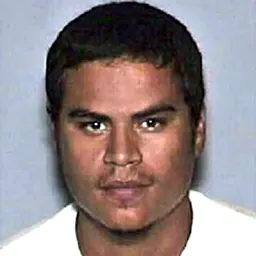
Ali Saleh Kahlah al-Marri
Al-Qaeda member convicted on terrorism charges in the United States
About Ali Saleh Kahlah al-Marri
Born 1966.
Early life and education Ali Saleh Kahlah al-Marri was born in Qatar in 1966 or 1967, as estimated by the United States government. He came to the United States to go to graduate school and was a legal resident. He attended Bradley University, a small private college in Peoria, Illinois.
Before coming to the United States, Al Marri is believed to have worked for nearly a decade as a "key person" in the audit department of Qatar Islamic Bank and then as a senior auditor for the government of Qatar.
Arrest The Peoria Journal Star reports that al-Marri's initial arrest in December 2001 was at a routine traffic stop in Peoria, Illinois. He was held by federal authorities in civilian jails in Peoria and New York City as a material witness.
In 2002, the government charged Al-Marri with making false statements to the FBI and to financial institutions, identity fraud, and credit card fraud. They also reportedly found lectures by Osama bin Laden and links to websites related to weaponry and satellite equipment.
After the Bush administration classified al-Marri as an "enemy combatant" in 2003, it dropped those federal charges and transferred him to military custody at Naval Consolidated Brig, in Charleston, South Carolina. He had been arrested while a legal resident of the United States.
Enemy combatant Aerial view of the Navy Consolidated Brig, in South Carolina, where Al Marri was held. Cell blocks in the Navy consolidated brig. An entire wing was reportedly devoted to Al Marris's detention.
Following the US Supreme Court decision in Rasul v. Bush (2004), which said that detainees had the right to challenge their detention, Al-Marri was allowed access to legal counsel in October 2004. His lawyers reported that al-Marri has described being subjected to extreme cold, with insufficient bedding and clothing. He has been deprived of all reading material except a Qur'an. His guards reportedly decline to inform him of which direction is East, which he needs for prayers. His cell's window is translucent (rather than transparent), and he has no clock, so he cannot know the proper times to say prayers. He reports having been deprived of personal hygiene items. The lack of such items have caused him to be unable to pray, because of ritual impurity.
In October 2004, Al-Marri told his lawyer that he had not been interrogated for a year. His lawyer sought to challenge his detention by a writ of habeas corpus.
In October 2008, the military released 91 pages of memos drafted in 2002 by officers at the Naval Consolidated Brig, Charleston, which showed that they had been concerned for the sanity of Al-Marri and other detainees confined to solitary. The memos indicate that officers were concerned that the mental states of the detainees Ali Saleh Kahlah al-Marri, Yasser Hamdi and José Padilla due to their isolation and lack of stimuli. It said that the Military Commissions Act of 2006 removed federal court jurisdiction for habeas corpus or any other actions related to aliens determined by the US to be "enemy combatants." On September 9, 2004, Jeffrey N. Rapp, Director of the Joint Intelligence Task Force for Combating Terrorism, had submitted a 16-page sworn statement containing many allegations against Al Marri, including: Al Marri was to hack into the US banking system, and "to wipe out balances and otherwise wreak havoc with banking records in order to damage the U.S. economy." Investigator had found information about hydrogen cyanide on Al Marri's laptop ... "The highly technical information found on al-Marri's laptop computer far exceeds the interests of a merely curious individual."
On June 11, 2007, in al-Marri v. Wright, the Fourth Circuit Court of Appeals ruled that the Military Commissions Act of 2006 cannot deny al-Marri his constitutional rights to challenge his accusers and reason for detention. The court ruled that al-Marri must be released from military detention to either be freed or to be placed in US civilian detention, when the federal government would have to charge him with crimes and provide a trial.
The court held an en banc rehearing of the ruling on October 31, 2007. In its decision issued on July 15, 2008, the Court voted 5-4 that if the Government's allegations are true, al-Marri can be held in military detention indefinitely as an enemy combatant. But, they determined that he has not received sufficient due process to determine if these allegations are in fact true. The case is allowed to return to trial court but no particular proceedings have been specified.
On November 9, 2008, Jerry Markon, writing in The Washington Post, reported that al-Marri's lawyers had petitioned the United States Supreme Court to overturn the lower court ruling that allowed him to be treated as an enemy combatant in spite of being a legal resident of the US. On December 5, 2008, the Supreme Court agreed to hear al-Marri's case.
On January 22, 2009, newly elected President Barack Obama issued a memorandum requiring that al-Marri's status be reviewed by his administration, in addition to those of detainees currently held at Guantanamo Bay detention camp.
The New York Times editorials The New York Times outlined the case of Ali al-Marri in an editorial on November 24, 2008, titled "Indefinite Detention". It criticized the George W. Bush administration's enemy combatant doctrine, and called on the Supreme Court justices to make clear that a president cannot trample on individual rights by imprisoning people indefinitely simply by asserting that they are tied to terrorism.
In an editorial of December 8, 2008, titled "Tortured Justice", the Times editorial board wrote:
The extent of the damage to American liberties, and how lasting it will be, will be told in part by the outcome of two cases [Ali al-Marri's "enemy combatant" and Maher Arar's "extraordinary rendition"] that are to be heard by the federal courts." They said the Obama administration would have to decide "whether to defend the indefensible when the case comes to trial."
Court case Following this review, the government transferred Al-Marri's case from military custody to the federal court system and went to trial. In a 2009 plea bargain, al Marri pleaded guilty to one count of conspiracy to support a terrorist group. He was sentenced to 8 years in prison.
The New Yorker, quoting inside sources, reported on February 26, 2009, that al-Marri was to be indicted by Obama's Department of Justice.
On February 27, 2009, Attorney General Eric Holder announced that a federal grand jury in the Central District of Illinois had returned a two-count indictment charging Ali Saleh Kahlah al-Marri, 43, with providing material support to al-Qaeda and conspiring with others to provide material support to al-Qaeda. He said that the Office of the Solicitor General would move to dismiss al-Marri's pending litigation before the U.S. Supreme Court, and that al-Marri would be transferred to Department of Justice custody for criminal prosecution as soon as the Supreme Court rules on that motion. On March 6, 2009, the U.S. Supreme Court dismissed the application, remanded to the Fourth Circuit, and instructed the Fourth Circuit to dismiss the appeal as moot. In March 2009, al-Marri made his first appearance before a judge in Charleston, South Carolina. After denying al-Marri's request for bail, the South Carolina judge ordered his transportation to Illinois. al-Marri pleaded not guilty before Judge Michael Mihm in a U.S. District Court of Illinois. Judge Mihm set the date of the trial for May 26. Mihm also ordered the prosecution to hand over evidence, such as a copy of al-Marri's hard drive, to the defense attorneys.
Al-Marri was transported afterward back to the Peoria federal court by the marshals and appeared before Mihm. He indicated to Mihm he understood the charges against him. In March 2009, al-Marri was returned to civilian custody in Peoria, from military custody.
Guilty plea On April 30, 2009, al-Marri entered a plea of guilty to one count of conspiracy to provide material support or resources to a foreign terrorist organization. He agreed in his plea that he attended terrorist training camps between 1998 and 2001, where he studied weapons and operational security. He met with Khalid Sheikh Mohammed and "offered his services" to aid al-Qaeda. Mohammed told him to travel to the United States by September 20, 2001, and wait for further instructions. In March 2010, he was moved from Federal Correctional Institution, Pekin to the US Penitentiary, Florence Supermax security in Colorado.
On October 12, 2011, Tony Bartelme, writing in the Charleston Post and Courier reported on documents the paper had recently received from an 8-year-old Freedom of Information Act (FOIA) request about the use of the consolidated Navy brig in Charleston in the "war on terror". Among those documents was a 2005 exchange of memos between the prison's commander, E.P. Giambastiani, to Charles Stimson, Deputy Assistant Secretary of Defense for Detainee Affairs. In the memos, Giambastiani requested that al-Marri, Hamdy and Padilla be transferred to Guantanamo.
Release and repatriation
Al-Marri was repatriated to Qatar on January 18, 2015. He also received a congratulatory phone call from the country's prime minister upon his release.
Don’t just read it —
keep it.
Full-length biographies made to live with: read them, listen on the way to work, watch them tonight.
- E-book
- Audio
- Video
Instant download · yours to keep · every purchase keeps this site free
Important facts
People in Ali Saleh Kahlah al-Marri's life
Named in this biography and alive at the same time







Contemporaries
People whose lives overlapped Ali Saleh Kahlah al-Marri's





Frequently asked questions
Who is Ali Saleh Kahlah al-Marri?
Al-Qaeda member convicted on terrorism charges in the United States
When was Ali Saleh Kahlah al-Marri born?
Ali Saleh Kahlah al-Marri was born in 1966 in Qatar.
What nationality is Ali Saleh Kahlah al-Marri?
Ali Saleh Kahlah al-Marri's recorded nationality: Qatar.
Sources & further reading
· Wikipedia: Ali Saleh Kahlah al-Marri
· DBpedia: Ali Saleh Kahlah al-Marri
Cite this page
APA: Biography.guide. (2026). Ali Saleh Kahlah al-Marri. https://biography.guide/ali-saleh-kahlah-al-marri/
MLA: "Ali Saleh Kahlah al-Marri." Biography.guide, https://biography.guide/ali-saleh-kahlah-al-marri/.
Chicago: "Ali Saleh Kahlah al-Marri." Biography.guide. https://biography.guide/ali-saleh-kahlah-al-marri/.
Data last updated: 2026-09-20 · Spot an error? Report a correction.
Page generated 2026-09-27 05:27 UTC