
Alexandros Papagos
Greek military leader and politician
About Alexandros Papagos
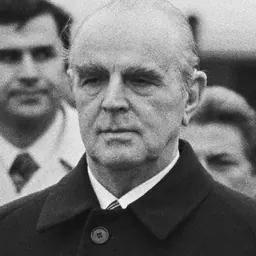
Lived 1883 – 1955 (aged 71). Alexandros Papagos was a Greek politician, military personnel, marshal and head of government.
Alexandros Papagos (; 9 December 1883 – 4 October 1955) was a Greek military officer who led the Hellenic Army in World War II and in the later stages of the subsequent Greek Civil War. Afterwards, he served as Prime Minister of Greece from 1952 to 1955.
The only Greek army career officer to rise to the rank of Field Marshal, Papagos became the first Chief of the Hellenic National Defence General Staff from 1950 until his resignation the following year. He then entered politics, founding the nationalist Greek Rally party and becoming the country's Prime Minister after his victory in the 1952 elections.
His premiership was shaped by the Cold War and the aftermath of the Greek Civil War, and was defined by several key events, including Greece becoming a member of NATO; U.S. military bases being allowed on Greek territory and the formation of a powerful and vehemently anti-communist security apparatus. Papagos' tenure also saw the start of the Greek economic miracle, most famously devaluing the drachma by half in 1953, and rising tensions with Britain and Turkey during the Cyprus Emergency over the Cyprus issue and over the Istanbul pogrom. He died in office in October 1955, hand-picking Stephanos Stephanopoulos as his successor; King Paul intervened and ordered Konstantinos Karamanlis to form a government.
Military career Upper part of Papagos ceremonial uniform, Athens War Museum. Alexandros Papagos was born in Athens on 9 December 1883. His father was Major General Leonidas Papagos from the island of Syros, who occupied senior posts during his military career, including Director of Personnel at the War Ministry and aide-de-camp to the King. His mother was Maria Averoff, daughter of the politician Dimitrios Averoff and niece of the magnate George Averoff. As a result, Alexandros Papagos was born into the Greek social elite, with close ties to the royal palace. He initially entered the Law School of the University of Athens, but soon switched to a military career. In 1902 he entered the Brussels Military Academy and followed it up with studies at the Cavalry Application School at Ypres. He was commissioned as a cavalry second lieutenant in the Hellenic Army on 15 July 1906. and was re-appointed to the post in the succeeding Konstantinos Demertzis cabinet on 13 December 1935 until 5 March 1936. On 5 March 1936 he was named Inspector-General of the Army, holding the post until 31 July. On the next day, 1 August, he was promoted to Chief of the Army General Staff. In late April 1945 he was transferred to Tyrol together with about 140 other prominent inmates of the Dachau concentration camp, where the SS left the prisoners behind. He was liberated by the Fifth U.S. Army on 5 May 1945.
Greek Civil War Papagos returned to Greece in May 1945. In August 1945, he was appointed an Honorary Knight Grand Cross of the Order of the British Empire by the British. He remained retired and held no active military position, but served as grand chamberlain to King Paul and in July 1947 was promoted to the exceptionally rare rank of full general as a token of honour.
In January 1949, he was once again appointed Commander-in-Chief in the ongoing Greek Civil War.
The Athens suburb of Papagou, where the Ministry of Defence is located, is named after him.
Honours National
Foreign
Don’t just read it —
keep it.
Full-length biographies made to live with: read them, listen on the way to work, watch them tonight.
- E-book
- Audio
- Video
Instant download · yours to keep · every purchase keeps this site free
Important facts
Family & relationships
People in Alexandros Papagos's life
Named in this biography and alive at the same time

Related people
Same field, nearest in time





Contemporaries
People whose lives overlapped Alexandros Papagos's


Frequently asked questions
Who was Alexandros Papagos?
Greek military leader and politician (1883-1955)
When was Alexandros Papagos born?
Alexandros Papagos was born on 9 December 1883 in Athens.
When did Alexandros Papagos die?
Alexandros Papagos died on 4 October 1955 in Athens.
What was Alexandros Papagos's occupation?
Alexandros Papagos was a politician, military personnel, marshal and head of government.
What nationality was Alexandros Papagos?
Alexandros Papagos was Greek.
Sources & further reading
· Wikipedia: Alexandros Papagos
Cite this page
APA: Biography.guide. (2026). Alexandros Papagos. https://biography.guide/alexandros-papagos/
MLA: "Alexandros Papagos." Biography.guide, https://biography.guide/alexandros-papagos/.
Chicago: "Alexandros Papagos." Biography.guide. https://biography.guide/alexandros-papagos/.
Data last updated: 2026-09-20 · Spot an error? Report a correction.
Page generated 2026-09-27 05:24 UTC