
About Alexander Ross
Lived 1838 – 1884 (aged 45). Alexander Ross was a British explorer, known for Cameroon, Cross River State and Nigeria.
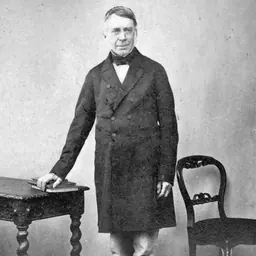
Alexander Ross (31 October 1838 – 6 May 1884) was a Scottish missionary with the United Presbyterian Church (Scotland) in Duke Town, Old Calabar, West Africa along with other notable missionaries including William Anderson, Hugh Goldie, and Mary Slessor. Making two separate expeditions in 1877 and 1878, Ross was the first white man to venture south of Old Calabar to the palm-oil town of Odobo. He discovered the Falls of Komè ('Düben' falls]) on the River Meme and recorded details of the places, customs and languages of Efut. In 1881 the Mission was torn apart by a schism between Ross and Anderson that was to be a crucial link in the chain of events which led to the annexation by Britain of the territory from Calabar to the Niger.
Early life
Ross was born on 31 October 1838 at Braefindon in the parish of Urquhart and Logie Wester, Ross and Cromarty, Scotland. He was the second of twelve children born to Ranald Ross, a carpenter, and his wife, Janet (née Ellison). By the age of twelve, Ross was employed as a farm servant in the nearby parish of Kiltearn and, ten years later, in 1861, he was a coachman for Allan Maclean, Chieftain of the Clan Maclean, at Dochgarroch near Inverness.
From boyhood, it had been Ross's desire to become a missionary abroad.
By 1864, Ross was a member of the United Presbyterian Church (Scotland), at Queen Street, Inverness and expressed his desire to attend college as a Gaelic student. He enrolled as a student at the Divinity Hall, Edinburgh in 1867 and began preaching at Baligrundle Church, Lismore in April 1868. During the next twenty months he built a new school house, removed the Ikunetu mission-house to Duke Town, and secured funds to renovate the church. On 11 September 1876, Ross was the first person to greet Mary Slessor on her arrival at the anchorage of Old Calabar.
Expeditions Early in 1877, Ross embarked on the first of two major expeditions to Efut country and was the first white person to venture southeast from Old Calabar. Leaving on 30 January, he was accompanied on the boat trip by fellow missionary, Mrs Sutherland, and Prince James Eyamba, one of the leading chiefs and an elder in the church, with whom he had developed good relations. They were guided by Yellow Duke, a major palm-oil trader who had connections with the Archibong family and a base at Odobo
A year later, departing on 3 December, Ross followed the same route, arriving at an unknown lake in south west Cameroon. Without knowledge of his predecessors, Comber and Thomson, who had discovered the lake some months earlier as Lake Rickards (today Lake Barombi Koto), Ross named it Lake Paton in honour of a keen missionary family in the church.
Of his journeys to Efut, Ross said,
During 1878, Ross made a shorter trip north from Duke Town, largely on foot, and was the first European to visit the class of natives known as the Blood-Men.
Returning to Scotland on furlough in 1879, Ross addressed several public meetings across Scotland to help promote the work of missionaries abroad. His talk on 26 February 1880, at the St. Andrews U.P. Church in Ceres, Fife, about "how the gospel had won its way in these distant and benighted lands in the face of prejudice, ignorance and opposition", was told in "graphic and vigorous language and listened to with rapt attention".
Dispute Between 1879 and 1881, growing tensions between Ross and Anderson developed into a schism involving the United Presbyterian Church, the British government, and local rulers within Old Calabar. Anderson, now an ageing figure, had seen many changes during his tenure at the mission and recognised that the pace of progress was, necessarily, slow. On the other hand, Ross was young and energetic and impatient to see further improvements to the humanitarian conditions within Old Calabar. He declined the invitation and tendered his resignation from the Ministry and immediately, supported by Prince James Embaya, set up his own independent mission taking with him five teachers and a substantial part of the congregation. Details on its eventual fate are scarce but it seems that it was taken over by the Apostolic Church after some association with the Primitive Methodists and the Qua Iboe Mission.
Death Ross died at Duke Town on 6 May 1884 from dysentery after a few days illness and was laid to rest, with Mrs. Ross's consent, in the mission burying ground. Inscribed on a family gravestone at Urquhart Old Churchyard at Conon Bridge, Ross and Cromarty, Scotland is the dedication: REV. ALEX ROSS WHO DIED IN AFRICA 6TH MAY 1884 AGED 44.
Family At the age of 34, on 21 August 1874 at 22 Rutland Square, Edinburgh, Ross married Jane Innes who was the second eldest surviving daughter of William Innes, Union Bank of Scotland. Their first son, Ranald Alexander Ross, was born on 18 June 1875 at the U.P. Manse in Lismore. Five years later while on furlough, Mrs. Ross gave birth, prematurely, to their second child, William Innes Whitson Ross on 13 June 1880 in Edinburgh. William died one year later, in July 1881, not long after the family had returned to Duke Town. After the death of her husband in 1884, Mrs. Ross died of fever on 21 April 1890 at Duke Town.
Don’t just read it —
keep it.
Full-length biographies made to live with: read them, listen on the way to work, watch them tonight.
- E-book
- Audio
- Video
Instant download · yours to keep · every purchase keeps this site free
Important facts
People in Alexander Ross's life
Named in this biography and alive at the same time


Related people
Same field, nearest in time


Contemporaries
People whose lives overlapped Alexander Ross's

Frequently asked questions
Who was Alexander Ross?
Scottish missionary (1838-1884)
When was Alexander Ross born?
Alexander Ross was born on 31 October 1838 in Urquhart and Logie Wester.
When did Alexander Ross die?
Alexander Ross died on 6 May 1884 in Akwa Akpa, West Africa.
What was Alexander Ross's occupation?
Alexander Ross was an explorer.
What was Alexander Ross known for?
Alexander Ross was known for Cameroon, Cross River State, Nigeria and Rio del Rey.
What nationality was Alexander Ross?
Alexander Ross was British.
Sources & further reading
· DBpedia: Alexander Ross (missionary)
Cite this page
APA: Biography.guide. (2026). Alexander Ross. https://biography.guide/alexander-ross-explorer-1838/
MLA: "Alexander Ross." Biography.guide, https://biography.guide/alexander-ross-explorer-1838/.
Chicago: "Alexander Ross." Biography.guide. https://biography.guide/alexander-ross-explorer-1838/.
Data last updated: 2026-09-20 · Spot an error? Report a correction.
Page generated 2026-09-27 05:23 UTC