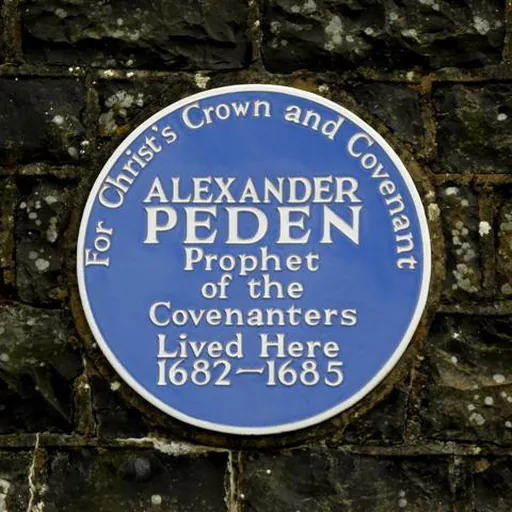
About Alexander Peden
Lived 1626 – 1686 (aged 59–60). Alexander Peden was a Scottish christian minister.
The Bass Rock, East Lothian. Peden endured upwards of five years from 26 June 1673 to 9 October 1678 closely shut up in that "desolate sea-girt Rock". Peden at Richard Cameron's grave. Peden is reported to have said "Oh to be wi thee, Ritchie!" at the grave of Cameron's decapitated body.
The Marriage of the Covenanter, by Alexander Johnston (1815–1891). Alexander Peden conducted the marriage of John Brown to Isabel Weir at Priesthill in Muirkirk parish in 1682
Alexander Peden (162626 January 1686), also known as "Prophet Peden", was one of the leading figures in the Covenanter movement in Scotland.
Life Peden was born at Auchincloich Farm near Sorn, Ayrshire, about 1626. He was the son of a small proprietor. His name can also be spelled Peathine or Pethein. He was possibly the Alexander Peden who was the restored heir of his grandfather in Hillhead of Sorn, 16 March 1648, and on the same day heir of Auchinlonfuird.
Of his early training, there is no clear record, but he may have attended the parish school of Mauchline, and he was a student at the University of Glasgow from 1643 to 1648. For a time he acted as schoolmaster, precentor, and session-clerk at Tarbolton, Ayrshire, and, according to Robert Wodrow, was employed in a similar capacity at Fenwick.
In 1660 he was ordained minister of New Luce in Wigtownshire. As he was about to receive license from the Presbytery of Ayr, an accusation of immorality was raised against him, but was found to be false. In 1659 he was ordained to this charge, and was deprived by Act of Parliament 11 June, and Decreet of Privy Council 1 October 1662. When he preached his farewell sermon, he is said to have occupied the pulpit till nightfall, and on leaving it, to have knocked three times on the pulpit door with his Bible, saying, "I arrest thee in my Master's name, that none enter thee but such as come by the door, as I have done."
Following his ejection, Peden became perhaps the most celebrated field preacher of his time. He wandered all over the south of Scotland, obtaining by his figurative and oracular style of address and his supposed prophetic gifts an extraordinary influence over the people, which was further increased by his hardships, perils, and numerous hairbreadth escapes.
After the Restoration of Charles II, Peden had to leave his parish under Middleton's Ejectment Act in 1663. For ten years he wandered far and wide, bringing comfort and succour to his co-religionists, and often very narrowly escaping capture, spending some of his time in Ireland. He fled to Ireland in 1670, but returned in 1673.
In June 1673, while holding a conventicle at Knockdow near Ballantrae, Ayrshire, he was captured by Major William Cockburn and condemned by the Privy Council to four years and three months' imprisonment on the Bass Rock and a further fifteen months in the Edinburgh Tolbooth. or to swear not to rise in arms against the king. This oath did not require one to proclaim the king as the head of the church. However, it would have been understood by a Covenanter to be a promise not to resist the king's claimed supremacy, ecclesiastical as well as civil. Peden was 11 miles away. He prayed with the family of John Muirhead in his home, "Lord, when wilt Thou avenge Brown's blood? O, let Brown's blood be precious in Thy sight." Peden told them of his vision of Brown's wife weeping over his corpse and of Claverhouse killing John Brown.
Death
Peden's privations and anxieties had gradually undermined his health. Resolving to spend his last days in his native district, he found shelter in a cave on the River Lugar in the parish of Sorn, near his brother's farm just north of Ochiltree, part of Auchinleck Estate. Peden receives attention in Jack Deere's 1993 book Surprised by the Voice of God, which records prophetic and other charismatic gifts practised by historical reformed figures.
Alexander Peden Stone
The Alexander Peden Stone south of Harthill, Shotts was one of the places where Rev. Alexander Peden and others were said to have preached to Covenanters. The monument was erected around 1866 and is maintained by a local Covenanters' committee. The stone on which the monument is mounted would have been used as the plinth by preachers.
Don’t just read it —
keep it.
Full-length biographies made to live with: read them, listen on the way to work, watch them tonight.
- E-book
- Audio
- Video
Instant download · yours to keep · every purchase keeps this site free
Important facts
People in Alexander Peden's life
Named in this biography and alive at the same time
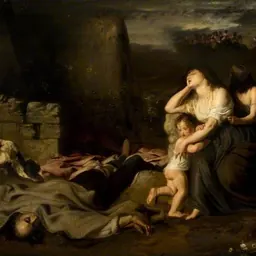

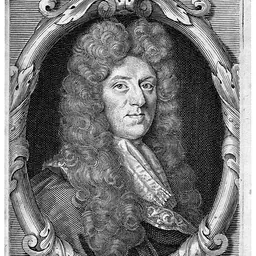
Related people
Same field, nearest in time
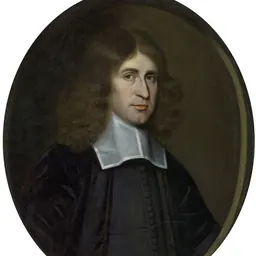



Contemporaries
People whose lives overlapped Alexander Peden's





Frequently asked questions
Who was Alexander Peden?
Scottish covenanter (1626–1686)
When was Alexander Peden born?
Alexander Peden was born in 1626 in Scotland, Sorn, East Ayrshire.
When did Alexander Peden die?
Alexander Peden died on 26 January 1686 in Scotland, Sorn, East Ayrshire.
What was Alexander Peden's occupation?
Alexander Peden was a christian minister.
What nationality was Alexander Peden?
Alexander Peden was Scottish.
Sources & further reading
Cite this page
APA: Biography.guide. (2026). Alexander Peden. https://biography.guide/alexander-peden/
MLA: "Alexander Peden." Biography.guide, https://biography.guide/alexander-peden/.
Chicago: "Alexander Peden." Biography.guide. https://biography.guide/alexander-peden/.
Data last updated: 2026-09-22 · Spot an error? Report a correction.
Portrait: Wikimedia Commons · author & licence
Page generated 2026-09-27 05:02 UTC