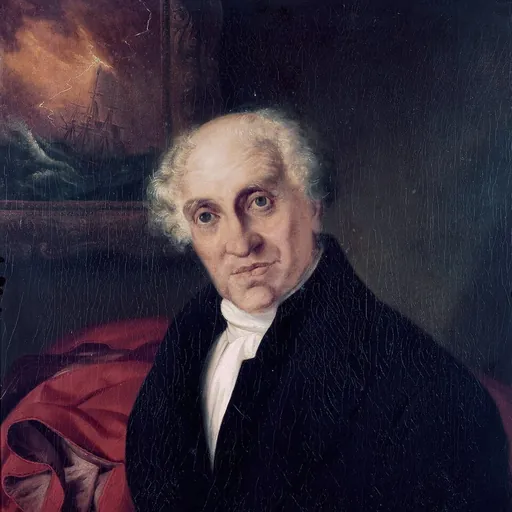
About Alexander John Scott
Lived 1768 – 1840 (aged 71–72). Alexander John Scott was a British military personnel.
Alexander John Scott (23 July 1768 - 24 July 1840) was an Anglican chaplain who served in the Royal Navy during the French Revolutionary and Napoleonic Wars. He served as Horatio Nelson's personal chaplain at the Battle of Trafalgar, and had previously served as his private secretary. Scott was a close friend of Nelson, and was with him as he died aboard .
Early life Scott was born on 23 July 1768, the son of Jane Comyn and Robert Scott, a lieutenant in the navy. He had two sisters. He was the nephew of Alexander Scott, a naval captain. Scott's father died in 1770, leading Scott to live with his uncle for the majority of his childhood. He was educated at Charterhouse, and after gaining a scholarship, he attended St John's College, Cambridge, graduating from there in 1792. He was ordained in 1793 and joined the navy that year as a chaplain. He was initially assigned to , which was part of the Mediterranean fleet under Admiral Samuel Hood.
Meeting Nelson Scott first met Nelson while in the Mediterranean. Nelson was at this time captain of the 64-gun . After Parker's recall, Nelson asked for Scott to join him, but Scott could not bear to leave Parker and returned to England with him while Nelson remained in the Baltic.
West Indies Scott was then assigned to the frigate which was sent to the West Indies, serving with Admiral John Thomas Duckworth. It's important to note that while Scott studied Portuguese, French, Italian, and Spanish, he admitted he was not a master of most of the languages he studied, but rather was assisted in his communication by either natives or Englishmen that spoke the language. Lord Hoartio Nelson's personal secretary was also named John Scott. To avoid confusion, Nelson termed Alexander Scott, now installed as his chaplain and private/foreign secretary, as 'Doctor Scott' to avoid confusion. Scott was not actually a Doctor at this point, the award of the Doctorate of Divinity from the University of Cambridge came after Trafalgar. Scott often spent his time aboard Victory reading newspapers and letters captured from foreign prizes to Nelson. Scott is prominently depicted in Arthur William Devis's The Death of Nelson, 21 October 1805. Scott is to the immediate left of Nelson in the picture, rubbing Nelson's chest to relieve his pain. Scott initially went below at the start of the battle to be with the wounded as they were brought to the cockpit. He soon became overwhelmed with the sights and sounds, and began to head up to the deck for fresh air. On the way he passed a figure being carried below to the surgeon, and learnt that it was Nelson. He remained with Nelson during his last hours, supporting him and rubbing his chest. After Nelson had died and the surgeon, William Beatty was summoned, Scott was found to be still rubbing the chest. He accompanied the body back to England, was with Nelson during the lying in state at Greenwich Hospital and attended the funeral processions and the ceremony in St Paul's Cathedral. He later wrote of his friend: Men are not always themselves and put on their behaviour with their clothes, but if you live with a man on board ship for years, if you are continually with him in his cabin, your mind will soon find out how to appreciate him. I could forever tell of the qualities of this beloved man, Horatio Nelson. I have not shed a tear before the 21st October, and since whenever I am alone, I am quite like a child. He also wished for his brother William Nelson to surrender his prebendal stall at Canterbury Cathedral to Scott, when William Nelson inherited. William however declined to.
After Trafalgar Scott lived a peaceful life after the battle although he suffered from painful illness in later life. He became Chaplain to the Prince Regent in 1816 and then the incumbent of a government living at Catterick.
In 1807, the 39-year-old Scott attracted his family's displeasure by eloping to marry the 17-year-old Mary Frances Ryder. They had a son who died shortly after birth named George Alexander, and two daughters, Horatia Sophia and Margaret. Mary died in 1811, having been weakened by the birth of their son.
Scott's daughter Margaret became a best selling author under her married name of Margaret Gatty. She authored a memoir about his life Recollections of the Life of the Rev. A. J. Scott.
He died at Ecclesfield, Yorkshire on 24 July 1840 at the age of 72, and was buried in the churchyard of the Church of St. Mary, Ecclesfield
Scott was a collateral forebear of the Antarctic explorer Captain Robert Falcon Scott.
Don’t just read it —
keep it.
Full-length biographies made to live with: read them, listen on the way to work, watch them tonight.
- E-book
- Audio
- Video
Instant download · yours to keep · every purchase keeps this site free
Important facts
People in Alexander John Scott's life
Named in this biography and alive at the same time





Related people
Same field, nearest in time


Contemporaries
People whose lives overlapped Alexander John Scott's



Frequently asked questions
Who was Alexander John Scott?
Anglican chaplain in the Royal Navy
When was Alexander John Scott born?
Alexander John Scott was born in 1768.
When did Alexander John Scott die?
Alexander John Scott died in 1840 in Ecclesfield.
What was Alexander John Scott's occupation?
Alexander John Scott was a military personnel.
What nationality was Alexander John Scott?
Alexander John Scott was British.
Sources & further reading
· Wikipedia: Alexander John Scott
· DBpedia: Alexander John Scott
Cite this page
APA: Biography.guide. (2026). Alexander John Scott. https://biography.guide/alexander-john-scott/
MLA: "Alexander John Scott." Biography.guide, https://biography.guide/alexander-john-scott/.
Chicago: "Alexander John Scott." Biography.guide. https://biography.guide/alexander-john-scott/.
Data last updated: 2026-09-20 · Spot an error? Report a correction.
Portrait: Wikimedia Commons · author & licence
Page generated 2026-09-27 04:58 UTC