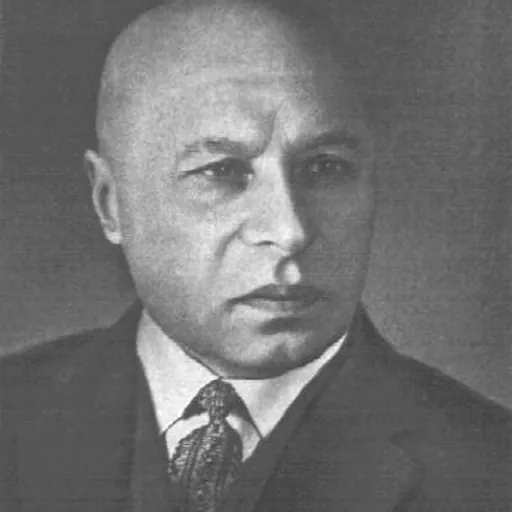
About Alexander Davydov
Lived 1912 – 1993 (aged 80). Alexander Davydov was a Russian and Ukrainian physicist and university teacher.
Alexander Sergeevich Davydov (, ) (26 December 1912 – 19 February 1993) was a Soviet and Ukrainian physicist. Davydov graduated from Moscow State University in 1939. In 1963-1990 he was Director of Institute for Theoretical Physics of the Ukrainian Academy of Sciences.
His main contributions were in theory of absorption, scattering and dispersion of the light in molecular crystals. In 1948, he predicted the phenomenon that is known as Davydov splitting or factor-group splitting, "the splitting of bands in the electronic or vibrational spectra of crystals due to the presence of more than one (interacting) equivalent molecular entity in the unit cell." In the period 1958–1960 he developed the theory of collective excited states in spherical and non-spherical nuclei, known as Davydov-Filippov Model and Davydov-Chaban Model. He studied theoretically the interaction of intramolecular excitations or excess electrons with autolocal breaking of the translational symmetry. These excitations are now known as Davydov solitons. In 1979, Davydov published the first textbook on quantum biology entitled "Biology and Quantum Mechanics" in Russian, which was then translated in English three years later.
Biography
Alexander Davydov was born in Yevpatoria in 1912 in a working class family. After graduating from high school in 1930, he moved to Moscow to work as a grinder at an automobile plant. In 1933, he joined the physics department at the Moscow State University, obtaining his diploma in 1939, five years later. He then joined the graduate school, working with Igor Tamm.
During World War II, he worked at an aircraft facility in Ufa. From 1945 to 1953, he worked at the NASU Institute of Physics.
Publications Theory of Absorption of Light by Molecular Crystals, Naukova Dumka, Kiev (1951) Theory of Atomic Nuclei, Nauka, Moscow (1958) Theory of Molecular Excitons, McGraw-Hill, New York (1962) Quantum Mechanics, Translated by Dirk ter Haar (Pergamon Press, 1965) and by Irene Verona Schensted (NEO Press, Ann Arbor, 1966) Theory of Molecular Excitons, Plenum Press, New York (1971) Theory of Solids, Nauka, Moscow (1980) Biology and Quantum Mechanics, Pergamon Press (1982) Solitons in Molecular Systems, D. Reidel (1985) Solitons in Bioenergetics, Naukova Dumka, Kiev (1986) The Theoretical Investigation of High-Temperature Superconductivity, Physics Reports, vol. 190, no. 4–5, pp. 191–306 (1990) High-Temperature Superconducitvity, Naukova Dumka, Kiev (1990).
Don’t just read it —
keep it.
Full-length biographies made to live with: read them, listen on the way to work, watch them tonight.
- E-book
- Audio
- Video
Instant download · yours to keep · every purchase keeps this site free
Important facts
People in Alexander Davydov's life
Named in this biography and alive at the same time



Related people
Same field, nearest in time


Contemporaries
People whose lives overlapped Alexander Davydov's





Frequently asked questions
Who was Alexander Davydov?
Ukrainian physicist (1912–1993)
When was Alexander Davydov born?
Alexander Davydov was born on 26 December 1912 in Yevpatoriya.
When did Alexander Davydov die?
Alexander Davydov died on 19 February 1993 in Kyiv.
What was Alexander Davydov's occupation?
Alexander Davydov was a physicist and university teacher.
What nationality was Alexander Davydov?
Alexander Davydov was Russian and Ukrainian.
Sources & further reading
· Wikipedia: Alexander Davydov
· DBpedia: Alexander Davydov (physicist)
Cite this page
APA: Biography.guide. (2026). Alexander Davydov. https://biography.guide/alexander-davydov/
MLA: "Alexander Davydov." Biography.guide, https://biography.guide/alexander-davydov/.
Chicago: "Alexander Davydov." Biography.guide. https://biography.guide/alexander-davydov/.
Data last updated: 2026-09-23 · Spot an error? Report a correction.
Portrait: Wikimedia Commons · author & licence
Page generated 2026-09-27 05:05 UTC