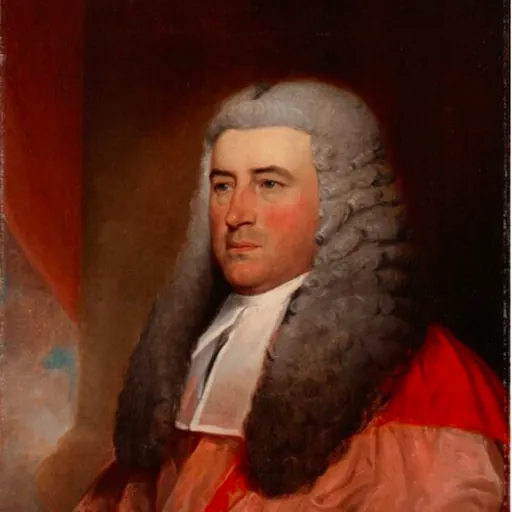
Alexander Croke
British judge and colonial administrator
About Alexander Croke
Lived 1758 – 1842 (aged 84). Alexander Croke was an administrator of the government and writer.
Sir Alexander Croke (July 22, 1758 – December 27, 1842) was a British judge, colonial administrator and author influential in Nova Scotia of the early nineteenth century.
Life Croke was born in Aylesbury, England, to a wealthy family and attended Oriel College, Oxford, where he earned the degree of Doctor of Civil Law. He was called to the bar in 1786. Practicing maritime law, he earned a strong enough reputation for his work that in 1801 he was offered his choice of appointments to the newly established vice-admiralty courts in Nova Scotia or the West Indies.
He married Alice Blake in 1796.
Career
Croke's bench in Nova Scotia had considerable jurisdiction: it covered all maritime cases in a colony based largely on fishing and where smuggling was commonplace. Since the population and the Assembly was highly sympathetic to smuggling, the court, which denied jury trials to the accused was unpopular. During the War of 1812, the ever-conservative Croke even found guilty merchants who had been granted licences by colonial authorities to engage in the slave trade with New England, on the grounds that he could not support an illegal policy.
His appointment to the Nova Scotia Council in 1802 gave him seniority over the other councilors, contrary to the established order. As the senior councilor, Croke administered the colony while the lieutenant governor was away, from December 6, 1808, to April 15, 1809, and again from August 25 to October 16, 1811. His administration was marked with conflict with the Assembly, whose budget he vetoed.
Croke influenced the development of educational institutions in Nova Scotia. He was on the first board of King's College and was primarily responsible for drafting its statutes, which required students to subscribe to the Anglican faith (as only a quarter of Nova Scotians did). When a strong movement to establish inter-denominational education appeared a few years later, Croke was among its most vocal opponents.
Croke published works of satirical poetry (which exacerbated his unpopularity in certain circles), a book on the genealogy of his family, and many letters.
He left Nova Scotia in 1815 and was knighted on July 5, 1816. He died in 1842 at his family home Studley Priory, Oxfordshire.
Don’t just read it —
keep it.
Full-length biographies made to live with: read them, listen on the way to work, watch them tonight.
- E-book
- Audio
- Video
Instant download · yours to keep · every purchase keeps this site free
Important facts
Related people
Same field, nearest in time


Contemporaries
People whose lives overlapped Alexander Croke's






Frequently asked questions
Who was Alexander Croke?
British judge and colonial administrator
When was Alexander Croke born?
Alexander Croke was born on 22 July 1758.
When did Alexander Croke die?
Alexander Croke died on 27 December 1842.
What was Alexander Croke's occupation?
Alexander Croke was an administrator of the government and writer.
Sources & further reading
Cite this page
APA: Biography.guide. (2026). Alexander Croke. https://biography.guide/alexander-croke/
MLA: "Alexander Croke." Biography.guide, https://biography.guide/alexander-croke/.
Chicago: "Alexander Croke." Biography.guide. https://biography.guide/alexander-croke/.
Data last updated: 2026-09-23 · Spot an error? Report a correction.
Portrait: Wikimedia Commons · author & licence
Page generated 2026-09-27 05:07 UTC