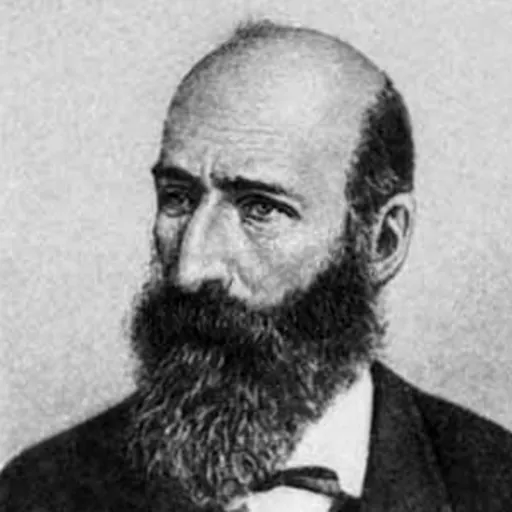
Alexander Afanasyev
Russian folklorist, collector of folk tales
About Alexander Afanasyev
Lived 1826 – 1871 (aged 45). Alexander Afanasyev was a Russian anthropologist, linguist, journalist, children's writer, collector of fairy tales and literary critic.
Alexander Nikolayevich Afanasyev (; – ) was a Russian Slavist and ethnographer, best known for publishing nearly 600 East Slavic and Russian fairy and folk tales, one of the largest collections of folklore in the world. This collection was not restricted to Great Russia, but included folk tales from what are now Ukraine and Belarus as well. The first edition of his collection was published in eight volumes from 1855 to 1867, earning him the reputation of being the Russian counterpart to the Brothers Grimm.
Life Alexander Afanasyev was born in the town of Boguchar in the Voronezh Governorate of the Russian Empire (modern-day Voronezh Oblast of Russia) into a family of modest means. His mother, Varvara Mikhailovna Afanasyeva, came from common people. Alexander was her seventh child; she became very ill after giving birth and died by the end of the year. The children were raised by their father, Nikolai Ivanovich Afanasyev, who had the rank of titular councillor and served as a prosecutor's assistant on probable causes, and whom Alexander described as a man of high intellectual and moral qualities, 'deservedly known as the smartest person in the whole uyezd'.
In three years, the family moved to Bobrov, Voronezh, where Alexander spent his childhood. He became addicted to reading early in his life, having access to the well-stocked library left by his grandfather (a member of the Russian Bible Society), as well as to various magazines.
In 1837, he was sent to the Voronezh male gymnasium, and in 1844 he entered the Law Faculty of the University of Moscow, which he finished in 1848. There he attended the lectures of Konstantin Kavelin, Timofey Granovsky, Sergey Solovyov, Stepan Shevyryov, Osip Bodyansky, and Fyodor Buslaev. He published a series of articles on government economy during the times of Peter the Great, on the Pskov Judicial Charter, and on other topics in the Sovremennik and Otechestvennye Zapiski magazines. Despite being one of the most promising students, he failed to become a professor. The conservative Minister of National Enlightenment, Count Sergey Uvarov, who oversaw the final exams, attacked Afanasyev's essay, which discussed the role of autocracy in the development of Russian criminal law during the 16th and 17th centuries.
In 1849, Konstantin Kavelin helped him to get a place at the Moscow Main Archive Directorate under the Ministry of Foreign Affairs of the Russian Empire, and here Afanasyev worked for the next 13 years. During that time, he met many people of science and culture, and collected a large number of ancient books and manuscripts that formed a huge library. His articles, reviews, and ethnographical and historical works regularly appeared in the leading Russian magazines, newspapers, almanacs, and scientific periodicals. His essays on Russian satire of the 18th century and on the works of prominent writers and publishers resulted in an 1859 monograph, Russian Satirical Magazines of 1769–1774 , published in Otechestvennye Zapiski (Nos. 3, 4 of 1855; No. 6 of 1859).
Work Afanasyev became interested in old Russian and Slav traditions and stories in the 1850s ("folklore" as an area of study did not exist at the time). His early scholarly articles, including – "Ведун и ведьма" ("Wizard and Witch", published in "Комета", 1851); "Языческие предания об острове Буяне" ("Pagan legends of Buyan Island", published in "Временнике общ. ист. и древ. росс." of 1858 No. 9) – drew upon the so-called Mythological school that treated legends and tales as a mine of information for the study of more ancient pagan mythology (see his definitive work on the subject "Поэтические воззрения славян на природу" ("", 1865–1869). In such an interpretation, he regarded the fairy tale Vasilisa the Beautiful as depicting the conflict between the sunlight (Vasilisa), the storm (her stepmother), and dark clouds (her stepsisters). A great archivist, his works provide copious information, evidence, documents, and passages of the old chronicles relating to Old Russian culture, history and tradition, as well as other Indo-European languages, folklore and legends, in particular German traditions (he knew to perfection German as well as all Slav languages and ancient ones).
In the early 1850s, being already known for his articles, Afanasyev began to think about a collection of folk tales. He was then asked by the Russian Geographical Society (ethnography section) of Saint Petersburg to publish the folktales archives that the Society had been in possession of for about ten years. These archives are at the start of his Collection. Afanasyev chose 74 tales out of these. He added to them the enormous collection of Vladimir Dal (about 1000 texts), from which he kept 148 numbers, finding the other ones too distorted, his own collection (of about 10 folktales from the Voronezh region), and a few other collections. He added already published tales (such as Maria Marievna, The Firebird, The Grey Wolf, etc.), a few tales coming from epic songs, stories about the dead, a few medieval satirical texts (such as The Shemiaka Sentence), and anecdotes.
He owes his prominent place in the history of Slavonic philology chiefly to these Russian Fairy Tales (Народные русские сказки), published between 1855 and 1863, and inspired by the famous collection of the Brothers Grimm. From the scientific point of view, his collection goes further. He had at his disposal a lot of contributors, he tried to give the source and place where the tale was told, he never tried to give any definitive version of a folktale: so, if he gathered seven versions of one folk type, he edited them all (this is the case for The Firebird for instance).
In 1860 a scandal was provoked following the publication of the "Русские народные легенды" ("Russian Folk Legends", 1860), a collection of folk tales from all over the country based on the lives of Jesus and Christian saints. The result was a unique blend of Christianity with paganism and social undertones. Some of them were labeled unorthodox by the Most Holy Synod and the book was officially banned.
Publications
]
, alt link , 3 vols, (first edition 1859) alt links vol. 1, vol. 2, vol. 3
Translations
, 70+ fairy tales, translated by Leonard A. Magnus , 43 fairy tales , 178 fairy tales + commentary by Roman Jakobson, translated by Norbert Guterman, illustrated by Alexander Alexeieff , 120 fairy tales, translated by Stephen Pimenoff, cover by Will Dady
Significance Prior to Afanasyev's works in the 1850s, only a few attempts had ever been made to record or study the folk beliefs of peasant Russia. Though written Church Slavonic had existed since the 10th century, it was used almost solely by the church and only for parochial written works. It was not until the 18th and 19th centuries that a sizable body of secular literature developed in vernacular Russian. Thus, Afanasyev's collections made a highly valuable contribution to the dissemination and legitimization of Russian culture and folk belief. The influence of these folk tales can be seen in the works of many writers and composers, notably Nikolai Rimsky-Korsakov (Sadko, The Snow Maiden) and Igor Stravinsky (The Firebird, Petrushka, and L'Histoire du soldat).
In popular culture In the 2019 film John Wick: Chapter 3, John Wick visits the New York Public Library and requests "Russian Folk Tale, Aleksandr Afanasyev, 1864."
Don’t just read it —
keep it.
Full-length biographies made to live with: read them, listen on the way to work, watch them tonight.
- E-book
- Audio
- Video
Instant download · yours to keep · every purchase keeps this site free
Important facts
People in Alexander Afanasyev's life
Named in this biography and alive at the same time





Related people
Same field, nearest in time



Contemporaries
People whose lives overlapped Alexander Afanasyev's




Frequently asked questions
Who was Alexander Afanasyev?
Russian folklorist, collector of folk tales (1826-1871)
When was Alexander Afanasyev born?
Alexander Afanasyev was born on 11 July 1826 in Boguchar.
When did Alexander Afanasyev die?
Alexander Afanasyev died on 23 September 1871 in Moscow.
What was Alexander Afanasyev's occupation?
Alexander Afanasyev was an anthropologist, linguist, journalist, children's writer, collector of fairy tales and literary critic.
What nationality was Alexander Afanasyev?
Alexander Afanasyev was Russian.
Sources & further reading
· Wikipedia: Alexander Afanasyev
· DBpedia: Alexander Afanasyev
Cite this page
APA: Biography.guide. (2026). Alexander Afanasyev. https://biography.guide/alexander-afanasyev/
MLA: "Alexander Afanasyev." Biography.guide, https://biography.guide/alexander-afanasyev/.
Chicago: "Alexander Afanasyev." Biography.guide. https://biography.guide/alexander-afanasyev/.
Data last updated: 2026-09-23 · Spot an error? Report a correction.
Portrait: Wikimedia Commons · author & licence
Page generated 2026-09-27 05:05 UTC