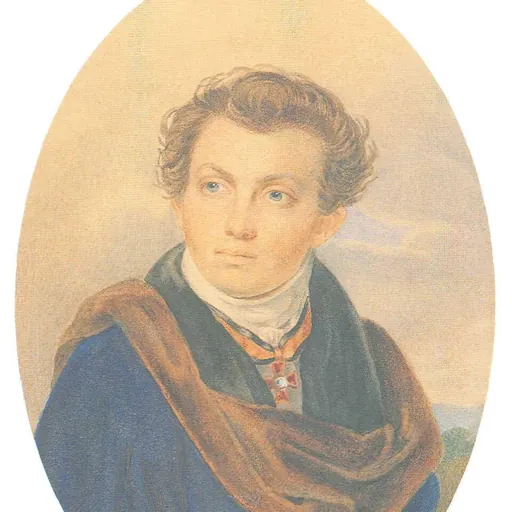
About Aleksandr Vitberg
Lived 1787 – 1855 (aged 67). Aleksandr Vitberg was a Russian architect and painter.
Karl Magnus Vitberg (26 January 1787 – 24 January 1855) was a Russian Neoclassical architect of Swedish descent.
Biography Vitberg was born in Saint Petersburg. As a young man he was a member of Alexander Labzin's Masonic lodge, the "Dying Sphinx", and studied Boehmist theosophy. The lodge, which had been the first to reopen, in 1800, was ordered closed in 1822.
Vitberg won a design competition and in 1817 had the satisfaction of witnessing the groundbreaking ceremony for his neoclassical Cathedral of Christ the Saviour, a monument to the resistance to the French invasion of Russia in 1812. In order to undertake this project, Vitberg had converted to the Russian Orthodox Church, as stipulated by Tsar Alexander I. After his conversion, Vitberg changed his name from Karl Magnus to Aleksandr Lavrentyevich , after the monarch.
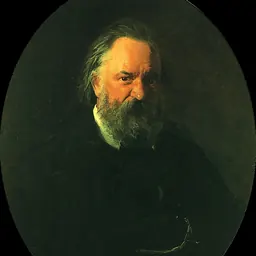
Though construction of Vitberg's cathedral on the Sparrow Hills was begun in 1826, a new emperor, Nicholas I abandoned the "Masonic" plan for a less "Roman Catholic" neo-Byzantine construction. The architect was accused of bribery and exiled to Vyatka, an isolated city halfway between Moscow and the Ural Mountains. There his most successful work was accomplished, among which were his monumental gates for the Alexander Garden (1836) and the Alexander Nevsky Cathedral (1839–1848). A fellow-exile there was Alexander Herzen, who made friends with Vitberg, portrayed him sympathetically in My Past and Thoughts, and was briefly influenced by Vitberg's strain of mystical thought. thumb Vitberg's design for Cathedral of Christ the Saviour in Moscow.
Vitberg was eventually allowed to return to Moscow, but found little work, and died in poverty and official neglect. The Russian neoclassical revival in the late 19th century contributed to a reappraisal of his architectural legacy. An exhibition, Alexander Witberg (1787–1855). En Arkitekurhistorisk Installation was mounted in Stockholm from 1993 to 1994.
Don’t just read it —
keep it.
Full-length biographies made to live with: read them, listen on the way to work, watch them tonight.
- E-book
- Audio
- Video
Instant download · yours to keep · every purchase keeps this site free
Important facts
People in Aleksandr Vitberg's life
Named in this biography and alive at the same time

Related people
Same field, nearest in time
Contemporaries
People whose lives overlapped Aleksandr Vitberg's



Frequently asked questions
Who was Aleksandr Vitberg?
Russian architect (1787-1855)
When was Aleksandr Vitberg born?
Aleksandr Vitberg was born on 15 January 1787 in Saint Petersburg.
When did Aleksandr Vitberg die?
Aleksandr Vitberg died on 12 January 1855 in Saint Petersburg.
What was Aleksandr Vitberg's occupation?
Aleksandr Vitberg was an architect and painter.
What nationality was Aleksandr Vitberg?
Aleksandr Vitberg was Russian.
Sources & further reading
· Wikipedia: Aleksandr Vitberg
Cite this page
APA: Biography.guide. (2026). Aleksandr Vitberg. https://biography.guide/aleksandr-vitberg/
MLA: "Aleksandr Vitberg." Biography.guide, https://biography.guide/aleksandr-vitberg/.
Chicago: "Aleksandr Vitberg." Biography.guide. https://biography.guide/aleksandr-vitberg/.
Data last updated: 2026-09-22 · Spot an error? Report a correction.
Portrait: Wikimedia Commons · author & licence
Page generated 2026-09-27 05:04 UTC