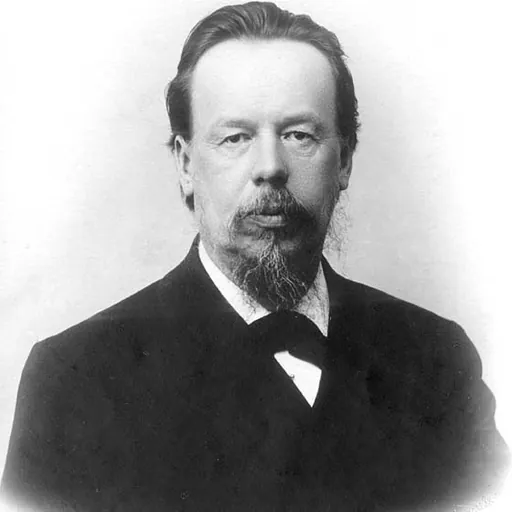
About Aleksandr Popov
Lived 1859 – 1905 (aged 46). Aleksandr Popov was a Russian physicist, inventor, engineer and pedagogue.
Alexander Stepanovich Popov (sometimes spelled Popoff; ; – ) was a Russian physicist who was one of the first people to invent a radio receiving device.
Popov's work as a teacher at a Russian naval school led him to explore high-frequency electrical phenomena. On 7 May 1895, he presented a paper on a wireless lightning detector he had built that worked via using a coherer to detect radio noise from lightning strikes. This day is celebrated today in Russia as Radio Day. In a 24 March 1896 demonstration, he transmitted radio signals 250 meters between different campus buildings in St. Petersburg. His work was based on that of another physicist, Oliver Lodge, and contemporaneous with the work of Guglielmo Marconi.
Early life Born in the town of Krasnoturyinsk, currently Sverdlovsk Oblast, in the Urals as the son of a priest, he became interested in natural sciences when he was a child. His father wanted Alexander to join the priesthood and sent him to the Seminary School at Yekaterinburg. After graduation with honors in 1882, he stayed on as a laboratory assistant at the university. However, the salary at the university was inadequate to support his family, and in 1883 he took a post as teacher and head of laboratory at the Russian Navy's Torpedo School in Kronstadt on Kotlin Island. His interest in this area of study (including the new field of "Hertzian" or radio waves) was intensified by his trip in 1893 to the Chicago World's Columbian Exposition in the United States, where he was able to confer with other researchers in the field.
Popov also read an 1894 article about British physicist Oliver Lodge's experiments related to the discovery of radio waves by German physicist Heinrich Hertz 6 years earlier. Lodge used a detector called a coherer, a glass tube containing metal filings between two electrodes.
Demonstrations On 7 May 1895 Popov presented the paper "On the Relation of Metallic Powders to Electric Oscillations", which described his lightning detector, to the Russian Physical and Chemical Society in St. Petersburg. and 7 May has been celebrated since 1945 in the Russian Federation as "Radio Day". Popov and Marconi's early work seems to have been done without knowledge of each other's system, although reading Marconi's June 1896 patent disclosures led Popov to develop a long-range wireless telegraphy system.
By the time the Apraksin was freed from the rocks by the icebreaker Yermak at the end of April, 440 official telegraph messages had been handled by the Hogland Island wireless station. Besides the rescue of the Apraksin's crew, more than 50 Finnish fishermen, who were stranded on a piece of drift ice in the Gulf of Finland, were saved by the icebreaker Yermak following distress telegrams sent by wireless telegraphy. In 1901 Alexander Popov was appointed as professor at the Electrotechnical Institute. In 1905 he was elected director of the institute.
Death
In 1905 he became seriously ill and died of a brain hemorrhage on 13 January 1906.
He was succeeded as head of the Russian national wireless organisation by Simeon Aisenstein with whom he had worked closely.
Honors Radio Day In 1945 on the 50th anniversary of Popov's experiment the old Soviet Union made 7 May a new holiday, Radio Day, the day they claim Popov invented radio. Historians note this holiday may be more due to Cold War era politics than historical evidence. Crater Popov on the back side of the Moon. A huge conference room "Alexander Stepanovich Popov" at the ITU's headquarters in Geneva was inaugurated at the ITU Telecom World 2011 by Igor Shchyogolev, Minister of Telecom and Mass Communications of the Russian Federation alongside Hamadoun Touré, Secretary General of the ITU.
Monuments Monument to A. S. Popov, Nizhny Novgorod, Museum of Radiophysics Monument to A. S. Popov, Yekaterinburg, Popov Square on Pushkin Street. Monument to A. S. Popov, Rostov-on-Don, Radio Frequency Center of the Southern Federal District, main entrance, 50 Budennovsky Ave., the opening took place on 7 May 2009, on Radio Day Monument to A. S. Popov, Krasnoturinsk Monument to A. S. Popov, Peterhof, Naval Institute of Radio Electronics named after A.S. Popov, main entrance Monument to A. S. Popov, Peterhof, Naval Institute of Radio Electronics named after A.S. Popov, entrance from the Scout boulevard Monument to A. S. Popov, Saint Petersburg, sculptors: V. Ya. Bogolyubov and V.V. Isaev, architect: N.V. Baranov – (1959; Kamennoostrovsky Prospekt, in the square between houses 39 and 41), at the station Petrogradskaya Monument to A. S. Popov, Moscow, Alley of Scientists, Sparrow Hills, Moscow State University n.a. M.V. Lomonosov Monument to A. S. Popov, Ryazan, at the main entrance to the Ryazan State Radio Engineering University Monument to A. S. Popov, Kronstadt, square at the memorial museum of the inventor of radio A. S. Popov Monument to A. S. Popov, Perm, architects: D. Lapshin, E. Koltsova; artist I. Dymshakov; sculptor A. Matveev Monument to A. S. Popov, Kotka, Finland Monument to A. S. Popov, Dnipro, st. Stoletova Monument to A. S. Popov on the territory of Odessa Electrotechnical Institute of Communications named after A.S. Popov (now Odessa National Academy of # Communications named after A.S. Popov) Monument to A. S. Popov, Dalmatovo in the territory of school No. 2, named after the inventor. Monument to A. S. Popov, Omsk, the territory of "Radio Plant named after A. S. Popov", a bust. The obelisk, a memorial stone and a stele in honor of the implementation in 1900 by inventor A.S. Popov of the first practical radio communication session, Hogland Memorial stone in honor of the invention of the radio in 1895 by A. S. Popov, Kronshtadt, Toulonskaya Alley, Yachtennaya Square Sign 100 years of radio (1997), Sevastopol
Commemorative plaques
In Kronstadt, Sovetskaya St., at the house 43 a memorial plaque states: "Here, in the naval assembly, in 1886–1898 the inventor of the radio A. S. Popov gave public lectures", 1995. Sculptor Sidorenko V. G. Marble, bronze. In Kronstadt, Makarovskaya St., there is a memorial plaque on the house states: "Here, in the former marine technical school, in 1890–1901, radio inventor A. S. Popov worked as a teacher", 1995. Sculptor Sidorenko V. G. Marble, bronze. In Kronstadt, Makarovskaya St., there is a memorial plaque on the house: "Here, in the former mine officer class, the inventor of the radio A. S. Popov worked. 1883–1901", 1945. Marble. In Kronstadt, 1 Makarovskaya St., a gazebo in the courtyard, memorial plaque: "Here, in April–May 1895, the inventor of the radio A. S. Popov tested the world's first radio receiver", 1945. Marble. In Kronstadt, Uritsky St., on the house 35 a plaque: "I, the great Russian scientist, inventor of radio Alexander Stepanovich Popov, lived here in 1895–1901.", 1945. Marble. In Kronstadt, Ammerman St., on the house 31 a plaque: "The great Russian scientist, inventor of radio Alexander Stepanovich Popovlived here from 1886 to 1898", 1974. Marble. In Saint Petersburg, Admiralteysky passage, 2. In the building of the Higher Naval Engineering School. F. E. Dzerzhinsky memorial plaque states: "The great Russian scientist, radio inventor A. S. Popov taught at the Marine Engineering School from 1890 to 1900." Until 1977. Marble, bronze. In Saint Petersburg, Makarova Embankment (formerly Tuchkova Embankment) at building 22, in which A.S. Popov lived in 1901–1902, a memorial plaque was installed. Marble. In Saint Petersburg, Professor Popov Str., On the house 3 there is a plaque: "Inventor of the radio A. S. Popov lived, worked and died on December 31, 1905", 1925 – originally installed, 1945 – renewed. Marble. In Saint Petersburg, Professor Popov St., 5/3. Electrotechnical University, memorial plaque: "In this room in 1903–1905 Alexander Stepanovich Popov was a lecturer", 1959. Arch. Ivanov A.I., Gellerstein R.I. Marble In Saint Petersburg, Professor Popov St., 5/3. University of Electrical Engineering, memorial plaque: "Office of the inventor of radio, Professor A. S. Popov. 1901–1905.", 1948. Marble. In Saint Petersburg, Professor Popov St., 5/3. Electrotechnical University, memorial plaque: "In 1905 Radio inventor Professor Alexander Stepanovich Popov was the first elected director of this institute" 1947. Arch. Smirnov N.I. Marble. In Saint Petersburg, V.I., Szedovskaya line, on house 31/22, a plaque: "In this house in 1901–1902 lived the inventor of the radio A. S. Popov", 1947. Smirnov N. I. Marble. In Saint Petersburg, Pochtamtskaya St., 7. Central Museum of Communications named. A. S. Popov, lobby, memorial plaque: "In 1945 the Central Museum of Communications was named after A. S. Popov", marble. In Saint Petersburg, V.I., in the courtyard of Saint Petersburg State University on the building of the Russian Physics-chemical Society, Universitetskaya emb., memorial plaque: "Here on March 24 (12), 1896 A.S. Popov received the very first radiogram using the device he invented", 1961. Marble. With the support of the International Telecommunication Union (ITU) in Geneva from 5 to 9 October 2009, the World Exhibition "Telecommunication World 2009" was held (ITU Telecom World 2009). Among the events was the opening of a plaque to A. S. Popov at the world communications management center.
Museums Museum of Radio named after A. S. Popova, Ekaterinburg House-Museum of Alexander Stepanovich Popov, Krasnoturyinsk Memorial Museum of Radio Inventor A.S. Popov, Kronstadt Museum-cabinet and museum-apartment of A. S. Popov, LETI, St. Petersburg The postal and telecommunications museum in Saint Petersburg, the leading museum in its field in the Russian Federation, has since 1945 bore the name A.S. Popov Central Museum of Communications.
Books Radio pioneer Alexander Popov on the 1989 USSR stamp. The text says "Inventor of radio, A. S. Popov, 1859–1906. Demonstration of the first radio, 1895" Books about A. S. Popov:
Golovin G.I. ("The life of wonderful people" Series, No. 141): Alexander Stepanovich Popov – 1945, 88 pp., 50
Movies Films about A. S. Popov:
Alexander Popov (film) is a 1949 biographical film about the life and work of Alexander Stepanovich Popov.
Holidays 16 March is the birthday of A. S. Popov 7 May – Radio Day
Numismatics In 1984, the USSR State Bank issued a jubilee coin with a face value of 1 ruble dedicated to A.S. Popov.
Philately Many stamps have been issued depict A.S.Popov bearing the honor of him inventing radio.
Family Some of his descendants escaped to Manchuria during the Bolshevik Revolution and eventually made their way to the United States. Among others were his cousin, Dr. Paul Popov, who became a prominent physician in San Francisco and Paul's son, Egor Popov (1913–2001), who became a UC Berkeley Professor Emeritus of Civil and Environmental Engineering.
Don’t just read it —
keep it.
Full-length biographies made to live with: read them, listen on the way to work, watch them tonight.
- E-book
- Audio
- Video
Instant download · yours to keep · every purchase keeps this site free
Important facts
People in Aleksandr Popov's life
Named in this biography and alive at the same time



Related people
Same field, nearest in time



Contemporaries
People whose lives overlapped Aleksandr Popov's



Frequently asked questions
Who was Aleksandr Popov?
Russian physicist (1859–1906)
When was Aleksandr Popov born?
Aleksandr Popov was born on 4 March 1859 in Krasnoturyinsk.
When did Aleksandr Popov die?
Aleksandr Popov died on 31 December 1905 in Saint Petersburg.
What was Aleksandr Popov's occupation?
Aleksandr Popov was a physicist, inventor, engineer and pedagogue.
What nationality was Aleksandr Popov?
Aleksandr Popov was Russian.
Sources & further reading
· DBpedia: Aleksandr Popov (physicist)
Cite this page
APA: Biography.guide. (2026). Aleksandr Popov. https://biography.guide/aleksandr-popov-physicist/
MLA: "Aleksandr Popov." Biography.guide, https://biography.guide/aleksandr-popov-physicist/.
Chicago: "Aleksandr Popov." Biography.guide. https://biography.guide/aleksandr-popov-physicist/.
Data last updated: 2026-09-20 · Spot an error? Report a correction.
Page generated 2026-09-27 05:09 UTC