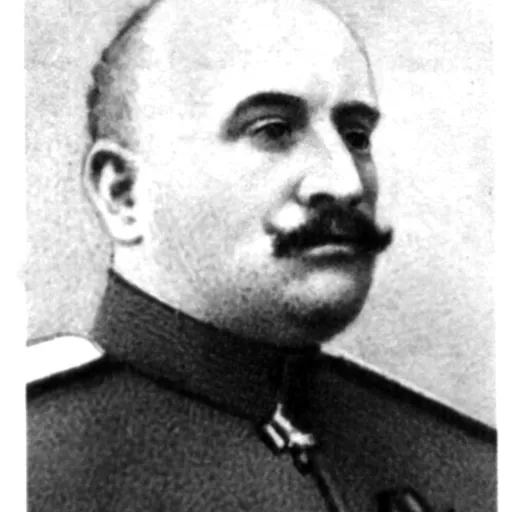
About Aleksandr Krymov
Lived 1871 – 1917 (aged 45). Aleksandr Krymov was a military personnel.
Aleksandr Mikhailovich Krymov (; – ) was a Russian lieutenant general and military commander of during the Russo-Japanese War, World War I and the Russian Revolution.
On 4 April 1917, he was appointed acting commander of the 3rd Cavalry Corps, which included the Savage Division. He refused to accept the appointment of Military Minister by the Russian Provisional Government. On 24 August 1917, Commander-in-Chief Lavr Kornilov appointed Krymov commander of the detached Petrograd Army (отдельная Петроградская армия) to secure the Russian capital of Petrograd.
Early life Krymov was part of the nobility of the Warsaw Governorate. Krymov participated in the Russo-Japanese War and World War I.
Kornilov affair
On 25 August 1917, Kornilov's troops were given the order to occupy Petrograd, disperse the Soviet, and disarm the city's garrison in case of a Bolshevik uprising. He was given the order to advance on Petrograd to rescue the Provisional Government from what was believed to be a Bolshevik coup. On 29 August, Kerensky made himself commander-in-chief, and ordered Krymov via cable to halt the advance of his troops, some of whom were moving through the southern suburbs of Petrograd. The Soviet executive in the capital now decided to support the now 'Revolutionary Dictator' Kerensky on news of the advance of Krymov's soldiers, and his troops were 'harangued' by Bolsheviks.
Krymov and his staff, travelling on the train of the 1st Don Cossack Division, were halted at Luga by the railway workers, and they continued to be harangued by Soviet deputies. Powerless, Krymov could only watch in his train compartment as Cossacks in large numbers defected to the Soviet side. On 30 August, he agreed to travel with a government representative to Petrograd, and on 31 August, he met with Kerensky, where he tried to explain that he had only brought his troops in an attempt to defend the government, but Kerensky ordered him to trial by military court.
Death Despondent after the meeting with Kerensky, Krymov left for a friend's apartment, where he was heard saying: "The last card for saving the Fatherland has been beaten – life is no longer worth living." He retired to a private room where he wrote a short note to Kornilov, before he shot himself through the heart.
Honours and awards Order of St. Stanislaus, 3rd class (1898), 2nd class with Swords (1905) Order of St. Vladimir, 4th class with Swords (1905), 3rd class (19 April 1911) Order of St. Anne, 4th class (1905), 3rd class with Swords and Bow (1905), 2nd class with Swords (1906) Order of St. George, 4th class (26 June 1916) Gold Sword for Bravery (8 November 1914)
Don’t just read it —
keep it.
Full-length biographies made to live with: read them, listen on the way to work, watch them tonight.
- E-book
- Audio
- Video
Instant download · yours to keep · every purchase keeps this site free
Important facts
People in Aleksandr Krymov's life
Named in this biography and alive at the same time
Related people
Same field, nearest in time





Contemporaries
People whose lives overlapped Aleksandr Krymov's

Frequently asked questions
Who was Aleksandr Krymov?
Russian general (1871–1917)
When was Aleksandr Krymov born?
Aleksandr Krymov was born on 23 October 1871.
When did Aleksandr Krymov die?
Aleksandr Krymov died on 31 August 1917 in Saint Petersburg.
What was Aleksandr Krymov's occupation?
Aleksandr Krymov was a military personnel.
Sources & further reading
Cite this page
APA: Biography.guide. (2026). Aleksandr Krymov. https://biography.guide/aleksandr-krymov/
MLA: "Aleksandr Krymov." Biography.guide, https://biography.guide/aleksandr-krymov/.
Chicago: "Aleksandr Krymov." Biography.guide. https://biography.guide/aleksandr-krymov/.
Data last updated: 2026-09-22 · Spot an error? Report a correction.
Portrait: Wikimedia Commons · author & licence
Page generated 2026-09-27 05:03 UTC