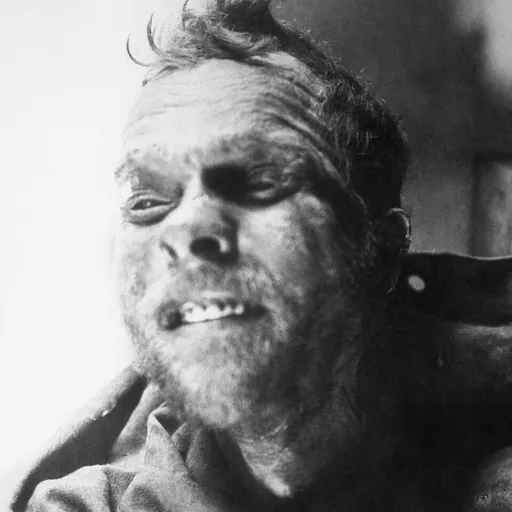
Albert Johnson
Canadian fugitive and murderer
About Albert Johnson
Lived 1895 – 1932 (aged 36–37). Albert Johnson was a Canadian trapper.
Attack on police Albert Johnson arrived in Fort McPherson after coming down the Peel River on 9 July 1931. He was questioned by RCMP constable Edgar Millen, but provided little information. Millen thought he had a Scandinavian accent, generally kept himself clean-shaven, and seemed to have plenty of money for supplies. He was suspected to be in his 30s. After venturing the waterways in an indigenous-built raft to the Mackenzie River delta, he built a small cabin on the banks of the Rat River. Johnson had not acquired a trapping licence, which was considered odd for someone living in the bush. At that time many northern native traditional trapping areas were being invaded by outsiders fleeing the Great Depression and some complaints may have been intended to remove him.
In the end of December, indigenous trappers complained to the local RCMP detachment in Aklavik that 'Johnson' was tampering with their traps,
On 26 December, Constable Alfred King and Special Constable Joe Bernard, each of whom had a considerable northern experience, trekked the to Johnson's cabin to ask him about the allegations. Seeing smoke coming from the chimney, they approached the hut to talk. Johnson refused to talk to them, however, seeming not even to notice them. King looked into the cabin window, at which point Johnson placed a sack across it. The two constables eventually decided to return to Aklavik and get a search warrant. After surrounding the cabin they thawed the dynamite inside their coats. The common version states that this charge was thrown onto the roof of the cabin, collapsing it in the following explosion. After the explosion, the men tried to rush in. Johnson opened fire from a deep dugout beneath the ruins. No one was hit, and after a 15-hour standoff (ending at 4:00 am) in the weather, the posse retreated to Aklavik for further assistance. Once again the pursuers retreated. The posse continued to grow, enlisting local Inuvialuit and Gwichʼin who were better able to move in the back country. Johnson had apparently decided to leave for the Yukon, but the RCMP blocked the only two passes over the Richardson Mountains. That did not stop Johnson, who climbed a peak and once again disappeared.
After Millen's death, the RCMP requested an aircraft for the search. Canadian Airways pilot Wilfrid "Wop" May, a First World War flying ace and postwar aviator, flew north with mechanic Jack Bowen to assist. They arrived at Aklavik in a ski-equipped Bellanca monoplane on 5 February. May spotted Johnson's tracks beyond the Richardson Mountains, showing that Johnson had crossed the range despite the RCMP blocking the main passes. On 14 February, May found tracks on the Bell River and followed them to where they turned south up the Eagle River. It is believed that the bullet passed through vital tissues, bowels, and main arteries, which led to his death. May landed the plane, picked up the injured King and flew him to help, for which May was credited with saving King's life. His dental work was of exceptional quality, suggesting poverty was not a reason for him to relocate North. Johnson had led a successful solitary life, if not a middle-class background, making his actions even more mysterious. During the entire chase, the Mounties had never heard Johnson utter a single word. At the time, the only person known to have heard his spoken voice was the RCMP constable who had interviewed him over his business in the town. The constable believed Johnson to be of Scandinavian origin, which modern DNA tests seem to confirm. All that the posse had heard from Johnson was his laugh after he shot Constable Edgar Millen. To this day people debate who he was, why he moved to the Arctic, and if he was actually responsible for interfering with the trap lines as alleged.
Proposed identities Arthur Nelson In the 1930s, the initial investigation about the identity of Albert Johnson primarily focused on an obscure individual named Arthur Nelson. Details of Nelson's life were recorded by Yukon researcher and author Richard North. Nelson apparently travelled from Dease Lake, British Columbia, up into the Yukon in the 1927 to 1931 period. He had similar guns (a Savage Model 99, a .30-30 Winchester calibre lever action rifle, a sawn-off Iver-Johnson 16 gauge shotgun and a sawn-off Winchester Model 58 .22 Long Rifle) as Albert Johnson. Nelson was also remembered by Kaska Dena elders Art John Sr. and others who knew him by the alias "Mickey Nelson" when he trapped and prospected in the Ross River region in west-central Yukon.
John Johnson North's 1989 book Trackdown put forward his theory that Albert Johnson, Arthur Nelson, and a North Dakota repeat criminal by the name of John Johnson were one and the same person. John Johnson did time in San Quentin Prison and Folsom Prison, and his physical description is well documented and similar to the Mad Trapper's. North traced John Johnson's identity back to Norway. "Johnny Johnson" was born Johan Konrad Jonsen (1898) in Bardu Municipality in Norway, north of the Arctic Circle. However, the Mad Trapper's expensive dental work were not likely to belong to the criminal Johnson. Also, DNA tests involving John Johnson's great-nephew Ole Getz disproved that Johnny Johnson and the Mad Trapper were the same people.
Owen Albert Johnston The Johnston family of Pictou, Nova Scotia, have long believed that Albert Johnson is actually Owen Albert Johnston, a relative who had left Pictou at the beginning of the Great Depression to find work in the United States. The family's last letter from Johnston was posted from Revelstoke, British Columbia, early in 1931. They never heard from him again. According to a 2009 Halifax radio interview a relative was arranging for DNA tests.
Sigvald Pedersen Haaskjold Previous theories were challenged with the release of Mark Fremmerlid's book What Became of Sigvald Anyway. He proposed too many coincidences to ignore the possibility of Sigvald Pedersen Haaskjold from Norway emerging as Albert Johnson. Sigvald was last known as a highly self-sufficient 32-year-old in 1927, years before the chase and death of Albert Johnson, who was estimated between 35 and 40 years. Sigvald had become obsessed with the notion that the authorities were still looking for him after evading conscription during the First World War. He had built a fortress-like cabin on Digby Island on the north coast of B.C. before disappearing. This author points out circumstantial evidence for this case.
Contemporary analysis Exhumation and forensic examination A 2007 forensic examination found that Johnson was approximately 30 to 40 years old, had scoliosis, had undergone sophisticated dental work for the period, and had isotope results suggesting he had spent his youth in the U.S. Midwest.
It took place in August 2007 when a forensic team was assembled by Myth Merchant Films located and exhumed Johnson's grave near the cemetery in Aklavik, and the book The Mad Trapper: Unearthing a Mystery by Barbara Smith.
This team found that isotope analysis of his teeth suggested he may have grown up in Scandinavia or the U.S. Midwest, that he had scoliosis which would have led to chronic back pain, that he was approximately 35 years of age, and that he had been struck multiple times in his final gun battle including his leg, thorax and a debilitating shot from behind through his pelvis.
In popular culture Films and music
In August 2007, Myth Merchant Films produced a documentary of the exhumation of Johnson's grave and the subsequent modern forensic examination seeking information about his identity. The documentary was released in 2009. The Mad Trapper, a highly fictionalized film based on these events, was released in 1972, and in 1975 Challenge to Be Free was released. An U.S. production, it referred to Johnson's character merely as "Trapper", or in the theme song, "Trapper Man". It portrayed Johnson as a man who lived in peace and harmony with wild animals, similar to Johnny Appleseed and whose initial interference with other traps was due to rival trappers' inhumane techniques. Death Hunt, a 1981 film starring Charles Bronson as Albert Johnson and Lee Marvin as Constable Edgar Millen, is a fictionalized version of the story.
Books Rudy Wiebe, The Mad Trapper, 1980, Jackpine House Ltd., 186 pages, Thomas York, Trapper, 1981, Avon Books, 476 pages. Dick North, The Mad Trapper of Rat River, 2003, The Lyons Press, 338 pages, Hélèna Katz, The Mad Trapper, 2004, Altitude Publishing Canada Ltd., 133 pages, Dick North, The Man Who Didn't Fit In, 2005, The Lyons Press, 259 pages, Barbara Smith, The Mad Trapper: Unearthing a Mystery, 2009, Heritage House Publishing Co., 160 pages, Mark Fremmerlid, What Became of Sigvald Anyway? Was He The Mad Trapper of Rat River? 66 pages, Thomas P. Kelley, Rat River Trapper, 1972, Paper Jacks, 141 pages, Dick North, Trackdown, 1989, Macmillan of Canada, 202 pages, Ian Manook, Ravage, 2023, Éditions Paulsen, 352 pages, ISBN 9-782375-021958
Don’t just read it —
keep it.
Full-length biographies made to live with: read them, listen on the way to work, watch them tonight.
- E-book
- Audio
- Video
Instant download · yours to keep · every purchase keeps this site free
Important facts
People in Albert Johnson's life
Named in this biography and alive at the same time



Related people
Same field, nearest in time




Contemporaries
People whose lives overlapped Albert Johnson's
Frequently asked questions
Who was Albert Johnson?
Canadian fugitive and murderer
When was Albert Johnson born?
Albert Johnson was born in 1895.
When did Albert Johnson die?
Albert Johnson died on 17 February 1932 in Eagle River.
What was Albert Johnson's occupation?
Albert Johnson was a trapper.
What nationality was Albert Johnson?
Albert Johnson was Canadian.
Sources & further reading
· DBpedia: Albert Johnson (criminal)
Cite this page
APA: Biography.guide. (2026). Albert Johnson. https://biography.guide/albert-johnson-trapper/
MLA: "Albert Johnson." Biography.guide, https://biography.guide/albert-johnson-trapper/.
Chicago: "Albert Johnson." Biography.guide. https://biography.guide/albert-johnson-trapper/.
Data last updated: 2026-09-22 · Spot an error? Report a correction.
Portrait: Wikimedia Commons · author & licence
Page generated 2026-09-27 05:04 UTC