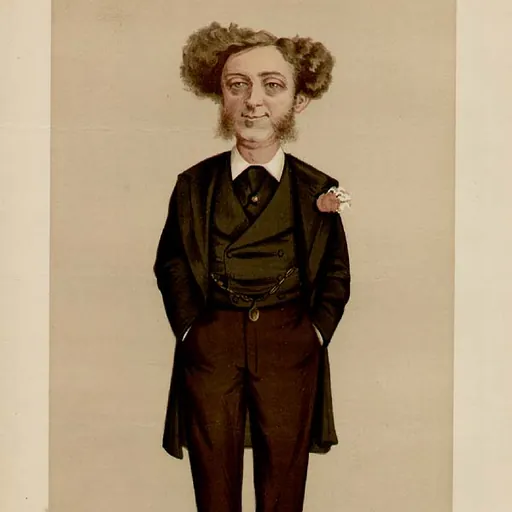
About Albert Grant
Lived 1831 – 1899 (aged 67–68). Albert Grant was a British politician and businessperson.
Albert Grant (18 November 1831 – 30 August 1899) (born Abraham Gottheimer); Baron Grant in the nobility of Italy, was an Irish-born British company promoter and Conservative politician, unseated in 1874 for election offences.
Early life Born in Dublin, Abraham was the son of Bernard Gottheimer, a poor Jewish pedlar from Central Europe. The family subsequently moved to London where his father became a partner in a business importing fancy goods. Abraham Gottheimer was educated in London and Paris, and assumed the name "Albert Grant" prior to his marriage to Emily Isabella Robinson in 1856. He entered employment as a clerk, later becoming a travelling salesman of wines.
In a court case of 1875 Grant was shown to be in a corrupt relationship with the financial journalist Marmaduke Sampson, financial editor of the London Times: in "Rubery v. Grant", a libel action against Grant and Sampson, the plaintiff was awarded £500 from the second defendant, Sampson. Evidence was produced that Grant had paid the journalist thousands of pounds for favourable reports. The "humiliated" newspaper dismissed Sampson in January 1875. A second journalist, David Morier Evans of the Standard, was also in his pay.
In 1875, Grant bought The Echo, the London evening newspaper, but sold it after less than 12 months to John Passmore Edwards.
Cooper's Hill Grant built a mansion house at Cooper's Hill near Egham, Surrey, in c.1865, to a semi-Gothic design by F. & H. Francis. From 1872 until 1906, it housed the Royal Indian Engineering College.
Member of Parliament 1865–1868 In 1865 Grant was chosen as Conservative candidate for the parliamentary constituency of Kidderminster, in opposition to the sitting Liberal Member of Parliament (MP), Colonel Luke White. The election generated great interest as a letter had been sent to all members of the electorate denouncing Grant as "a fraudulent adventurer". Grant and White were nominated at Kidderminster Town Hall on 11 July in front of a huge crowd. Grant was proposed and seconded by two local carpet manufacturers, who dismissed the charges against him at length and read out a number of character references defending his reputation. Grant unseated White to become Kidderminster's MP when the poll was held two days later. Three years later another general election was held, but Grant did not stand. The seat was regained by the Liberals, with Thomas Lea becoming member of parliament.
Italian and Portuguese honours In 1868 Victor Emmanuel II of Italy created Grant a hereditary baron. This was declared to be due to his services to the Galleria Vittorio Emanuele in Milan, although it was widely believed that the honour had been purchased. The petition came before the courts in July 1874, and the evidence against Grant was found by Mr Justice Mellor to be compelling: he was unseated and ordered to pay costs.
Leicester Square
During 1873 the Metropolitan Board of Works had been attempting to acquire Leicester Square for use as a public gardens. In January 1874 they were unexpectedly informed that Grant had "for some months past been in negotiation with the owners for the purchase of the ground with a view to laying it out as a garden, and handing it over to the Board as a gift to the Metropolis". He purchased it for £11,060. The square was laid out at Grant's expense, and the deeds formally handed over to the board on 3 July 1874.
Bankruptcy From 1876 until his death, Grant was constantly being pursued by creditors in the courts. While most of his failing companies were British, he was involved in an international scandal involving the fraudulent sale of shares in the exhausted Emma Silver Mine at Alta, Utah.
Don’t just read it —
keep it.
Full-length biographies made to live with: read them, listen on the way to work, watch them tonight.
- E-book
- Audio
- Video
Instant download · yours to keep · every purchase keeps this site free
Important facts
People in Albert Grant's life
Named in this biography and alive at the same time



Related people
Same field, nearest in time






Contemporaries
People whose lives overlapped Albert Grant's




Frequently asked questions
Who was Albert Grant?
British politician (1831–1899)
When was Albert Grant born?
Albert Grant was born in 1831 in Dublin.
When did Albert Grant die?
Albert Grant died in 1899 in Aldwick.
What was Albert Grant's occupation?
Albert Grant was a politician and businessperson.
What nationality was Albert Grant?
Albert Grant was British.
Sources & further reading
· DBpedia: Albert Grant (company promoter)
Cite this page
APA: Biography.guide. (2026). Albert Grant. https://biography.guide/albert-grant/
MLA: "Albert Grant." Biography.guide, https://biography.guide/albert-grant/.
Chicago: "Albert Grant." Biography.guide. https://biography.guide/albert-grant/.
Data last updated: 2026-09-20 · Spot an error? Report a correction.
Portrait: Wikimedia Commons · author & licence
Page generated 2026-09-27 04:58 UTC