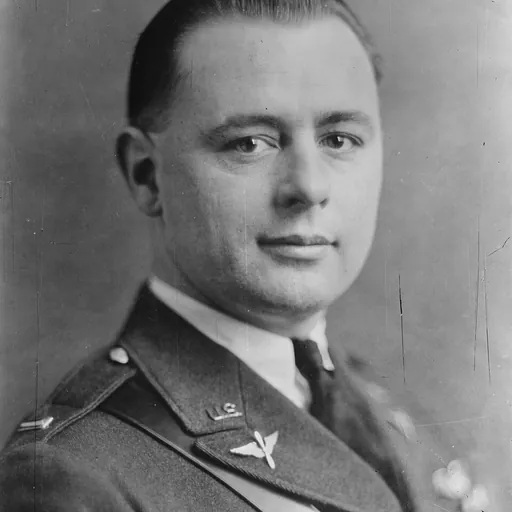
About Albert Francis Hegenberger
Lived 1895 – 1983 (aged 87). Albert Francis Hegenberger was an American aircraft pilot and military personnel.
Albert Francis Hegenberger (September 30, 1895 – August 31, 1983) was a major general in the United States Air Force and a pioneering aviator who set a flight distance record with Lester J. Maitland, completing the first transpacific flight to Hawaii in 1927 as navigator of the Bird of Paradise. Hegenberger was an aeronautical engineer of note, earning both the Mackay Trophy and Collier Trophy (1934) for achievement. Hegenberger also invented the non-directional beacon, adopted for both military and civil use.
Biography
Early years and World War I
Hegenberger was born at Boston, Massachusetts, in 1895. He entered the Massachusetts Institute of Technology in 1913 to undertake the course in civil engineering. When the United States entered World War I, Hegenberger enlisted in the Aviation Section, Signal Enlisted Reserve Corps as a private first class (flying cadet) on September 14, 1917. He completed ground school training at the school of military aeronautics at M.I.T. in December 1917, and proceeded to Ellington Field, Texas, where he earned a rating of Reserve Military Aviator. He was appointed a second lieutenant in the Signal Officer Reserve Corps on April 6, 1918. He was sent to the pilot pool at the Aviation Concentration Center at Camp John Dick, Dallas, Texas; then assigned successively to the School of Aerial Observers, Post Field, Fort Sill, Oklahoma; the School of Aerial Gunnery, Taliaferro Field, Texas, graduating as a gunnery pilot of July 5, 1918; and in October, 1918 back to M.I.T. for a four-month course in aeronautical engineering.
Air Service and Air Corps Upon completing his technical training in February 1919, Hegenberger became chief of the Instrument Branch at McCook Field, Dayton, Ohio. He was commissioned a first lieutenant, Air Service, in the Regular Army July 1, 1920, and subsequently served as assistant engineer of the Equipment Section, Air Service Engineering Division. Hegenberger transferred overseas to the 72nd Bombardment Squadron at Luke Field, Hawaii, in October 1923, and later served as operations officer of the 5th Composite Group. In March 1925, he was transferred to the 5th's 23rd Bombardment Squadron.
He joined the 30th Bombardment Squadron at Rockwell Field, San Diego, California, in August 1935, and was made squadron commander in October. He later moved with this unit to March Field, California, where he served until August 1937. Hegenberger was a student at the Air Corps Tactical School at Maxwell Field, Alabama from September 1937 to June 1938. He then moved on to Fort Leavenworth, Kansas, where he completed the Command and General Staff School in June 1939.
Hegenberger was assigned to Hickam Field, Hawaii, as operations officer of the 5th Bombardment Group in July 1939, and the following February became operations officer of the 18th Wing at Hickam Field. He moved to Fort Shafter, Hawaii, in November 1940 to become assistant chief of staff for operations of the Hawaiian Air Force, and in April 1941, was named commanding officer of the 11th Bombardment Group at Hickam Field.
Hegenberger retired August 31, 1949. and in 1976 was enshrined in the National Aviation Hall of Fame. He died of pneumonia in Goldenrod, Florida on August 31, 1983.
Awards and decorations SOURCE: Biographical Data on Air Force General Officers, 1917–1952, Volume 1 – A thru L Distinguished Flying Cross (with oak leaf cluster) World War I Victory Medal American Defense Service Medal American Campaign Medal Asiatic-Pacific Campaign Medal (with three campaign stars)
Technical Observer
Hegenberger also received the 1927 Mackay Trophy, the 1934 Collier Trophy, and was a fellow of the Institute of Aeronautical Engineers. In 1976, Hegenberger was inducted into the National Aviation Hall of Fame in Dayton, Ohio.
Dates of promotion
Don’t just read it —
keep it.
Full-length biographies made to live with: read them, listen on the way to work, watch them tonight.
- E-book
- Audio
- Video
Instant download · yours to keep · every purchase keeps this site free
Important facts
People in Albert Francis Hegenberger's life
Named in this biography and alive at the same time



Related people
Same field, nearest in time

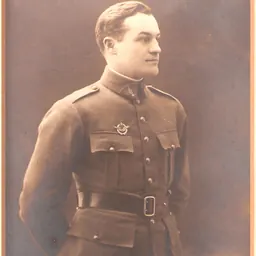
Contemporaries
People whose lives overlapped Albert Francis Hegenberger's

Frequently asked questions
Who was Albert Francis Hegenberger?
United States Army general (1895-1983)
When was Albert Francis Hegenberger born?
Albert Francis Hegenberger was born on 30 September 1895 in Boston.
When did Albert Francis Hegenberger die?
Albert Francis Hegenberger died on 31 August 1983 in Goldenrod.
What was Albert Francis Hegenberger's occupation?
Albert Francis Hegenberger was an aircraft pilot and military personnel.
What nationality was Albert Francis Hegenberger?
Albert Francis Hegenberger was American.
Sources & further reading
· Wikipedia: Albert Francis Hegenberger
· DBpedia: Albert Francis Hegenberger
Cite this page
APA: Biography.guide. (2026). Albert Francis Hegenberger. https://biography.guide/albert-francis-hegenberger/
MLA: "Albert Francis Hegenberger." Biography.guide, https://biography.guide/albert-francis-hegenberger/.
Chicago: "Albert Francis Hegenberger." Biography.guide. https://biography.guide/albert-francis-hegenberger/.
Data last updated: 2026-09-22 · Spot an error? Report a correction.
Portrait: Wikimedia Commons · author & licence
Page generated 2026-09-27 05:03 UTC