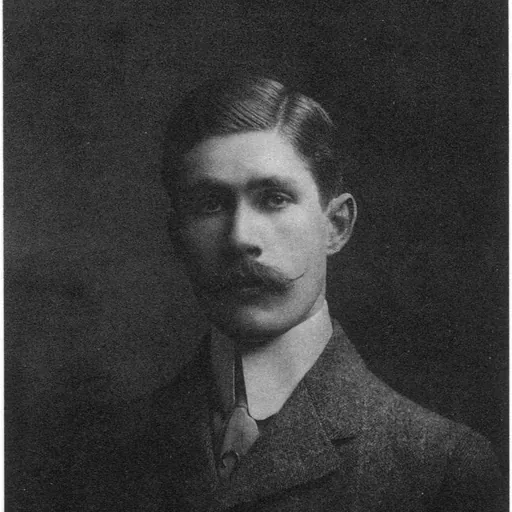
About Albert Eugene Gallatin
Lived 1881 – 1952 (aged 70). Albert Eugene Gallatin was an American artist, painter, art collector and art historian.
Albert Eugene Gallatin (July 23, 1881 – June 15, 1952) was an American artist. He wrote about, collected, exhibited, and created works of art. Called "one of the great figures in early 20th-century American culture," Between 1900 and 1910 most of these concerned Beardsley and Whistler. In examining their drawings and paintings he sought to find out what gave these works enduring value as opposed to superficial and temporary popularity. To him, their excellence showed in elegance of line and quality of design. In another article, he called Whistler an artist "whose work must remain more or less incomprehensible to the general public." Gallatin said Whistler's subjects were never ugly or lacking taste. In his view, Whistler was not a realist because he never descended to the obvious or commonplace. By the middle of the 1920s, through the influence of Nevinson, of the critic, Clive Bell, and of the authors of articles in The Arts magazine, he had thoroughly revised his opinions.
In the years between 1920 and 1926 Gallatin became a member of the modernist Société Anonyme and was introduced to the influential artist-critic Jacques Mauny who soon became his friend and advisor. There was no entry fee and from the beginning it was seen as a place for artists to use as well as the general public. He donated it to the Philadelphia Museum of Arts, against which a claim for restitution was filed in 2021 because the painting had been seized by Nazis.
Art work: 1930s–1940s
In February 1936 Gallatin resumed painting. He had been deliberate and unhurried in his collecting, acquiring first small pieces on paper and, on becoming comfortable with an artist's work, gradually moving on to larger oil paintings. Similarly, he took many months to work up his own easel productions from conception to finished state. The works themselves were uniformly non-objective. At the time critics saw them as cerebral and "Euclidean." They have since been seen as "sensitively realized abstractions," structural designs of an architectural nature, imbued with "subtle structural strength," and "endlessly inventive." The term "decorative" was also applied to them, both in a pejorative sense and one more in keeping with his own use of the term, which connoted harmony and a higher plane of taste.
He was generally reticent about his work but in 1938 told an interviewer that he tried to strip his painting down to the essentials of art. The statement fits with his writings on the artists whose work he admired. He felt art was best when least connected to things in the world: pure line, color, shape, texture, and tone. and in 1947 he wrote that Gallatin was secure in his position as "uncompromising nonobjectivist" whose work was "all neatness and smooth reasonable decorum." In 1942 Gallatin was referred to as New York's "abstract king" in a profile that appeared in the "Talk of the Town" section of the New Yorker magazine. During the remainder of the 1940s until his death in 1952, he continued to paint, promote, and collect non-objective art. In 1952 he was given a one-man retrospective exhibition at the Rose Fried Gallery, New York.
Gallatin's father, Albert Horatio Gallatin, was born March 7, 1839, and died March 25, 1902.
Don’t just read it —
keep it.
Full-length biographies made to live with: read them, listen on the way to work, watch them tonight.
- E-book
- Audio
- Video
Instant download · yours to keep · every purchase keeps this site free
Important facts
People in Albert Eugene Gallatin's life
Named in this biography and alive at the same time

Related people
Same field, nearest in time




Contemporaries
People whose lives overlapped Albert Eugene Gallatin's

Frequently asked questions
Who was Albert Eugene Gallatin?
American artist and art collector (1881-1952)
When was Albert Eugene Gallatin born?
Albert Eugene Gallatin was born on 23 July 1881 in Villanova.
When did Albert Eugene Gallatin die?
Albert Eugene Gallatin died on 15 June 1952 in New York City.
What was Albert Eugene Gallatin's occupation?
Albert Eugene Gallatin was an artist, painter, art collector and art historian.
What nationality was Albert Eugene Gallatin?
Albert Eugene Gallatin was American.
Sources & further reading
· Wikipedia: Albert Eugene Gallatin
· DBpedia: Albert Eugene Gallatin
Cite this page
APA: Biography.guide. (2026). Albert Eugene Gallatin. https://biography.guide/albert-eugene-gallatin/
MLA: "Albert Eugene Gallatin." Biography.guide, https://biography.guide/albert-eugene-gallatin/.
Chicago: "Albert Eugene Gallatin." Biography.guide. https://biography.guide/albert-eugene-gallatin/.
Data last updated: 2026-09-22 · Spot an error? Report a correction.
Portrait: Wikimedia Commons · author & licence
Page generated 2026-09-27 05:04 UTC