
Albert Brunner
German fighter ace and Knight's Cross recipient
About Albert Brunner
Lived 1918 – 1943 (aged 24). Albert Brunner was an airman.
Albert Brunner (17 July 1918 – 7 May 1943) was a German Luftwaffe ace and recipient of the Knight's Cross of the Iron Cross during World War II. Brunner claimed 53 aerial victories, all over the Eastern Front. The Knight's Cross of the Iron Cross, and its variants were the highest awards in the military and paramilitary forces of Nazi Germany during World War II.
Career Brunner was born on 17 July 1918 in Dörtel, present-day part of Bad Mergentheim, at the time in the Kingdom of Württemberg within the German Empire. He joined the military service of the Luftwaffe in 1939. Following completion of flight and fighter pilot training, Brunner was transferred to Ergänzungs-Jagdgruppe West, a fighter pilot training unit, where he served as an instructor. In April 1942, he was transferred to II. Gruppe (2nd group) of Jagdgeschwader 5 (JG 5—5th Fighter Wing) and assigned to 6. Staffel (6th squadron). At the time, 6. Staffel was commanded by Oberleutnant Horst Carganico, while II. Gruppe of JG 5 was headed by Major Hennig Strümpell. The Staffel was based at an airfield at Petsamo, present-day Pechenga in Murmansk Oblast, Soviet Union on the Eismeerfront (Ice Sea Front)—the area of operations nearest the Arctic Ocean. On 1 June, Strümpell was transferred and command of II. Gruppe was given to Carganico. In consequence, 6. Staffel command was passed on to Oberleutnant Hans-Diether Hartwein. During this period, II. Gruppe received the Messerschmitt Bf 109 F-4. Training on this aircraft was done in small groups at Pori Airfield in Finland.
War on the Arctic Front On 29 May 1942, Brunner claimed his first aerial victory. Scrambled at 23:20, he shot down a Hawker Hurricane fighter south of Nautsi shortly after. Brunner claimed his second aerial victory on 24 June, another Hurricane, while escorting Junkers Ju 88 bombers to Murmansk. On 5 September during operations against the Arctic convoy PQ 18, Brunner claimed two aerial victories. However, his Bf 109 F-4 trop (Werknummer 10144—factory number) was also hit. He was last seen in combat near Warlamowo, present-day Severomorsk-1, and reported as missing in action. However, Brunner had bailed out and returned to his unit on 9 September.
On 23 March 1943, on a mission to Murmansk, Brunner claimed a Curtiss P-40 Warhawk fighter shot down. On 4 April, following aerial combat with Bell P-39 Airacobra fighters, Brunner made a crash landing in his Bf 109 G-2 (Werknummer 13923). Following these events, he was picked up by Oberfeldwebel Rudolf Müller who flew back to Petsamo and returned with a Fieseler Fi 156 Storch. During this period, Brunner was awarded the Honor Goblet of the Luftwaffe on 12 April. On 22 April, 6. Staffel flew a combat air patrol to the area north of Murmansk, up to the Kildin Island. On this mission, Brunner claimed a P-40 and a misidentified North American P-51 Mustang fighter, the P-51 was never deployed in this theater. His opponents belonged to 769 IAP PVO (Fighter Aviation Regiment—; Home Air Defense—), which reported three P-40s lost.
Brunner was killed in action on 7 May 1943 near Petsamo, Finland. Following combat with P-39s, he was forced to bail out of his Bf 109 G-2 (Werknummer 14802) approximately southwest of Groß Venedigerberg, a German name for a hill east of Pechenga. Too low for his parachute to fully deploy, he fell to his death. That day, 15 Bf 109s from II. and III. Gruppe had taken off at 03:25 to escort eight Ju 88 bombers and ten Messerschmitt Bf 110 and Focke-Wulf Fw 190 ground-attack aircraft on a mission to Murmansk. At approximately 04:00, a Luftwaffe flight of Bf 109s engaged in aerial combat with six P-39s from 2 GvSAP (Guards Composite Aviation Regiment—). In this encounter, Brunner claimed his 53rd and last aerial victory but his aircraft was also hit. His victor may have been Leytenant Nikolai Andreevich Bokii. His body was recovered by the infantry and buried at the German war cemetery Petschenga-Parkkina, located approximately southeast of Kirkenes. Posthumously, Brunner was awarded the German Cross in Gold on 4 June and the Knight’s Cross of the Iron Cross on 3 July 1943.
Summary of career
Aerial victory claims According to US historian David T. Zabecki, Brunner was credited with 53 aerial victories. Obermaier also lists him with 53 aerial victories claimed in 135 combat missions, all of which claimed on the Eastern Front. Mathews and Foreman, authors of Luftwaffe Aces — Biographies and Victory Claims, researched the German Federal Archives and also state that he was credited with 53 aerial victory claims.
Chronicle of aerial victories Claim Date Time Type Location Claim Date Time Type Location – 6. Staffel of Jagdgeschwader 5 –Eastern Front and northern Norway, and Finland — 6 December 1941 – 31 December 1942 1 29 May 1942 23:20 Hurricane south of Nautsi 4 18 July 1942 P-40 north of Murmansk 2 24 June 1942 Hurricane west of Kola 5 19 July 1942 P-40 southwest of Shonguy 3 7 July 1942 Hurricane southwest of Murmansk 6 19 July 1942 Hurricane west of Kola According to Prien, Stemmer, Rodeike and Bock, Brunner claimed three undocumented aerial victories in July and August 1942. These claims are neither listed by Mombeek nor by Mathews and Foreman. 10 22 August 1942 P-39 According to Prien, Stemmer, Rodeike and Bock, Brunner claimed two undocumented aerial victories in August and September 1942. These claims are neither listed by Mombeek nor by Mathews and Foreman. 13 5 September 1942 unknown 14 5 September 1942 unknown According to Prien, Stemmer, Rodeike and Bock, Brunner claimed twelve to fifteen undocumented aerial victories in January to April 1943. These claims are neither listed by Mombeek nor by Mathews and Foreman. 23 March 1943 14:20 P-40 vicinity of Shonguy 46 13 April 1943 P-40 east of Murmansk 39 4 April 1943 Hurricane? 47 19 April 1943 P-40 east of Murmansk 40 4 April 1943 P-40? vicinity of Pechenga 48 17 April 1943 P-40 east of Kolo 41 4 April 1943 P-40? vicinity of Pechenga 49 22 April 1943 P-51 east of Murmansk 42 4 April 1943 P-40 vicinity of Pechenga 50 22 April 1943 P-40 east of Murmansk 43 13 April 1943 Hurricane vicinity of Murmashi 51 29 April 1943 P-39 44 13 April 1943 Hurricane vicinity of Murmashi 52 30 April 1943 P-40 45 13 April 1943 Hurricane vicinity of Murmashi 53 7 May 1943 P-39 east of Pechenga
Awards Iron Cross (1939) 2nd and 1st Class Honour Goblet of the Luftwaffe on 12 April 1943 as Oberfeldwebel and pilot German Cross in Gold on 4 June 1943 as Oberfeldwebel in the 6./Jagdgeschwader 5 Knight's Cross of the Iron Cross on 3 July 1943 as Oberfeldwebel and pilot in the 6./Jagdgeschwader 5
Don’t just read it —
keep it.
Full-length biographies made to live with: read them, listen on the way to work, watch them tonight.
- E-book
- Audio
- Video
Instant download · yours to keep · every purchase keeps this site free
Important facts
People in Albert Brunner's life
Named in this biography and alive at the same time
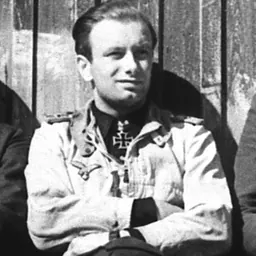

Related people
Same field, nearest in time




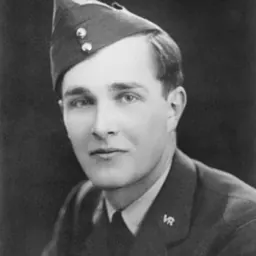
Contemporaries
People whose lives overlapped Albert Brunner's
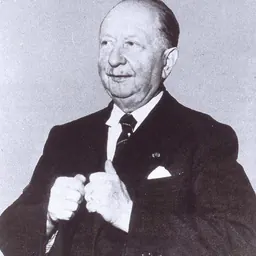
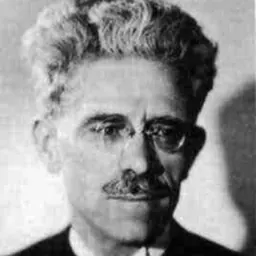

Frequently asked questions
Who was Albert Brunner?
German fighter ace and Knight's Cross recipient (1918-1943)
When was Albert Brunner born?
Albert Brunner was born on 17 July 1918 in Bad Mergentheim.
When did Albert Brunner die?
Albert Brunner died on 7 May 1943 in Pechengsky District.
What was Albert Brunner's occupation?
Albert Brunner was an airman.
What nationality was Albert Brunner?
Albert Brunner's recorded nationality: German Reich.
Sources & further reading
Cite this page
APA: Biography.guide. (2026). Albert Brunner. https://biography.guide/albert-brunner/
MLA: "Albert Brunner." Biography.guide, https://biography.guide/albert-brunner/.
Chicago: "Albert Brunner." Biography.guide. https://biography.guide/albert-brunner/.
Data last updated: 2026-09-20 · Spot an error? Report a correction.
Page generated 2026-09-27 05:26 UTC