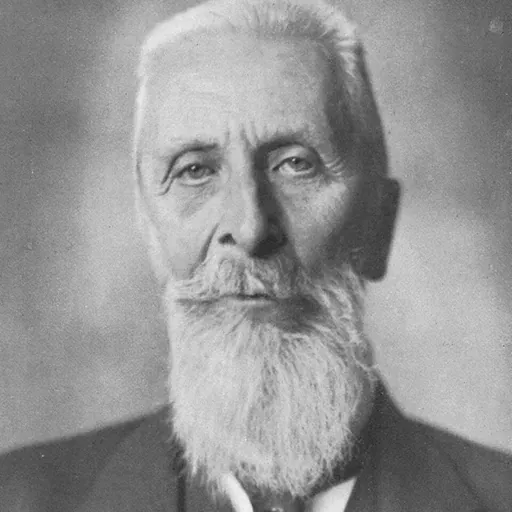
About Albert Apponyi
Lived 1846 – 1933 (aged 86). Albert Apponyi was a Hungarian politician, writer, diplomat and minister.
Albert György Gyula Mária Apponyi, Count of Nagyappony (; 29 May 18467 February 1933) was a Hungarian aristocrat and politician. He was a board member of the Hungarian Academy of Sciences, Chairman of from 1921 to 1933, and a knight of the Austrian Order of the Golden Fleece from 1921. He was nominated for Nobel Peace Prize five times.
Early life
Albert Apponyi was born on 29 May 1846, in Vienna, where his father, Count György Apponyi, was the resident Hungarian Chancellor at the time. He belonged to an ancient noble family dating back to the 13th century. His mother, Countess Júliane Sztáray de Nagymihály et Sztára (1820-1871) was also member of an equally old Hungarian nobility.
While other Hungarian aristocrats like István Széchenyi or Lajos Batthyány had to learn Hungarian separately in the aristocratic world of the time, Albert Apponyi grew up in a conservative Apponyi family with Hungarian as his mother tongue, but he mastered several Western European languages from an early age.
He was educated at the Jesuit institute in Calxburg (Lower Austria) until 1863, after which he studied law in Pest and Vienna. After completing his studies, he spent a long period (1868 to 1870) abroad, as was customary at the time, mainly in Germany, England and France, where he was introduced to the royalist aristocracy. Among the French aristocrats he was particularly influenced by Count Charles de Montalembert. It was at his house that he met Pierre Guillaume Frédéric Le Play, the famous conservative sociologist whose work was to have a major influence on his intellectual development. Despite owning a villa in London, he mostly spent time with the British royal family in the Buckingham Palace due to his close friendship to Queen Victoria and Edward VII.
Beyond his talent as an orator and fluency in six languages, Albert Apponyi had wide-ranging interests outside politics, encompassing philosophy, literature, and especially music and religion, namely Roman Catholicism. He visited the United States three times, first in 1904 and last in 1924, where he engaged in lecture tours and befriended leading public figures, including Presidents Theodore Roosevelt and William Howard Taft. He also visited Egypt twice, including in 1869 when he was invited to the inauguration of the Suez Canal.
He owned the family castle in Éberhard, (now Malinovo, Slovakia), where he entertained guests including Theodore Roosevelt during his tour of Europe in 1910. Roosevelt described Apponyi as "an advanced Liberal in matters political but also in matters ecclesiastical" and "like an American Liberal of the best type."
He considered his first political activity to be the role he once played alongside Ferenc Deák as a university student, when he was present as an Italian interpreter at a meeting with a delegation from Dalmatia.
Marriage and family
Count Albert Apponyi married to the women's rights activist Countess Clotilde von Mensdorff-Pouilly in Vienna on 1 March 1897. Their children:
Count György II Alexander Apponyi (Éberhárd, 30 June 1898 – Saarbrücken, West Germany, 7 August 1970), politician, member of the Parliament, journalist. Mária Alexandrina (Éberhárd, 29 May 1899 – Salzburg, 3 July 1967); marriage: Budapest, 29 June 1933 to Prince Karl de Rohan (9 January 1898 – 17 March 1975) Julianna (Budapest, 9 November 1903 – Paris, 17 January 1994); 1st husband: (1924, divorced: 1934) Count Ferenc Pálffy (30 August 1898); 2nd husband: (1943, divorced: 1947) Elemér Klobusiczky (Debrecen, 20 August 1899 – Budapest, 25 February 1986)
Political career
Count Albert Apponyi became a member of the Hungarian Parliament in 1872 and remained a member almost uninterrupted until his death.
Returning home from his travels abroad, he soon found himself in the thick of the political life of the time. In 1872, he was elected as a member of the Hungarian Parliament for the first time, and after that he was a member of the Hungarian legislature until his death, practically without interruption. He won his first mandate in the district of Szentendre as a member of the platform of Ferenc Deák. "Everyone greeted me with a certain curiosity", he writes in his memoirs of his first appearance in the House of Representatives, "but few with sympathy. The left considered me the offspring of the conservatives, the liberal Deák supporters saw me as the representative of an ultramontane action'. Curiosity was soon replaced by warm interest, however, because his oratory skills were a sensation from the very first time he spoke (in the detailed debate on the 1873 budget, he spoke in favour of the establishment of a National Academy of Music).
In the general elections of 1875 – the terms of the Parliament were then still three years – he lost the elections in three places: in Kőszeg, in a district of Bačka and in an Oláh district of Transylvania, as you write: he failed in the elections, if not from the Carpathians to the Adriatic, but from the Vág to the Olt, from the Danube to the Tisza. Only in 1877 was he elected – but this time unanimously – in the now vacant Bobró district in the county of Árva county, on the platform of the conservative Sennyey party. Until then, he represented that party's position in the upper House of the parliament (House of Magnates).
After the retirement of Baron Pál Sennyey (1878), when his conservative party, Dezső Szilágyi's extraordinary party group and the Independent Libertarian Party merged to form the united (moderate) opposition ("the mortar party", as Gyula Verhovay called it), he joined it, and his abilities made him a leader in this party after Dezső Szilágyi's departure. His party took the name of the National Party in October 1892, and remained under that name until February 1900, when it merged with the Libertarian Party. In 1889, he led all opposition parties in the debate on the development of the memorable army, demanding the assertion of the national rights guaranteed by the Compromise. This struggle broke the fifteen-year reign of Prime Minister Kálmán Tisza, and his fall soon followed (1890).
Tisza's successor, Prime Minister Gyula Szapáry, was initially supported by Apponyi, but he turned against him when, instead of the original bill on administrative reform, he would have settled for a law stating that public administration was a state function. He then went into permanent opposition when Szapáry asked for and received a provisoire in October 1891 to dissolve parliament. The dissolution was carried out, but the opposition, and with it the National Party, emerged stronger from the electoral struggle, which in 1892 was conducted in an exile situation. Szapáry was defeated in the same year, and Apponyi played no small part in his downfall.
Advisor to Franz Joseph
A serious and long crisis ensued, during which Franz Joseph sought Apponyi's opinion, and which ended with the appointment of Baron Dezső Bánffy, then Speaker of the House of Representatives, as Prime Minister on 17 January 1895. Bánffy invited Apponyi to formal merger talks, but these ended inconclusively, as Bánffy made the merger conditional on the renunciation of national military requirements.
It was in this year that Count Albert Apponyi first appeared in the Inter-Parliamentary Union. The conference was held in Brussels, and Bánffy initiated the strong participation of the Hungarian parliament, because in connection with the upcoming millenary celebrations of the Hungarian state, he wanted to invite the conference to be held the following year to Budapest, and a great battle was expected to develop around this invitation. The Hungarian delegation succeeded brilliantly: Budapest was accepted as the venue for the next conference by a majority of votes, with only five votes against.
Towards the end of the year the opposition, led by Apponyi, was again at war with the government. Apponyi was so taken by the idea of the upcoming millenary celebrations that on Christmas Day he proclaimed a "treuga Dei" in his party's organ, the National Newspaper. However, 1896 had not yet ended when Apponyi's fight against Bánffy began again, as the government resorted to all means of violence and corruption in the general elections of that year. Apponyi was merciless in his scourging of abuses and public corruption in the newspapers, and then turned against him over the so-called 'Ischl clause'. However, he still did not participate in the resulting parliamentary filibuster, because he considered it "medicina pejor morbo" (medicine is worse than death). The fight ultimately led to Bánffy's downfall.
The government of Kálmán Széll followed. Apponyi came to an agreement with Széll and joined the Libertarian Party with his party. Shortly afterwards, the 1901 Diet elected him president, and in the same year he became a de facto internal privy councillor to the king. Before the 1903 recruitment bill was discussed, he presented his military programme, calling for the implementation of the so-called national concessions, but he agreed to postpone the issue until the new law on defence was implemented. For this reason, he did not approve of the Independence Party's obstruction of the recruitment bill, but as president he conducted the House's often stormy negotiations objectively and urged the delegations that came to see him to maintain their confidence in Parliament. After Széll's resignation on 1 July 1903, in order to stop the obstruction, he resigned his presidency and made a speech in favour of parliamentary peace, but the obstruction continued until Khuen-Héderváry's second resignation, and when the Libertarian Party had to take a stand on military issues, Apponyi became a member of the Committee of Nine sent to draw up the party's new military programme.
Apponyi was inclined towards the opposition: although he did not succeed in asserting his position, he remained in the Libertarian Party until it became clear that he could not realise his military demands in that party. His intention to leave was matured by the parallel meetings decided by the majority, which were aimed at violently breaking down the obstruction. On 26 November, he therefore left the party, having already resigned the presidency on 3 November. He was followed by members of the former National Party, with whom he has now re-formed the National Party. This party was sixty-seven strong, but it was particularly close to the Independence Party on the military question and agreed with the Independence Party on the question of the house rule revision planned by István Tisza, which brought the house rule revision into line with a substantial extension of the right to vote.
Leader of the opposition
Apponyi was now the leader of the opposition in the struggle against the revision of the constitution, and on 18 November 1904 he declared on behalf of the whole opposition that he would never recognise the validity of the revision forced by the majority. This was followed that same evening by the memorable Perczel handkerchief vote. The fight went on. Apponyi joined the alliance of opposition parties (allied opposition) and the government hired bits and pieces to defend the lex Daniel (new house rules). The final big confrontation followed: on 13 December, the opposition beat up the bits and smashed up the Chamber. István Tisza responded by dissolving the House, although the next year's budget had not yet been voted.
Apponyi, thoroughly disillusioned with the politics of the 60 weeks, joined the Independence Party at the end of the year. He led the 1904/1905 winter election campaign, which ended in a resounding victory for the opposition (26 January 1905). The opposition had thus become a majority, but was not yet in government. Attempts to mediate with the king were fruitless. The Fejérváry government came to power and the serious internal political crisis was complete. Finally, on 23 September, the king invited the leaders of the allied opposition, including Apponyi, who was the leader of the national resistance and who, in order to counteract the plans of József Kristóffy, Minister of the Interior, advocated a broad extension of suffrage.
On 8 April 1906, the so-called pact between the Crown and the allied opposition was finally reached, by ruling out the military question, and Apponyi took over the cultural ministry in the Second Wekerle Government, appointed on 9 April under the presidency of Sándor Wekerle. His party alone won an absolute majority (61.26%) in parliament in the elections of 11 April, which confirmed this, and together with his coalition partners won almost 87% of the seats.
"Apponyi laws"
As the minister of education of the conservative-led government from 1906 to 1910 he drafted the laws passed in 1907, known as Apponyi laws or Lex Apponyi, in which the process of Magyarization culminated. However, the incentives started in 1879, until then Hungarian had not been prescribed or even to be taught by any means. Reading, writing and counting in selected primary schools was introduced in Hungarian for the first four years of education. The Hungarian Government claimed all citizens should be able to understand, speak and write in the state language at a basic level, being a necessity deserving of support. These laws caused various forms of resentment from the ethnic minorities.
Eventually, the law prescribed the teaching of Hungarian in all schools without Hungarian education, whether the pupils' mother tongue was Hungarian or not, ignoring parents' claims that Hungarian education could be provided privately. If the number of pupils with Hungarian-mother tongue reached 20% of the total number of pupils in a school, Hungarian education had to be provided. However, in case the total number of pupils whose mother tongue was Hungarian exceeded 50%, the language of all education had to be changed to Hungarian with the proviso that education to pupils with non-Hungarian mother tongues could still be provided.
The teachers got a grace period – 3–4 years – in order to learn the language. Schools which could not provide teachers able to deal with the Hungarian-language had to be closed. Approximately 600 Romanian villages were left without education as a result of the law.
Leader of the Independence and '48 Party
He was now leading the Kossuth Party in the opposition struggles, which, given the government's means at the time, certainly did not lead to breathtaking scenes in the House of Representatives. After the death of Ferenc Kossuth in 1914, he became the party's president. At the outbreak of the First World War, the opposition and the government were at their fiercest. Apponyi was again the one who initiated the reconciliation of the parties, so that by breaking down the partitions, the whole public opinion would stand united behind the government in the struggle that was forced upon the country.
The Treuga Dei lasted until 1916. At that time the opposition, seeing the great mistakes that had been made in the conduct of foreign affairs and military affairs, demanded that it should be allowed greater influence in the conduct of these affairs. The king and the government acceded to this demand, and the opposition gave Apponyi, jr. Gyula Andrássy Jr. Rakovszky István Jr. However, the then Foreign Minister, Baron István Burián, was so dismissive of the committee when it appeared in Vienna that all three resigned their mandates at an open session of the House of Representatives.
The fight in the Chamber of Deputies now revolved around the right to vote. Apponyi was one of the first to call for a democratic extension of suffrage after the great blood sacrifices made by the Hungarian people in the war. István Tisza, the prime minister, refused to give in, but when the manuscript of Charles IV on suffrage appeared in April 1917, Tisza's position was shaken and he was soon forced to resign. Apponyi was Minister of Culture in the subsequent Esterházy government and then in the third Wekerle government, which lasted two years during the war.
Unilingual schools Hungarian Non-Hungarian5818635573426052116643246
Multilingual schools Hungarian Non-Hungarian145517842287243715981620
Interwar Period
Károlyi government and the Hungarian Soviet Republic
During the regime of Mihály Károlyi, he completely withdrew from public life, and after the proclamation of Hungarian Soviet Republic, he was forced to flee from Hungary. The Reds did not allow him to leave the capital by rail: he fled by carriage and hid for a time in Fejér County and other parts of the Danube region, until he finally managed with great difficulty to cross the Danube to his estate in Éberhard. He lived there even after the collapse of the Communist Party and only returned home in November 1919, when his presence was indispensable in the unfolding negotiations initiated by Sir George Clark of the British Foreign Office's Oriental Department, the Entente's chief envoy in Budapest. Asked about his understanding of the Christian nationalist tendency then prevailing, he replied that his Christianity knew neither sectarian hatred nor racism, and that persecution was not a policy.
He had been a strong participant in the unfolding negotiations for the formation of a government of concentration, and had already appeared to be forming the new government, when this combination was thwarted at the last moment by opposition to Christian-National unification. On 18 November, at the last inter-party conference held under Clark's chairmanship, Károly Ereky, the Minister of Public Food in the Friedrich government, said on behalf of that party that he would not support an Apponyi government. "At last an honest word!" – Apponyi replied and left the meeting.
Paris Peace Conference
Albert Apponyi, top-hatted, in front of the Quai d'Orsay, January 1920.
After World War I, Apponyi's most notable public office was his appointment in late 1919 to lead the Hungarian delegation to the Paris Peace Conference to present Hungary's case to the Allied and Associated Powers assembled there to determine the terms of the peace treaty with Hungary, which subsequently became known as the Treaty of Trianon on account of it having been signed in the Grand Hall of the Palace of Trianon.
The Carte Rouge, a map used by Apponyi in his presentation on 16 January 1920.
Apponyi's mission culminated in a speech to the negotiators at the Quai d'Orsay on 16 January 1920, which he delivered in French, simultaneously translated himself into English, and concluded in Italian.
Aponyi tried to convince the decision makers about the importance of democratic referendums about the disputed borders:
In the name of the great principle so happily phrased by President Wilson, namely that no group of people, no population, may be transferred from one State to the other without being first consulted – as though they were a herd of cattle with no will of their own – in the name of this great principle, an axiom of good sense and public morals, we request and demand a plebiscite in those parts of Hungary which are now on the point of being severed from us. I declare that we are willing to bow to the decision of a plebiscite, whatever it should be.
After leading the Hungarian delegation at the Paris Peace Conference, he remained active in politics and diplomacy, as an opposition member of Parliament, legitimist advocate of the Habsburgs as Kings of Hungary, and regular representative at the League of Nations.
The Horthy era
Apponyi's death was widely mourned in the world press. The press in Europe and other continents covered the death of Albert Apponyi in detail:
Popolo d'Italia and other Italian newspapers, Manchester Guardian wrote an editorial on the death of the Hungarian statesman, The Daily Mail, which described the deceased as the greatest statesman of our time, The Times paid a very warm tribute to Apponyi, The Daily Telegraph describes how Apponyi fought the war, but could not decide who to side with in the battle between German and Slavic ambitions, and ended up choosing the Germans, so the Slavs confiscated most of his land, According to the Morning Post, Apponyi was the most popular campaigner against the peace treaties, Deutsche Allgemeine Zeitung puts him alongside Stresemann and Briand in terms of greatness, The Prager Tageblatt says that Albert Apponyi was a human monument, The American, Swiss and French newspapers, Petit Parisien and Figaro, also wrote about Apponyi with deep sympathy.
By the American and British media, he was often called as "The Grand Old Man of Central Europe". In Hungary he was named as "The Greatest Living Hungarian". His memory, however, is less positive in Slovakia and Romania where his name is associated with the Apponyi laws and Magyarization.
Between 1911 and 1932, he was five times nominated for the Nobel Peace Prize by Hungarian universities, scientists and political groups, but never became a laureate.
He was the subject of national celebration on the occasion of his seventy-fifth birthday in May 1921, when he was made an honorary citizen by numerous Hungarian cities and towns. This is also when Ferenciek tere, a major intersection in Budapest, was renamed Apponyi tér in his honor. (It was rechristened Felszabadulás tér, meaning Liberation Square, by the Communist authorities in 1953.) Many Hungarian cities and towns still have an Apponyi street (Apponyi utca, sometimes Gróf Apponyi Albert utca) or Apponyi square (Apponyi tér) in his memory. There is also an Apponyi Street in Fairfield, Connecticut, a town that was home to many Hungarian immigrants in the early 20th century.
A bust of Albert Apponyi by sculptor Géza Maróti was dedicated in 1939 in Jászberény, the seat of his parliamentary constituency for many decades. It was presumably destroyed during the Communist era. A new bust, by local sculptor György Máté, was dedicated in 1996.
A collection of Herend Porcelain is named after Albert Apponyi, who is said to have custom-ordered the collection's design.
A plaque on the Buda Castle Hill house which Apponyi inhabited from 1901 or 1902 until his death, Werbőczy (now Táncsics Mihály) street 17, honors his memory and that of his son György, a liberal politician who was arrested by the Gestapo and briefly deported to Mauthausen in March 1944 for his opposition to the persecution of Hungarian Jews.
Works (selected) In 1931 he started working on a collection of essays that was published in 1935 after his death as The Memoirs of Count Apponyi. In these, among other themes, he describes his encounters with Franz Liszt and Richard Wagner, his audiences with Popes Pius IX and Pius XI as well as with Benito Mussolini, his impressions of Egypt and America, and his role during the 1920 sequence that led to the Treaty of Trianon. One of his earlier books was titled Esthetics and Politics, the Artist and the Statesman.
1889: Parlamentarismusunk veszedelme, őszinte szó Apponyi Albert Grófról. Budapest 1895: Aesthetika és politika, művész és államférfiu (Esthetics and Politics, the Artist and the Statesmen), Budapest 1896: Apponyi Albert gróf beszédei. 2 vols. Budapest 1908: A Brief Sketch of the Hungarian Constitution and of the Relations between Austria and Hungary. Budapest 1909: Hungary of to-day. London 1911: Lectures on the Peace Problem and on the Constitutional Growth of Hungary: lectures. Budapest: St. Stephen's Printing Press 1912: Magyar közjog osztrák világitásban. Budapest 1915: Austria-Hungary and the War, New York: Austro-Hungarian Consulate-general. Co-authors: Albert Apponyi, Ladislaus Hengelmüller von Hengervár, Konstantin Theodor Dumba, Alexander Nuber von Pereked 1919: The american peace and Hungary. Budapest 1921: Hungarian foreign policy. London, New York, Budapest 1922: Ötven év, ifjukorom--huszonöt év az ellenzéken. Budapest: Pantheon irodalmi intézet r.-t 1922: Emlékirataim. Ötven év Apponyi Albert gróf. Második, átnézett kiadás. 2 vols. Budapest, 1922, 1934. 1925: Gróf Apponyi Albert hét előadása a magyar alkotmány fejlődéséről. Budapest 1928: Justice for Hungary: review and criticism of the effect of the Treaty of Trianon. 376 p. London: Longmans, Green (one of several contributors) 1935 (posthumous): The Memoirs of Count Albert Apponyi. The MacMillan Company, New York.
Ancestors +Count Albert György Apponyi de Nagy-Appony's ancestors in three generations Count Albert György Apponyi de Nagy-Appony Father:Count György Apponyi de Nagy-Appony Paternal Grandfather:Count György Apponyi de Nagy-Appony Paternal Great-grandfather:Count Antal György Apponyi de Nagy-Appony Paternal Great-grandmother:Countess Maria Karolina von Lodron-Laterano-Castelromano Paternal Grandmother:Countess Anna Zichy de Zich et Vásonkeö Paternal Great-grandfather:Count Ferencz Zichy de Zich et Vásonkeö Paternal Great-grandmother:Countess Maria Anna Kolowrat-Krakowsky Mother:Countess Juliánna Sztáray de Nagy-Mihály et Sztára Maternal Grandfather:Albert Sztáray de Nagy-Mihály et Sztára Maternal Great-grandfather:Mihály Sztáray de Nagy-Mihály et Sztára Maternal Great-grandmother:Mária Anna Eleonora Eszterházy de Galántha Maternal Grandmother:Franziska Károlyi de Nagykároly Maternal Great-grandfather:József Károlyi de Nagykároly Maternal Great-grandmother:Maria Elisabeth Johanna von Waldstein-Wartenberg
Don’t just read it —
keep it.
Full-length biographies made to live with: read them, listen on the way to work, watch them tonight.
- E-book
- Audio
- Video
Instant download · yours to keep · every purchase keeps this site free
Important facts
Family & relationships
People in Albert Apponyi's life
Named in this biography and alive at the same time




Related people
Same field, nearest in time





Contemporaries
People whose lives overlapped Albert Apponyi's



Frequently asked questions
Who was Albert Apponyi?
Hungarian politician (1846-1933)
When was Albert Apponyi born?
Albert Apponyi was born on 29 May 1846 in Vienna.
When did Albert Apponyi die?
Albert Apponyi died on 7 February 1933 in Geneva.
What was Albert Apponyi's occupation?
Albert Apponyi was a politician, writer, diplomat and minister.
What nationality was Albert Apponyi?
Albert Apponyi was Hungarian.
Sources & further reading
Cite this page
APA: Biography.guide. (2026). Albert Apponyi. https://biography.guide/albert-apponyi/
MLA: "Albert Apponyi." Biography.guide, https://biography.guide/albert-apponyi/.
Chicago: "Albert Apponyi." Biography.guide. https://biography.guide/albert-apponyi/.
Data last updated: 2026-09-20 · Spot an error? Report a correction.
Portrait: Wikimedia Commons · author & licence
Page generated 2026-09-27 04:58 UTC