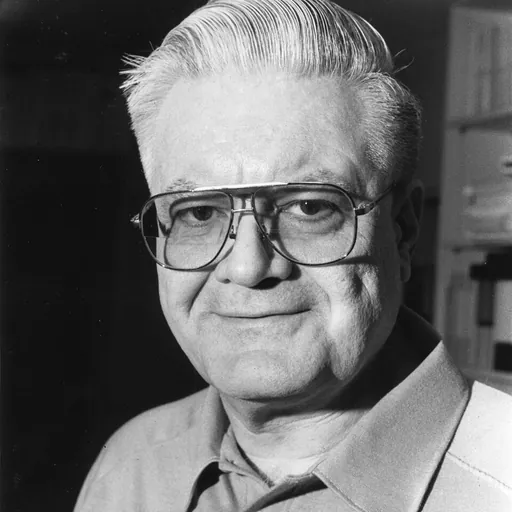
About Alastair G. W. Cameron
Lived 1925 – 2005 (aged 80). Alastair G. W. Cameron was a Canadian and American physicist, astronomer, astrophysicist, university teacher and nuclear physicist, known for R-process and Stellar nucleosynthesis.
Alastair Graham Walter Cameron (21 June 1925 – 3 October 2005) was an American–Canadian astrophysicist and space scientist who was an eminent staff member of the Astronomy department of Harvard University. He was one of the founders of the field of nuclear astrophysics, advanced the theory that the Moon was created by the giant impact of a Mars-sized object with the early Earth, and was an early adopter of computer technology in astrophysics.
Early life and education Alastair Cameron was born in Winnipeg, Manitoba, to parents of Scottish descent. His father, born in London, England, was chemist A.T. Cameron, a professor and chair of the biochemistry department at Manitoba Medical College. He recalls addressing all men as “Doctor” as a four-year-old, noting it was "clearly an early attempt at forming a hypothesis based on limited data."
In 1940 (When Cameron was only 15 years old), he made a bet with a high school classmate that man would land on the Moon within 40 years. When the Apollo program achieved a successful Moon landing in 1969, the former classmate sent a cheque to settle the bet, which Cameron had framed and hung on the wall in his office. He went on to do graduate work in both theoretical and experimental nuclear physics at the University of Saskatchewan. Under the supervision of Leon Katz, he studied photonuclear cross sections using the university's new 25 MeV betatron accelerator. In 1952, earned the first PhD awarded in physics from the university.
Career After finishing his PhD, he spent two years as an assistant professor at the Iowa State College and worked at the Ames Laboratory at the university, which was run by the United States Atomic Energy Commission. There he taught nuclear physics and helped to increase the electron beam current in the facility's new 70-MeV synchrotron particle accelerator.
In 1959, after growing frustrated with what he saw as the Canadian government's lack of interest in investing in science, Cameron emigrated to the United States, which had just seen a major expansion of funding for space-science research due to the Sputnik crisis. In this model, the outer silicates of the body hitting the Earth would be vaporized, whereas a metallic core would not. The more volatile materials that were emitted during the collision would escape the Solar System, whereas silicates would tend to coalesce. Hence, most of the collisional material sent into orbit would consist of silicates, leaving the coalescing Moon deficient in iron and volatile materials, such as water.
After seeing William Hartmann present a similar, independent model at a conference in 1974, Cameron began a several decade-long collaboration with Hartmann to develop the giant-impact hypothesis. 1970 R.M. Petrie Prize Lecture Award of the Canadian Astronomical Society 1972 Fellow of the American Physical Society 1976 Member of the National Academy of Sciences 1983 NASA Distinguished Public Service Medal 1988 J. Lawrence Smith Medal of the National Academy of Sciences 1989 Harry H. Hess Medal of the American Geophysical Union 1994 Leonard Medal of the Meteoritical Society 1997 Henry Norris Russell Lectureship of the American Astronomical Society 2006 Hans Bethe Prize of the American Physical Society
Personal life Cameron married Elizabeth MacMillan in 1955. from heart failure. He was 80 years old.
Don’t just read it —
keep it.
Full-length biographies made to live with: read them, listen on the way to work, watch them tonight.
- E-book
- Audio
- Video
Instant download · yours to keep · every purchase keeps this site free
Important facts
People in Alastair G. W. Cameron's life
Named in this biography and alive at the same time




Related people
Same field, nearest in time



Contemporaries
People whose lives overlapped Alastair G. W. Cameron's


Frequently asked questions
Who was Alastair G. W. Cameron?
Canadian astrophysicist (1925–2005)
When was Alastair G. W. Cameron born?
Alastair G. W. Cameron was born on 21 June 1925 in Winnipeg.
When did Alastair G. W. Cameron die?
Alastair G. W. Cameron died on 3 October 2005 in Tucson.
What was Alastair G. W. Cameron's occupation?
Alastair G. W. Cameron was a physicist, astronomer, astrophysicist, university teacher and nuclear physicist.
What was Alastair G. W. Cameron known for?
Alastair G. W. Cameron was known for R-process and Stellar nucleosynthesis.
What nationality was Alastair G. W. Cameron?
Alastair G. W. Cameron was Canadian and American.
Sources & further reading
· Wikipedia: Alastair G. W. Cameron
· DBpedia: Alastair G. W. Cameron
Cite this page
APA: Biography.guide. (2026). Alastair G. W. Cameron. https://biography.guide/alastair-g-w-cameron/
MLA: "Alastair G. W. Cameron." Biography.guide, https://biography.guide/alastair-g-w-cameron/.
Chicago: "Alastair G. W. Cameron." Biography.guide. https://biography.guide/alastair-g-w-cameron/.
Data last updated: 2026-09-22 · Spot an error? Report a correction.
Portrait: Wikimedia Commons · author & licence
Page generated 2026-09-27 05:02 UTC