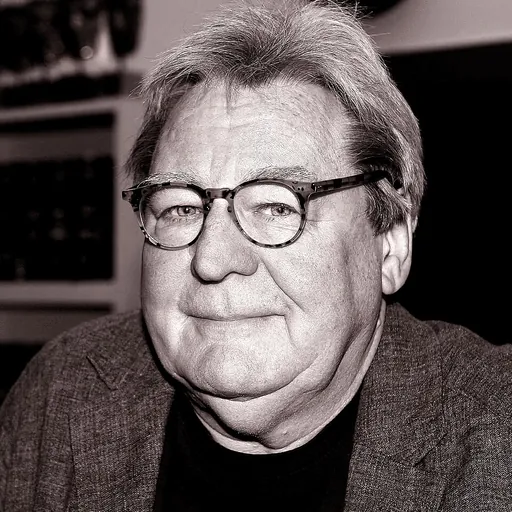
About Alan Parker
Lived 1944 – 2020 (aged 76). Alan Parker was a British screenwriter, film producer, film director, film actor, film editor and director.
Sir Alan William Parker (14 February 1944 – 31 July 2020) was an English filmmaker. His early career, beginning in his late teens, was spent as a copywriter and director of television advertisements. After about ten years of filming adverts, many of which won awards for creativity, he began screenwriting and directing films.
Parker was known for using a wide range of filmmaking styles and working in differing genres. He directed musicals, including Bugsy Malone (1976), Fame (1980), Pink Floyd – The Wall (1982), The Commitments (1991) and Evita (1996); true-story dramas, including Midnight Express (1978), Mississippi Burning (1988), Come See the Paradise (1990) and Angela's Ashes (1999); family dramas, including Shoot the Moon (1982), and horrors and thrillers including Angel Heart (1987) and The Life of David Gale (2003).
Parker's films won nineteen BAFTA awards, ten Golden Globes and six Academy Awards. His film Birdy was chosen by the National Board of Review as one of the Top Ten Films of 1984 and won the Grand Prix Spécial du Jury prize at the 1985 Cannes Film Festival. In 1984, Parker received the BAFTA for Outstanding British Contribution to Cinema, and in 2002 he was knighted for his services to the film industry. He was active in both British cinema and American cinema, along with being a founding member of the Directors Guild of Great Britain and lecturing at various film schools.
In 2000, Parker received the Royal Photographic Society Lumière Award for major achievement in cinematography, video or animation. In 2013, he received the BAFTA Academy Fellowship Award, the highest honour the British Film Academy can give a filmmaker. Parker donated his personal archive to the British Film Institute's National Archive in 2015.
Along with Hugh Hudson, Adrian Lyne, Ridley Scott, and Tony Scott, Parker was part of the "Adland Five" of British directors operating in the late 1970s and early 1980s who first established themselves in the advertising world, before going on to Hollywood success. The group's influence has been cited by the likes of Christopher Nolan and Christopher Frayling.
Early years and education Parker was born on 14 February 1944 into a working-class family in Islington, North London, the son of Elsie Ellen, a dressmaker, and William Leslie Parker, a house painter. He grew up on a council estate in Islington, which always made it easy for him to remain "almost defiantly working-class in attitudes" said the British novelist and screenwriter Ray Connolly. Parker said that although he had his share of fun growing up, he always felt he was studying for his secondary school exams, while his friends were out having a good time. He had an "ordinary background" with no aspirations to become a film director, nor did anyone in his family have any desire to be involved in the film industry. The closest he ever came, he said, to anything related to films was learning photography, a hobby inspired by his uncles: "... that early introduction to photography is something I remember." But more than anything, he said, he wanted to write, and would write essays and ads when he got home after work. Among their award-winning adverts were the UK Cinzano vermouth advertisement (starring Joan Collins and Leonard Rossiter), and a Heineken advert which used 100 actors. Parker credited his years writing and directing adverts for his later success as a film director: Looking back, I came from a generation of filmmakers who couldn't have really started anywhere but commercials, because we had no film industry in the United Kingdom at the time. People like Ridley Scott, Tony Scott, Adrian Lyne, Hugh Hudson, and myself. So commercials proved to be incredibly important. for which he wrote the script. The film is a bleak love story set against the Blitz in London during the Second World War, when the Luftwaffe bombed the city for 57 consecutive nights. Parker was born during one of those bombing raids, and said "the baby in that [film] could well have been me". The Evacuees won a BAFTA for best TV drama and also an Emmy for best International Drama.
Parker next wrote and directed his first feature film, Bugsy Malone (1976), a parody of early American gangster films and American musicals, but with only child actors. Parker's desire in making the film was to entertain both children and adults with a unique concept and style of film: I'd worked a lot with kids and I had four very young children of my own at the time. When you do have young children like that you're very sensitive to the kind of materials that's available for them ... The only kind of movies they could see were Walt Disney movies ... I thought it would be nice to make a movie that would be good for the kids, and also the adults that had to take them. So to be absolutely honest, Bugsy Malone was a pragmatic exercise to break into American film.
1978–1990: Subsequent success Parker next directed Midnight Express (1978), based on a true account by Billy Hayes about his incarceration and escape from a Turkish prison for trying to smuggle hashish out of the country. Parker made the film in order to do something radically different from Bugsy Malone, which would broaden his style of filmmaking.
Parker then directed Fame (1980), which follows the lives of eight students through their years at the New York City's High School of Performing Arts. It was a huge box-office success and led to a television spin-off series of the same name. Parker stated that after doing a serious drama like Midnight Express, he wanted to do a film with music, but very different from typical musicals of the past. Having already done Bugsy Malone, he felt confident that he knew how to go about creating a musical where the songs emerge from real situations. Its stars, Albert Finney and Diane Keaton, received Golden Globe nominations for their performances.
The film also had a personal significance for Parker, who said he was forced to examine his own marriage: "It was a painful film to make for me because there were echoes of my own life in it. It was about a breakup of a marriage, and the children in the story were quite close to my own children in age. Shoot the Moon was very, very close to my own life." Parker later described the filming as "one of the most miserable experiences of my creative life." Though not a major box office success, receiving lukewarm reviews from critics, the film has since become a cult classic amongst Pink Floyd fans.
Parker directed Birdy (1984), starring Matthew Modine and Nicolas Cage. It recounts the story of two school friends who have returned from the Vietnam War but who were both psychologically and physically injured. Parker called it a "wonderful story" after having read the book by William Wharton. However, because of the nature of the story, he had no idea how to make it into a movie: "I didn't know if you could take the poetry of the book and make it cinematic poetry, or if an audience would actually want it."
Continuing to explore different genres, Parker made a film that bridged horror and thriller territory, Angel Heart (1987), starring Mickey Rourke, Lisa Bonet, and Robert De Niro. He later wrote that he was fascinated by its "fusion of two genres: the noir, Chandleresque detective novel and the supernatural." The film was a disappointment at the box office, and received mixed reviews at the time, but has since become a cult classic.
With Mississippi Burning (1988), Parker received his second Oscar nomination for Best Director. The film is based on a true story about the murders of three civil rights workers in 1964, and stars Gene Hackman and Willem Dafoe. Hackman was nominated for Best Actor, while the film was nominated for five other Oscars, including Best Picture. It won for Best Cinematography.
Despite commercial success, Mississippi Burning received considerable criticism for centering three white characters in a story about the civil rights movement. Parker later wrote, "Certainly, the two protagonists of Mississippi Burning are white. At that time the film would never have been made if they weren't." He tried to address this in his next movie, Come See the Paradise (1990), about the internment of Japanese-Americans during World War II. Before and after making the film, he sought input from the community, agreeing to cast Japanese-American actress Tamlyn Tomita in the lead instead of a Chinese-American actress. However, the film ultimately faced similar criticism to Mississippi Burning, for focusing on a white character played by Dennis Quaid. As one woman who was born in the Gila River internment camp told the Rafu Shimpo newspaper, "My parents saw the movie and they said the camp scenes were authentic. It was interesting for me. I liked it." However, she added, "I would've preferred to see a Japanese actor in the role of Dennis Quaid."
1991–2003: Later works In 1991 Parker directed The Commitments, a comedy about working class Dubliners who form a soul band. The film was an international success and led to a successful soundtrack album. To find a cast Parker visited most of the estimated 1,200 different bands then playing throughout Dublin. He met with over 3,000 different band members. Rather than pick known actors, Parker says he chose young musicians, most of whom had no acting experience, in order to remain "truthful to the story".
Film critic David Thomson observes that with The Commitments, Parker "showed an unusual fondness for people, place, and music. It was as close as Parker has come to optimism." Parker said that it was the "most enjoyable" time he had making a film, to the extent that he would have been glad he made it even if it had ended up being terrible. However, novelist Boyle was pleased with the adaptation, calling it "daring, experimental, ballsy – it's something new for Christ's sake, new!… and killingly funny."
Evita (1996), was another musical, starring Madonna, Antonio Banderas and Jonathan Pryce. Andrew Lloyd Webber and Tim Rice's score originated from the earlier musical. Evita was nominated for five Academy Awards, winning for Best Original Song, which was sung by Madonna.
Parker's next film was Angela's Ashes (1999), a drama based on the real-life experiences of the Irish-American teacher Frank McCourt and his childhood. His family was forced to move from the United States back to Ireland because of financial difficulties, which led to the family's problems caused by his father's alcoholism.
Colm Meaney, who acted in The Commitments, noticed the dramatic shift in theme and style of Parker's films. He said "It's the variety of his work that sort of staggers me. He can go from Evita to Angela's Ashes. When Alan starts a project, it's going to be something very interesting and completely out of left field."
British film critic Geoff Andrew described Parker as a "natural storyteller" who got his message across using "dramatic lighting, vivid characterisation, scenes of violent conflict regularly interrupting sequences of expository dialogue, and an abiding sympathy for the underdog (he is a born liberal with a keen sense of injustice)".
Parker produced and directed The Life of David Gale (2003), a crime thriller about an advocate for the abolition of capital punishment who finds himself on death row after having been convicted of murdering a fellow activist. The film received generally poor reviews.
In addition to his work as a filmmaker, Parker was a published author. His first book was a novelization of his screenplay for Bugsy Malone. He went on to write a children's book, Puddles in the Lane (1977), and the well-reviewed novel The Sucker's Kiss (2003). Parker was also a prolific cartoonist, with several collections of his cartoons published as books.
Personal life Parker was married twice; first to Annie Inglis from 1966 until their divorce in 1992, and then to producer Lisa Moran, to whom he was married until his death. He had five children, including screenwriter Nathan Parker.
Parker died in London on 31 July 2020 at age 76, following a lengthy illness.
Honours and awards Parker was nominated for eight BAFTA awards, three Golden Globes and two Oscars. He was a founding member of the Directors Guild of Great Britain and lectured at film schools around the world. In 1985, the British Academy awarded him the Michael Balcon Award for Outstanding Contribution to British Cinema. Parker was appointed Commander of the Order of the British Empire (CBE) in the 1995 Birthday Honours and Knight Bachelor in the 2002 New Year Honours for services to the film industry. In 1999 he was given the Lifetime Achievement Award by the Directors Guild of Great Britain. He became chairman of the Board of Governors of the British Film Institute (BFI) in 1998 and in 1999 was appointed the first chairman of the newly formed UK Film Council.
In 2005 Parker received an honorary Doctorate of Arts from the University of Sunderland of which his long-time associate Lord Puttnam is chancellor. In 2004 he was the Chairman of the Jury at the 26th Moscow International Film Festival. In 2013 he was awarded the BAFTA Academy Fellowship Award "in recognition of outstanding achievement in the art forms of the moving image", which is the highest honour the British Academy can bestow.
Academy Awards
BAFTAs
Directors Guild of America
Golden Globes
Directed Academy Award performances Under Parker's direction, these actors have received Academy Award nominations for their performances in their respective roles.
Filmography
Don’t just read it —
keep it.
Full-length biographies made to live with: read them, listen on the way to work, watch them tonight.
- E-book
- Audio
- Video
Instant download · yours to keep · every purchase keeps this site free
Important facts
Family & relationships
People in Alan Parker's life
Named in this biography and alive at the same time





Related people
Same field, nearest in time



Contemporaries
People whose lives overlapped Alan Parker's

Frequently asked questions
Who was Alan Parker?
British filmmaker (1944–2020)
When was Alan Parker born?
Alan Parker was born on 14 February 1944 in Islington.
When did Alan Parker die?
Alan Parker died on 31 July 2020 in London.
What was Alan Parker's occupation?
Alan Parker was a screenwriter, film producer, film director, film actor, film editor and director.
What nationality was Alan Parker?
Alan Parker was British.
Sources & further reading
Cite this page
APA: Biography.guide. (2026). Alan Parker. https://biography.guide/alan-parker-screenwriter/
MLA: "Alan Parker." Biography.guide, https://biography.guide/alan-parker-screenwriter/.
Chicago: "Alan Parker." Biography.guide. https://biography.guide/alan-parker-screenwriter/.
Data last updated: 2026-09-23 · Spot an error? Report a correction.
Portrait: Wikimedia Commons · author & licence
Page generated 2026-09-27 05:08 UTC