
About Alajos Hauszmann
Lived 1847 – 1926 (aged 79). Alajos Hauszmann was a Hungarian architect and university teacher.
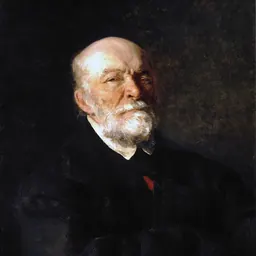
Alajos Hauszmann (also called as Alois, June 9, 1847 – July 31, 1926), from 1918 Hauszmann de Velencze, was a Hungarian architect, professor, and member of the Hungarian Academy of Sciences.
Life Hauszmann was born in Buda in 1847 into a family of Bavarian origin as the son of Ferenc Hauszmann and Anna Maár (siblings: Hermina (1845–1929), Ferenc (1850–1918) and Kornélia (1854–1837)). He studied painting from 1861, then became a bricklayer's apprentice. In 1864 he attended the Royal Joseph University, and in 1866 he continued architecture studies at the Bauakademie in Berlin, along with Ödön Lechner. 1868 Assistant Professor at the Royal Joseph University 1869–1870. Grand tour of Italy to study renaissance architecture 1872 Professor at the Royal Joseph University for the next 40 years 1874 Married Mariette Senior, whom he met in Berlin Designed barracks for the Red Cross, to be known as Hauszmann-barracks in Austria and Switzerland 1891 Named chief architect for Buda Castle in Budapest Received the Order of Franz Joseph, Grand Cross
Hauszmann employed several architects who later became prominent in their own right, including Albert Kálmán Kőrössy. In 1912 Hauszmann retired, and a year later he created a foundation for young architects graduating from the Royal Joseph University. In 1914 he went on an extended journey to Egypt and the Holy Land. In recognition of his work, he was ennobled by King Charles IV of Hungary with the suffix de Velencze on March 10, 1918. In the following year, his private home was confiscated during the Hungarian Soviet Republic. In 1924 he was elected an honorary member of the Hungarian Academy of Sciences. He died, aged 79, in Velence. He is buried in the Kerepesi Cemetery in Budapest.
Major works
Architecture and design
1870 German Theater, Budapest (destroyed by fire in 1890) 1870 Kiosk, Erzsébet tér, Budapest (destroyed) 1871–1872 Tüköry palace, Budapest (destroyed) 1874–1875 Coburg palace, Budapest (destroyed) 1876 Church of the Sacred Heart, Gyoma 1876–1878 Kégl mansion, Székesfehérvár 1877–1878 City Hall and theater, Szombathely (destroyed) 1878 Stefánia Yacht Club, Balatonfüred 1878–1879 Kégl palace, Budapest 1878–1880 St. Stephen Hospital, Budapest 1881–1883 Austro-Hungarian Bank, Szombathely 1882 Hungarian Parliament Building, Budapest (prize winning design, not built) 1882–1884 Erzsébet Hospital for the Red Cross, Budapest 1883–1884 Teachers' Training College, Budapest 1883–1884 Főreáliskola, Budapest 1884 Teachers' Training Institute, Budapest 1884 Scottish Abbey, Budapest (destroyed) 1884–1885 Nádasdy Mansion renovation and chapel, Nádasdladány 1884–1885 Batthyány palace, Budapest 1884–1886 Girls' Lyceum, Sopron 1884–1889 University Pathology Institute, Kolozsvár (today Cluj-Napoca) 1886 University Public Health Institute, Kolozsvár (today Cluj-Napoca) 1886 State Institute for Teaching Women, Budapest 1886–1887 Institute for Forensic Medicine, Budapest 1887–1889 Northeast Railroad Company apartment building, Budapest 1887–1889 Technical Training School and Museum, Budapest 1888–1890 Budapest Court House and Penitentiary, Budapest 1889–1890 commercial building, Budapest 1890 Kálmán Széll's mansion, Rátót 1890–1894 County hospital, Nitra 1891–1905 Buda Castle, Budapest, including the interiors 1891 Hauszmann house, Budapest 1890–1894 New York Palace, Budapest 1893 General Hospital, Kolozsvár (today Cluj-Napoca) 1893–1896 Royal Hungarian Palace of Justice, Budapest (Kúria, today: Ethnographic Museum) 1893–1897 Governor's Palace, Rijeka 1902–1909 Royal Joseph University, central building, Budapest 1904 City Hall, Nagyvárad (today Oradea) 1910 National Theater, Budapest (not built)
Publications A budapesti igazságügyi palota (Magy. Mérnök és Építész Egyl. Közl., 1897) A kir. József műegyetem új otthona (Magy. Mérnök és Építész Egyl. Közl., 1909) A magyar királyi vár (Budapest, 1912) Budapest városának építészeti fejlődésének története (Akad. Ért. 1925).
Don’t just read it —
keep it.
Full-length biographies made to live with: read them, listen on the way to work, watch them tonight.
- E-book
- Audio
- Video
Instant download · yours to keep · every purchase keeps this site free
Important facts
People in Alajos Hauszmann's life
Named in this biography and alive at the same time



Related people
Same field, nearest in time



Contemporaries
People whose lives overlapped Alajos Hauszmann's



Frequently asked questions
Who was Alajos Hauszmann?
architect (1847–1926)
When was Alajos Hauszmann born?
Alajos Hauszmann was born on 9 June 1847 in Buda.
When did Alajos Hauszmann die?
Alajos Hauszmann died on 31 July 1926 in Velence.
What was Alajos Hauszmann's occupation?
Alajos Hauszmann was an architect and university teacher.
What nationality was Alajos Hauszmann?
Alajos Hauszmann was Hungarian.
Sources & further reading
Cite this page
APA: Biography.guide. (2026). Alajos Hauszmann. https://biography.guide/alajos-hauszmann/
MLA: "Alajos Hauszmann." Biography.guide, https://biography.guide/alajos-hauszmann/.
Chicago: "Alajos Hauszmann." Biography.guide. https://biography.guide/alajos-hauszmann/.
Data last updated: 2026-09-20 · Spot an error? Report a correction.
Page generated 2026-09-27 05:30 UTC