
About Al Hirt
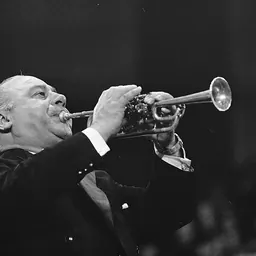
Lived 1922 – 1999 (aged 76). Al Hirt was an American trumpeter, bandleader, conductor, jazz musician, recording artist and musician.
Alois Maxwell "Al" Hirt (November 7, 1922 – April 27, 1999) was an American trumpeter and bandleader. Colin Escott, an author of musician biographies, wrote that RCA Victor, for which Hirt had recorded most of his best-selling recordings and for which he had spent most of his professional recording career, had simply dubbed him "The King." Hirt was inducted into The Louisiana Music Hall of Fame in November 2009. He received eight Grammy nominations during his lifetime, including winning the Grammy award in 1964 for his version of "Java".
Early life Hirt was born in New Orleans, Louisiana,
Hirt's Top 40 charted hit "Sugar Lips" in 1964 would be later used as the theme song for the NBC daytime game show Eye Guess, hosted by Bill Cullen and originally airing from January 1966 to September 1969. Hirt was chosen to record the frenetic theme for the 1960s TV show The Green Hornet, by famed arranger and composer Billy May. Based on Nikolai Rimsky-Korsakov's Flight of the Bumblebee from his opera The Tale of Tsar Saltan, it showcased Hirt's technical prowess. In 2003, the recording again gained public attention when it was featured in the film Kill Bill.
From the mid-1950s to early 1960s, Hirt and his band played nightly at Dan's Pier 600 at the corner of St. Louis and Bourbon Street. The nightclub was owned by his business manager, Dan Levy, Sr.
Hirt opened his own club, the Basin St. South, on Bourbon Street in the French Quarter, which existed from 1962 to 1983. He also became a minority owner in the NFL expansion New Orleans Saints in 1967.
In 1962, in an effort to showcase him in a different musical setting, Hirt was teamed with arranger and composer Billy May and RCA Victor producer Steve Sholes to record an album titled Horn a Plenty that was a departure from the Dixieland material that he was generally associated with. Covering an eclectic variety of popular, standard and show tunes, it featured a big-band supplemented by timpani, French horns and harp. He also appeared opposite Troy Donahue and Suzanne Pleshette in the 1962 motion picture, Rome Adventure.
In 1965, Hirt hosted the hour-long television variety series Fanfare, which aired Saturday nights on CBS as the summer replacement for Jackie Gleason and the American Scene Magazine.
Hirt starred along with Marguerite Piazza, Lionel Hampton, Doc Severinsen and the Southern University marching band at Super Bowl IV halftime show on January 11, 1970.
On February 8, 1970, while performing in a Mardi Gras parade in New Orleans, Hirt was injured while riding on a float. It was widely reported that he was struck in the mouth by a thrown brick or a piece of concrete and required 12 stitches to the underside of his upper lip. Factual documentation of the details of the incident is sparse, consisting primarily of claims made by Hirt after the incident although police reported that the 1970 Mardi Gras was one of the worst for trouble, with hundreds arrested for drunkenness and violence.
In 1987, Hirt played a solo rendition of "Ave Maria" for Pope John Paul II's visit to New Orleans. He is referred to in the 1987 film Good Morning, Vietnam, in a broadcast made by Lieutenant Hauk (Bruno Kirby).
Hirt died of liver failure at the age of 76, after having spent the previous year in a wheelchair due to edema in his leg. He was survived by his wife, Beverly Essel Hirt, and eight children from a previous marriage.
Discography
Singles
Albums
Don’t just read it —
keep it.
Full-length biographies made to live with: read them, listen on the way to work, watch them tonight.
- E-book
- Audio
- Video
Instant download · yours to keep · every purchase keeps this site free
Important facts
People in Al Hirt's life
Named in this biography and alive at the same time





Related people
Same field, nearest in time




Contemporaries
People whose lives overlapped Al Hirt's


Frequently asked questions
Who was Al Hirt?
American trumpeter and bandleader (1922–1999)
When was Al Hirt born?
Al Hirt was born on 7 November 1922 in New Orleans.
When did Al Hirt die?
Al Hirt died on 27 April 1999 in New Orleans.
What was Al Hirt's occupation?
Al Hirt was a trumpeter, bandleader, conductor, jazz musician, recording artist and musician.
What nationality was Al Hirt?
Al Hirt was American.
Sources & further reading
Cite this page
APA: Biography.guide. (2026). Al Hirt. https://biography.guide/al-hirt/
MLA: "Al Hirt." Biography.guide, https://biography.guide/al-hirt/.
Chicago: "Al Hirt." Biography.guide. https://biography.guide/al-hirt/.
Data last updated: 2026-09-20 · Spot an error? Report a correction.
Page generated 2026-09-27 05:29 UTC