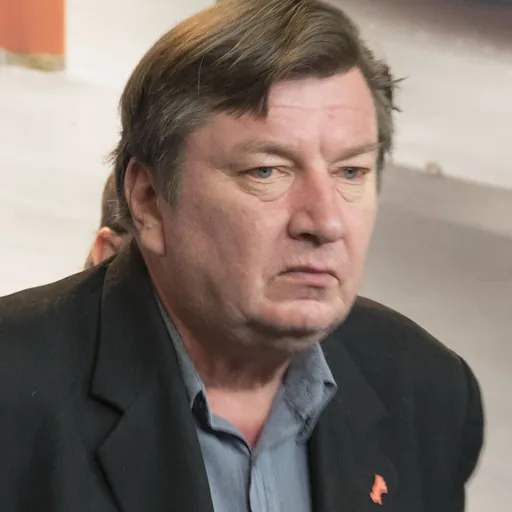
About Aki Kaurismäki
Born 1957. Aki Kaurismäki is a Finnish film director, film editor, actor, film producer, theatre director and film screenwriter.
Aki Olavi Kaurismäki (; born 4 April 1957) is a Finnish filmmaker. He is best known for films such as Leningrad Cowboys Go America, Drifting Clouds (1996), The Man Without a Past (2002), Le Havre (2011), The Other Side of Hope (2017), and Fallen Leaves (2023).
Early life Aki Olavi Kaurismäki was born in Orimattila on 4 April 1957. His older brother, Mika, is also a filmmaker. He grew up in Karkkila and graduated with a degree in media studies from the University of Tampere, but did not pursue a career in film immediately; he instead went to work as a bricklayer, dish washer, and postman. His first foray into the film world was as a critic.
Career Kaurismäki started his career as a co-writer and actor in films made by his brother Mika. He played the main role in Mika's film The Liar (1981). They co-founded the production company Villealfa Filmproductions and the Midnight Sun Film Festival.
Kaurismäki's directorial debut was Crime and Punishment (1983), an adaptation of the Dostoyevsky novel set in modern Helsinki. He gained worldwide attention with Leningrad Cowboys Go America (1989). In 1992, New York Times film critic Vincent Canby declared him "an original, one of cinema's most distinctive and idiosyncratic new artists, and possibly one of the most serious" and said he "could well turn out to be the seminal European filmmaker of the '90s". He has since gone to make films such as Leningrad Cowboys Go America (1989), Drifting Clouds (1996), The Man Without a Past (2002), Le Havre (2011), The Other Side of Hope (2017), and Fallen Leaves (2023). He has been described as Finland's most famous film director.
Style
Kaurismäki is known for his minimalistic style. He has been called an auteur as he usually writes, produces, and edits the films he has directed and thus introduces his personal "droll, deadpan" style.
In Kaurismäki's films, the camera is often still. Events are shown in a plain manner and characters are usually left alone facing the consequences. However, despite their tragedies and setbacks, they do not give up and eventually survive. In 2014, he called it "a devil's invention which destroys human culture as we know it, robs us of our jobs and makes us in the long run slaves". He softened his position later that year, stating, "In order to keep my humble film oeuvre accessible to a potential audience, I have ended up rendering [my work] to digital in all its present and several of its as-yet-unknown forms."
Kaurismäki has criticised Finland's strict immigration policy. When Iraqi refugees arrived in Finland, he said many people in the country "perceived that as an attack, like a war". He was alarmed by their reaction and decided to make a film, The Other Side of Hope, in an effort to "change the Finns' attitude". He later said of German chancellor Angela Merkel's open-door refugee policy, "I respect Mrs. Merkel. She is the only politician who seems to be at least interested in the problem." In a 2007 interview with film scholar Andrew Nestingen, he said, "The real disgrace here is Finland's refugee policy, which is shameful. We refuse refugee status on the flimsiest of grounds and send people back to 'secure' places like Darfur, Iraq, and Somalia. [We say] 'It's perfectly safe, go ahead.' Our policy is a stain among the Nordic nations. Shameful."
In December 2019, along with 42 other leading cultural figures, Kaurismäki signed an open letter endorsing the British Labour Party under Jeremy Corbyn's leadership in the 2019 general election. The letter stated that "Labour's election manifesto under Jeremy Corbyn's leadership offers a transformative plan that prioritises the needs of people and the planet over private profit and the vested interests of a few".
In May 2023, Kaurismäki spoke out against the potential entry of Finland into NATO. The letter demanded a ceasefire, an end to the killing of civilians, the establishment of a corridor into Gaza for humanitarian aid, and the release of hostages. In May 2025, Kaurismäki and over 350 other film industry figures signed an open letter criticizing the industry's passivity about the war in Gaza. Four months later, he joined numerous others in signing an open agreement with Film Workers for Palestine, pledging not to work with Israeli film institutions "that are implicated in genocide and apartheid against the Palestinian people".
Personal life
Kaurismäki and his wife Paula Oinonen have lived in Lisbon since 1989. He said they moved to Portugal because "in all of Helsinki there is no place left where [he] could place [his] camera", though he has since continued to set his films in Helsinki. His brother Mika also moved to Portugal with his Brazilian wife in the mid-2010s after nearly 30 years in Brazil, but they returned to Finland in 2019.
Kaurismäki co-owns a complex in Helsinki called Andorra, which features a cinema, several bars, and a pool hall with a giant poster of Robert Bresson's L'Argent and the jukebox from Leningrad Cowboys Meet Moses. In 2021, he opened a cinema called Kino Laika in his hometown of Karkkila, which was the subject of the documentary Cinéma Laika by Croatian-French director Veljko Vidak.
Filmography Feature films
Documentaries Year Title Director Writer Producer Notes 1981 The Saimaa GestureCo-directed with Mika Kaurismäki 1994 Total Balalaika Show 2013 Juice Leskinen & Grand Slam: Bluesia Pieksämäen asemalla Documentary short film
Short films
Music videos Year Title Director Writer Producer Editor1987 "Thru the Wire" "Rich Little Bitch" "L.A. Woman" 1992 "Those Were the Days" 1993 "These Boots" 1996 "Always Be a Human"
As actor The Liar (1981) The Worthless (1982) Huhtikuu on kuukausista julmin (1983) Apinan vuosi (1983) Viimeiset rotanrahat (1985) Calamari Union (1985) Ylösnousemus (1985) Shadows in Paradise (1986) Rocky VI (1986) I Hired a Contract Killer (1990) Shit Happens (1992) Leningrad Cowboys Meet Moses (1994) Iron Horsemen (1994) Mustasilmä-Susanna ja lepakkoluolan aarre (1996) Aaltra (2004) Vandaleyne (2015)
Awards and protests Kaurismäki's film Ariel (1988) was entered into the 16th Moscow International Film Festival where it won the Prix FIPRESCI.
Kaurismäki's most acclaimed film has been The Man Without a Past, which won the Grand Prix and the Prize of the Ecumenical Jury at the 2002 Cannes Film Festival and was nominated for an Academy Award in the Best Foreign Language Film category in 2003. However, Kaurismäki refused to attend the Oscar ceremony, asserting that he did not feel like partying in a country that was in a state of war. Kaurismäki's next film Lights in the Dusk was also chosen to be Finland's nominee for best foreign-language film, but Kaurismäki again boycotted the awards and refused the nomination, as a protest against U.S. President George W. Bush's foreign policy. In 2002 Kaurismäki also boycotted the 40th New York Film Festival in a show of solidarity with the Iranian director Abbas Kiarostami, who was not given a US visa in time for the festival.
Kaurismäki's 2017 film The Other Side of Hope won the Silver Bear for Best Director award at the 67th Berlin International Film Festival. At the same festival he also announced that it would be his last film as a director, although the retirement was short-lived as he began filming another film, Fallen Leaves, which premiered at the 2023 Cannes Film Festival. Kaurismäki became the second director, after Paul Thomas Anderson, to win his third FIPRESCI Grand Prix.
List of awards
Don’t just read it —
keep it.
Full-length biographies made to live with: read them, listen on the way to work, watch them tonight.
- E-book
- Audio
- Video
Instant download · yours to keep · every purchase keeps this site free
Important facts
People in Aki Kaurismäki's life
Named in this biography and alive at the same time


Related people
Same field, nearest in time


Contemporaries
People whose lives overlapped Aki Kaurismäki's

Frequently asked questions
Who is Aki Kaurismäki?
Finnish film director (born 1957)
When was Aki Kaurismäki born?
Aki Kaurismäki was born on 4 April 1957 in Orimattila.
What is Aki Kaurismäki's occupation?
Aki Kaurismäki is a film director, film editor, actor, film producer, theatre director and film screenwriter.
What nationality is Aki Kaurismäki?
Aki Kaurismäki is Finnish.
Sources & further reading
Cite this page
APA: Biography.guide. (2026). Aki Kaurismäki. https://biography.guide/aki-kaurismaki/
MLA: "Aki Kaurismäki." Biography.guide, https://biography.guide/aki-kaurismaki/.
Chicago: "Aki Kaurismäki." Biography.guide. https://biography.guide/aki-kaurismaki/.
Data last updated: 2026-09-23 · Spot an error? Report a correction.
Portrait: Wikimedia Commons · author & licence
Page generated 2026-09-27 05:05 UTC