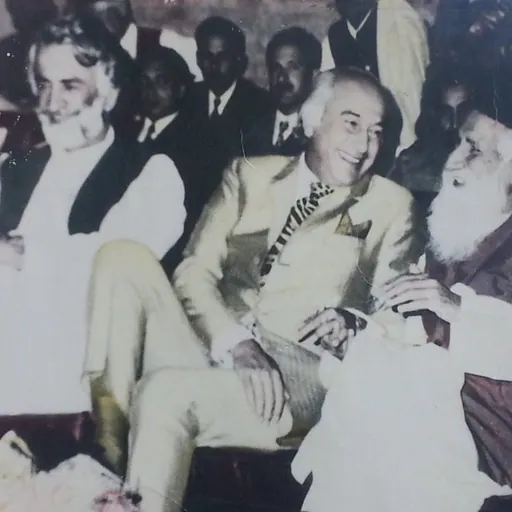
About Akbar Bugti
Lived 1926 – 2006 (aged 80). Akbar Bugti was a Pakistani and Indian politician.
Akbar Shahbaz Khan Bugti (Urdu: ; 12 July 1926 – 26 August 2006) was a Pakistani politician and the tumandar (tribal chief) of the Bugti tribe of Baloch people. Over a career spanning nearly five decades, he held several senior offices in Pakistan, including Minister of State for Defence in the cabinet of Prime Minister Feroz Khan Noon, Governor of Balochistan from 1973 to 1974, and Chief Minister of Balochistan from 1989 to 1990. He founded and led the Jamhoori Watan Party (JWP) from 1989 until his death.
In his later years, Bugti came into armed conflict with the government of President Pervez Musharraf over the political and economic status of Balochistan. He was killed on 26 August 2006 during a military operation in Kohlu district. In July 2012, an Anti-Terrorism Court issued arrest warrants for Musharraf and other senior officials in connection with the killing.
Early life and education
Akbar Shahbaz Khan Bugti was born on 12 July 1926 in Barkhan, in what was then the Chief Commissioner's Province of Balochistan under British rule. He was the son of Nawab Mehrab Khan Bugti, chief of the Bugti tribe, and the grandson of Sir Shahbaz Khan Bugti. He received his early education at Karachi Grammar School and subsequently at Aitchison College in Lahore. Following his father's death, he succeeded as tumandar of the Bugti tribe.
As governor, Bugti did not oppose the military deployment in the province, a position that drew criticism from Baloch nationalist figures. President Musharraf subsequently stated on national television that the accused officer was not guilty, a statement that drew public criticism and contributed to an escalation of tensions in Balochistan. A ceasefire was subsequently reached but broke down without a political settlement. The allegation was not independently verified at the time of reporting.
Death
Military operation
On 26 August 2006, Akbar Bugti was killed near Kohlu, approximately 150 miles east of Quetta. Pakistani authorities reported that 21 soldiers and approximately 60 militia members were killed in the operation.
Inter-Services Public Relations (ISPR) stated that soldiers discovered a cave in the mountains near Dera Bugti and entered it to apprehend Bugti. According to the ISPR, a blast of undetermined origin caused the cave to collapse, killing all those inside, including the soldiers. The ISPR director general stated that no fighting or prior use of explosives preceded the collapse. The Pakistan military invited media representatives to the site after the operation.
Competing accounts
Brahumdagh Bugti, a grandson of Akbar Bugti, alleged that Balach Marri, then associated with the Baloch Liberation Army, was responsible for the cave collapse, claiming that a remote-controlled device caused the blast and that Marri was present outside the cave at the time. No independent investigation corroborated this account.
Aftermath
Burial
Bugti was buried on 1 September 2006 in Dera Bugti, with a sealed coffin, next to the graves of his son and brother. His family, who had sought a public funeral in Quetta, did not attend.
Investigation and prosecution
In September 2010, Abdul Qayyum Khan Jatoi, a senior federal minister, publicly accused the army of involvement in Bugti's killing. He resigned from his ministerial post after his party asked him to account for his remarks.
On 11 July 2012, an anti-terrorism court in Sibi, Balochistan, issued arrest warrants for former military ruler Pervez Musharraf and several other senior officials in connection with Bugti's killing.
Personal life
Akbar Bugti had three wives and was the father of thirteen children, including six sons and seven daughters. His sons included Talal Bugti, Saleem Bugti, Rehan Bugti, Salal Bugti, Jameel Bugti, and Shahzwar Bugti. His grandchildren include Brahumdagh Bugti and Shahzain Bugti.
Assessments
Assessments of Bugti's political significance have varied. A 2006 analysis published by the Institute of Peace and Conflict Studies noted that Bugti was not primarily a Baloch nationalist ideologue in the manner of Khair Bakhsh Marri or Ataullah Mengal, and that his actions throughout much of his career reflected the interests of his tribe more than a broader nationalist programme.
Al Jazeera reported in 2006 that to Pakistani military rulers and political rivals in Balochistan, Bugti was characterised as a feudal lord who prevented development from reaching ordinary tribespeople and who maintained a state-within-a-state, with private courts financed through gas field revenues. To members of the Bugti tribe and Baloch nationalists, he was described as a defender of the province against exploitation by federal authorities. Dawn described him at the time of his death as "maligned, but widely respected."
Don’t just read it —
keep it.
Full-length biographies made to live with: read them, listen on the way to work, watch them tonight.
- E-book
- Audio
- Video
Instant download · yours to keep · every purchase keeps this site free
Important facts
Family & relationships
People in Akbar Bugti's life
Named in this biography and alive at the same time





Related people
Same field, nearest in time



Contemporaries
People whose lives overlapped Akbar Bugti's


Frequently asked questions
Who was Akbar Bugti?
Baloch politician (1926-2006)
When was Akbar Bugti born?
Akbar Bugti was born on 12 July 1926 in Barkhan.
When did Akbar Bugti die?
Akbar Bugti died on 26 August 2006 in Kohlu Tehsil.
What was Akbar Bugti's occupation?
Akbar Bugti was a politician.
What nationality was Akbar Bugti?
Akbar Bugti was Pakistani and Indian.
Sources & further reading
Cite this page
APA: Biography.guide. (2026). Akbar Bugti. https://biography.guide/akbar-bugti/
MLA: "Akbar Bugti." Biography.guide, https://biography.guide/akbar-bugti/.
Chicago: "Akbar Bugti." Biography.guide. https://biography.guide/akbar-bugti/.
Data last updated: 2026-09-23 · Spot an error? Report a correction.
Portrait: Wikimedia Commons · author & licence
Page generated 2026-09-27 05:07 UTC