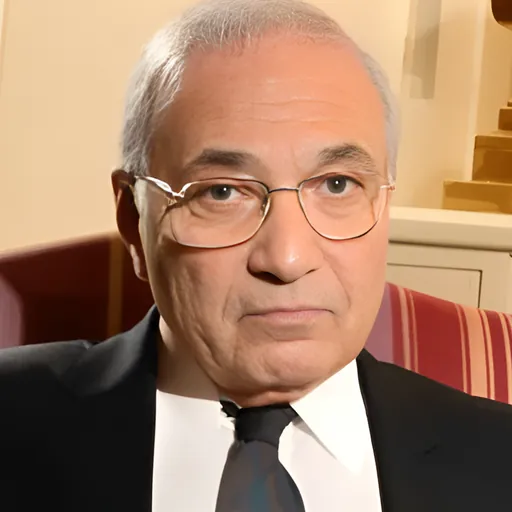
About Ahmed Shafik
Born 1941. Ahmed Shafik is an Egyptian politician, military personnel, fighter pilot, aircraft pilot and military officer.
Early life and education Shafik was born in the Heliopolis district of Cairo on 25 November 1941. His parents were prominent members of Egyptian society, with his father, Mohamed Shafiq Zaki, serving as undersecretary at the ministry of irrigation and his mother, Naja Alwi, being the daughter of a noted ophthalmologist. After completing his schooling at the Heliopolis Secondary School, he attended the Egyptian Air Academy from where he graduated in 1962 at the age of 21 and became a member of the Egyptian Air Force (EAF). Later in his career, he gained a master's degree in military science; a Fellowship of High War College from Nasser Military Academy; a Fellowship of Combined Arms from the High War College in Paris; a Fellowship of the National Defense College from Nasser Military Academy; and a PhD in "The National Strategy of Outer-Space". Air Marshal Ahmed Shafik received the highest medals and merits during his service.
Military career As a young officer, Shafik served as a Mig-19 and Mig-21 fighter pilot and was later appointed as fighter air squadron commander. During the War of Attrition (1967–1970), Shafik saw active service as the Multi-Task Airwing Commander. Subsequently, he took up a post as an air base commander.
During his 40 years of service in the Egyptian Air Force as a fighter pilot, he flew several types of fighter jets including the Mikoyan-Gurevich MiG-17, Mikoyan-Gurevich MiG-19, Mikoyan-Gurevich MiG-21 and the Dassault Mirage 2000; he also acted as the wing commander for the Egyptian Air Force acrobatic team. He is also fully qualified on the American-built McDonnell Douglas F-4 Phantom II and the General Dynamics F-16 Fighting Falcon. Whilst he was the minister for civil aviation, he oversaw improvements in EgyptAir and helped construct a new third terminal at Cairo International Airport which was completed in 2008 and opened for commercial operations on 27 April 2009. He continued the position until succeeding Ahmed Nazif as the Prime Minister of Egypt on 29 January 2011.
During the course of the Egyptian Revolution of 2011, Shafik was named prime minister by then president Hosni Mubarak on 29 January 2011. Shafik's period in office as prime minister was short-lived, lasting just over a month, after he resigned on 3 March due to pressure from protestors and the opposition. They had objected to Shafik staying on as PM, having been seen as one of Mubarak's old guard. Shafik was alleged to have been a member of the Supreme Council of the Armed Forces that took over power after Mubarak's departure on 11 February 2011, although initial reporting only reflected a poor understanding of the makeup of the SCAF immediately following Mubarak's fall. Shafik was succeeded by Essam Sharaf after he stepped down.
Shafik resigned from office one day after a contentious interview on the Egyptian ONTV satellite network in which he was confronted by Alaa Al Aswany, author of The Yacoubian Building, on Reem Maged's talk show Baladna bel Masry. Al Aswany was highly critical of Shafik during the broadcast, representing one of the first televised public criticisms of a high-ranking government official in Egyptian history. At one point, Al Aswany said about Shafik, "if your son had been one of those who got run over by the police cars, you would not have remained silent like that." Al Aswany furthermore accused Shafik of being a holdover of the regime that Egyptians had struggled to topple, and that he was unfit to represent Egyptians in the post-revolution era.
On 10 July, Shafik made his first public appearance since resigning as prime minister. He attended the graduation ceremony of the Egyptian Air Force Academy class along with the Chief of Staff of the Egyptian Armed Forces. At one campaign event, a protester hurled shoes at him, although Shafik was not struck. Shafik's candidacy was noted as supported by many in Egypt's Coptic Christian minority who are opposed to Islamist candidates in the election.
Along with the Muslim Brotherhood's Freedom and Justice Party candidate Mohamed Morsi, Shafik was one of two candidates who survived the first round of voting on 23–24 May, coming in behind Morsi. The second and final round of voting was held on 16–17 June 2012. Allegations have arisen that the interior ministry handed out over 900,000 ID cards to Egyptian soldiers so that they could vote for Shafik, which would be a major campaign violation. Fellow presidential candidate Hamdeen Sabahi, who finished in third place in the first round of voting, asked for the Egyptian election to be temporarily suspended until an investigation could be carried out.
On 28 May 2012, protesters angry at Shafik's advancement to the second round of voting set fire to an office associated with his campaign in Cairo. Fellow candidate Khaled Ali said while participating in a protest against the election results in Tahrir Square that Tahrir had "toppled Mubarak, and would topple Shafik". The election contest between Shafik and Morsi had been described as a "choice between two of Egypt's most polarizing politicians", and some activists resorted to participation in a hunger strike to protest his candidacy.
Shafik's presidential campaign was characterized by an emphasis on public order and security, and although the ruling Supreme Council of the Armed Forces did not endorse a candidate, American news outlet McClatchy Newspapers pointed to the "conspicuous presence of sympathetic security forces at his campaign stops" as evidence of his close relationship with the military.
Although preliminary election results indicated that the Muslim Brotherhood's candidate Mohamed Morsi won the second round of elections by a slight margin, the results remained within the margin of error and the Supreme Council of the Armed Forces, with Shafik claiming victory in the election. Protesters tearing a campaign billboard of Shafik after the election results were announced. On 24 June, the High Presidential Electoral Commission, headed by Farouk Sultan, announced Shafik's narrow defeat by his bitter rival Morsi, with 48.27% of the vote for the former, compared to Morsi's 51.73%.
In the hours following his defeat, it was widely reported that Shafik and his family flew out to Abu Dhabi, wary of potential charges of financial irregularities and electoral fraud, a move he later confirmed on Sky News.
Shafik alleged that the election was flawed; Public Prosecutor Abdel Meguid Mahmoud called for an investigation into the claims. In August 2013, former Israeli negotiator Yossi Beilin stated that an Egyptian official had told him that the true results of the election were in favor of Shafik, but the military gave the presidency to Morsi out of fear of unrest.
Launch of new political party Shafik announced that he would launch a new political party, called the Egyptian National Movement, on 24 September 2012.
On 7 January 2018, Shafik withdrew his candidacy. The New York Times published an article in which it confirmed that Shafik's withdrawal was based on threats made by the Egyptian government with old corruption charges and an alleged sex tape. The New York Times confirmed having audio recordings from an officer in one of the Egyptian security services, Ashraf al-Kholi, instructing a number of media professionals to put pressure on public opinion on the former candidate and head of the air force in order to force him to withdraw from the presidential race.
These audio leaks, broadcast simultaneously by Al Jazeera and the opposition channel Mekameleen on its program "Egypt Today" with journalist Mohamed Nasser on Monday, January 8, 2018, featuring Mofeed Fawzy, Saeed Hassasein, Azmi Megahed, and others, corroborated the New York Times' claims and fueled a wave of anger against a number of artists and media figures on social media.
Don’t just read it —
keep it.
Full-length biographies made to live with: read them, listen on the way to work, watch them tonight.
- E-book
- Audio
- Video
Instant download · yours to keep · every purchase keeps this site free
Important facts
People in Ahmed Shafik's life
Named in this biography and alive at the same time



Related people
Same field, nearest in time





Contemporaries
People whose lives overlapped Ahmed Shafik's


Frequently asked questions
Who is Ahmed Shafik?
former Prime Minister of Egypt
When was Ahmed Shafik born?
Ahmed Shafik was born on 25 November 1941 in Cairo.
What is Ahmed Shafik's occupation?
Ahmed Shafik is a politician, military personnel, fighter pilot, aircraft pilot and military officer.
What nationality is Ahmed Shafik?
Ahmed Shafik is Egyptian.
Sources & further reading
Cite this page
APA: Biography.guide. (2026). Ahmed Shafik. https://biography.guide/ahmed-shafik/
MLA: "Ahmed Shafik." Biography.guide, https://biography.guide/ahmed-shafik/.
Chicago: "Ahmed Shafik." Biography.guide. https://biography.guide/ahmed-shafik/.
Data last updated: 2026-09-20 · Spot an error? Report a correction.
Page generated 2026-09-27 05:09 UTC