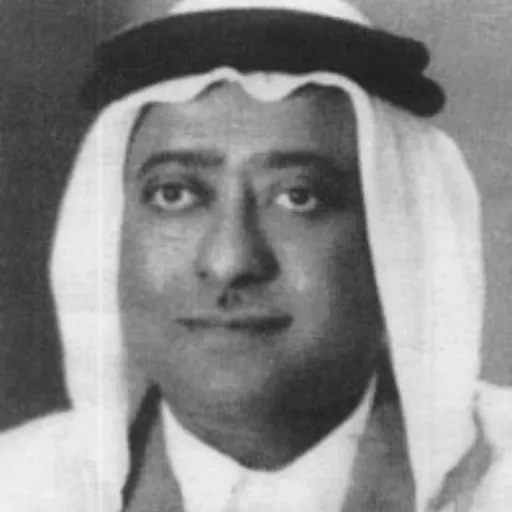
About Ahmad Abd al-Ghafur Attar
Lived 1916 – 1991 (aged 74). Ahmad Abd al-Ghafur Attar was a Saudi writer, journalist, essayist, translator and poet.
Ahmad Abd al-Ghafur Attar (; 11 October 1916 – 1 February 1991) was a Saudi Arabian writer, journalist and poet, best known for his works about 20th-century Islamic challenges. Born in Mecca, capital city of Hejazi Hashemite Kingdom. He received a basic education and graduated from the Saudi Scientific Institute in 1937, took a scholarship for higher studies in Cairo University, then returned to his country and worked in some government offices before devoting himself to literature and research. Attar wrote many works about Arabic linguistic and Islamic studies, and gained fame as a Muslim apologist, anti-communist and anti-Zionist, he who believed in flexibility of Islamic jurisprudence for the modern era. Praised by Abbas Mahmoud al-Aqqad, he was also noted for his defense of Modern Standard Arabic against colloquial or spoken Arabic. In the 1960s, he established the famous Okaz newspaper and then the Kalimat al-Haqq magazine, which lasted only about eight months. He died at the age of 74 in Jeddah.
Biography
Early years Attar, when he was a student at Dar Al Uloom School in Cairo, 1937. His nasab is Ahmad bin Abd al-Ghafoor bin Muhammad Noor bin Bakku Attar, belongs to a family of Bengali descent who migrated from Bengal to Hejaz in the mid-19th century and settled in Mecca. He was born in 14 Dhul-Hijjah 1334/ 11 October 1916 in the neighborhood of Jabal al-Kaaba of Mecca, capital city of the Hejazi Hashemite Kingdom, and raised in the Misfalah neighborhood. His father, a Hanafi Sunni Muslim scholar, worked in the trade of perfumes, silk textiles, and turbans, He was also studied Qur'an and the Sunnah, and his mother taught him the alphabets and writing. As a child, he attended regular schools, Al-Fayizin School, then Al-Falah School, from which he moved to Al-Masaa' School. He learned Hanafi jurisprudence from his father. He also studied some of his religious sciences and Quran reading in the Al-Masjid an-Nabawi in 1926, as his parents traveled to Medina that year. He obtained his high school diploma from the Saudi Scientific Institute in Mecca in 1936. In the next year sent by then the Saudi government to the Dar Al Uloom School in Cairo, Kingdom of Egypt. He spent one year there, during which he combined Dar Al Uloom classes and listening at the Faculty of Arts in the Fouad I University. But special family circumstances forced him to drop out of higher education in these two institutes, and he was forced to return to Saudi Arabia. Continued his studies as an autodidact by extensive reading in Arabic literature, language, philosophy, religion and various knowledges.
Ahmad Attar worked in the Saudi Public Security as Inspector for three years, then switched from his employee career to devote himself to journalism and writing. In 1949, he published the newspaper Al-Bayan.
He established a newspaper titled Okaz, the first issue of which was published on 28 April 1960, and became its editor-in-chief. In 1964, he founded the Okaz Organization for press and publication. He published in Okaz many of his articles, as well as issued from Mecca a magazine called Kalimat al-Haqq, which ceased publication after four issues of it he suspended it due to financial circumstances. As a journalist, he is one of the pioneers of the Saudi press and has participated in the development of essays of Saudi prose literature. The topics of his articles and essays varied between criticism, literature, language, sociology and religion, has published in many Saudi newspapers and magazines, except for Okaz. Okaz continued to be published until the dissolution of the system of press institutions in Saudi Arabia in 1963, from the ownership of individuals to the ownership of institutions; Okaz joined to an institution bearing the same name. He wrote numerous critical articles in the newspapers Umm Al-Qura, Sawt Al-Hijaz, Al-Manhal and Al-Bilad in which he expressed his views clearly; he defended "authentic" Arabic poetry, criticized the "free" poetry movement, and participated in some literary feuds of the time. His articles were published in collections: Al-Maqalat (1947), Al-Bayan (1949) and Kalam fi Al-Adab (1964). He was also appointed as an advisor to the royal court.
Attar also developed strong interpersonal relationships with some of the writers of his time, especially the Egyptians. He participated with Muhammad Abd al-Salam Harun in his classical linguistic research. In the last period of his writing career, his literary works dwindled, and he engaged in research in the fields of language, history and religion, which inspired some of his books. His linguistic output included research in confronting the advocates of "colloquial Arabic" and defending the supremacy of "Fusha" Arabic. However, his strongest relationship was with another Egyptian writer, Abbas Mahmoud al-Aqqad.
Political interests Attar wrote many anti-communism and anti-Zionism works and he is considered one of the most famous Saudi critical-political writers of the 20th century. According to his biographer , Attar had prominent tendencies to the Muslim Brotherhood (Ikhwan) of Egypt. Kutubi stated in May 2015 that Attar had a "great, sensitive, and influential role" in spreading the Ikhwan's ideology in Saudi Arabia, and was a friend of Sayyid Qutb: "Al-Attar is the only Saudi – as far as I know – who has been in the international organization of the Brotherhood, and a non-permanent member of the Irshad Office since the fifties. He used to meet – Sayyid Qutb in Cairo a lot, and Hassan al-Banna, and the others who came after him, and he had wonderful intellectual and cultural positions with them, by support of King Faisal."
Personal life He was married to Muzayyin Haqqi, another writer. In March 2011, a thought-gathering was held in Jeddah for his honor whose participants were his granddaughters.
He had a big private library containing over 25,000 volumes, which by his will moved to the Library of the Grand Mosque of Mecca in 1987.
Death He suffered a stroke in his old age. After that, he lived with a long treatment, became blind and weak-walking. A street was named after him in the city of Riyadh, Ar Ruwaidhah 19976.
Honors and awards He was honored by Syrian and Iraqi Academy of Sciences. He has been awarded by: 1984: State Appreciation Award in Literature. He donated the prize of the award to the Afghan mujahideen in the same year. Saudi Medal of Merit
Works He wrote many books, including:
Don’t just read it —
keep it.
Full-length biographies made to live with: read them, listen on the way to work, watch them tonight.
- E-book
- Audio
- Video
Instant download · yours to keep · every purchase keeps this site free
Important facts
more
Ahmad AttarPeople in Ahmad Abd al-Ghafur Attar's life
Named in this biography and alive at the same time



Related people
Same field, nearest in time



Contemporaries
People whose lives overlapped Ahmad Abd al-Ghafur Attar's





Frequently asked questions
Who was Ahmad Abd al-Ghafur Attar?
Saudi Arabian writer and journalist
When was Ahmad Abd al-Ghafur Attar born?
Ahmad Abd al-Ghafur Attar was born on 11 October 1916 in Mecca.
When did Ahmad Abd al-Ghafur Attar die?
Ahmad Abd al-Ghafur Attar died on 1 February 1991 in Jeddah.
What was Ahmad Abd al-Ghafur Attar's occupation?
Ahmad Abd al-Ghafur Attar was a writer, journalist, essayist, translator and poet.
What nationality was Ahmad Abd al-Ghafur Attar?
Ahmad Abd al-Ghafur Attar was Saudi.
Sources & further reading
· Wikipedia: Ahmad Abd al-Ghafur Attar
· DBpedia: Ahmad Abd al-Ghafur Attar
Cite this page
APA: Biography.guide. (2026). Ahmad Abd al-Ghafur Attar. https://biography.guide/ahmad-abd-al-ghafur-attar/
MLA: "Ahmad Abd al-Ghafur Attar." Biography.guide, https://biography.guide/ahmad-abd-al-ghafur-attar/.
Chicago: "Ahmad Abd al-Ghafur Attar." Biography.guide. https://biography.guide/ahmad-abd-al-ghafur-attar/.
Data last updated: 2026-09-20 · Spot an error? Report a correction.
Portrait: Wikimedia Commons · author & licence
Page generated 2026-09-27 04:58 UTC