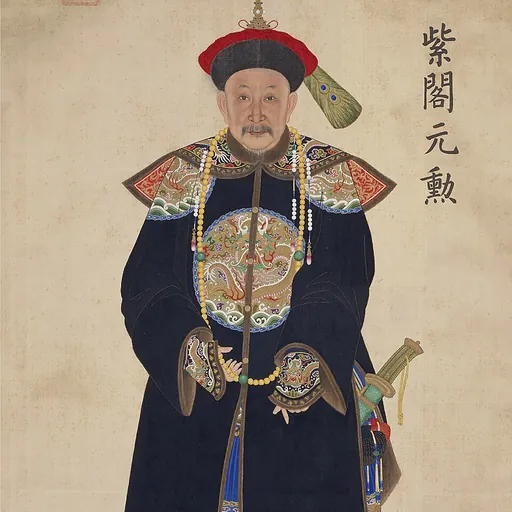
About Agui
Lived 1717 – 1797 (aged 80). Agui was a Chinese military personnel and politician.
Agui (; ; September 7, 1717 – October 10, 1797) was a Manchu noble general for the Qing dynasty. As the only son of Akdun, he was a scion of a noble family who led a number of important Manchu military operations, including several of the "Ten Great Campaigns".
Sino-Burmese War On April14, 1768, Fuheng was appointed military commissioner (Jinglue) and Agui and Aligun, both Manchus, were appointed deputies. This occurred due to the death of the previous commander Ming Rui. Agui had already proven himself in Chinese Turkestan, as a competent commander. The main push occurs in December at the height of the disease period and the Chinese suffer great losses to disease. Confusion surrounds the following events. Some sources say that the Myanmar nation initiated peace talks and others say the Chinese did; however it happened, by December 1769 peace negotiations had started, and on December22 the treaty was signed. However, both Agui and Fuheng were absent. The chief negotiator for the Chinese was Ha Guoxing. Documents from this era seem to support the fact that the only reason the Chinese agreed to a treaty was through the leadership of Agui and other generals, as Fuheng was vehemently opposed to a peace treaty. When the treaty was brought from the Myanmar king to Fuheng to be signed, he refused. Agui, after allying other powerful generals on his side, confronted Fuheng again. Fuheng demanded that all those allied against him and for peace, sign a statement (ganjie) to that effect. When they all did, he grew furious and threatened impeachment. This did not occur as he was getting sicker each day. At this time a decree was received from Qianlong, demanding a complete withdrawal regardless of the circumstances. This withdrawal, may also have been attributed to Agui, as he was the one responsible for letting the emperor know of the illness affecting Fuheng. Agui took charge of the troops during the withdrawal as Fuheng was worsening.
When all was said and done, Agui took the majority of the emperor's wrath as Fuheng was on his deathbed. The emperor in acknowledging the retreat and defeat at the hands of the Myanmar, stated that it made the Myanmar look down upon our celestial dynasty. He also blamed Agui and others for not stopping Fuheng from the foolhardy decision to invade Myanmar if they knew that it would fail. The Jinchuan uprising could not come at a better time for Agui, who would alter drastically, the emperor's opinion of him after his coming victories. Agui thought so negatively of his time in Myanmar that he had all correspondence and writings concerning this time destroyed upon his death. called the second Battle of the Jinchuan. This battle took place from 1771 until 1776. During this battle, Agui expressed the importance in shangyun which was the policy of utilizing merchants in keeping the military stocked.
In 1781, Agui went to Lanzhou, in the northwestern Gansu province, to lead the suppression of the Jahriyya revolt by the Salar adherents of the Jahriyya Sufi order. along with Heshen, Li Shiyao and Fuk'anggan.
Agui also led campaigns to unify the Yili area and Taiwan island (1786-1787) within the Chinese state.
He served as a minister to the emperor and a member of the Grand Council and Grand Secretariat (both administrative cabinets of the Chinese government) until his death.
Agui's grandson was Na-yen-ch'êng who served as an official in Xinjiang after the Afaqi Khoja revolts.
Footnotes
Don’t just read it —
keep it.
Full-length biographies made to live with: read them, listen on the way to work, watch them tonight.
- E-book
- Audio
- Video
Instant download · yours to keep · every purchase keeps this site free
Important facts
Related people
Same field, nearest in time




Contemporaries
People whose lives overlapped Agui's





Frequently asked questions
Who was Agui?
Qing Dynasty general (1717-1797)
When was Agui born?
Agui was born on 7 September 1717 in Qing dynasty.
When did Agui die?
Agui died on 10 October 1797 in Beijing.
What was Agui's occupation?
Agui was a military personnel and politician.
What nationality was Agui?
Agui was Chinese.
Sources & further reading
Cite this page
APA: Biography.guide. (2026). Agui. https://biography.guide/agui/
MLA: "Agui." Biography.guide, https://biography.guide/agui/.
Chicago: "Agui." Biography.guide. https://biography.guide/agui/.
Data last updated: 2026-09-21 · Spot an error? Report a correction.
Portrait: Wikimedia Commons · author & licence
Page generated 2026-09-27 04:59 UTC