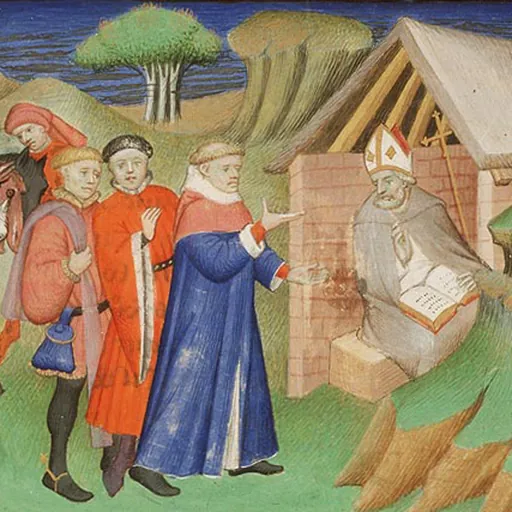
About Ælfheah of Canterbury
Lived 954 – 1012 (aged 57–58). Ælfheah of Canterbury was a catholic priest, anchorite, bishop and archbishop.
Ælfheah (Officially remembered as Saint Alphege within some churches, or Godwine.) and became a monk early in life. The 12th-century chronicler, William of Malmesbury recorded that Ælfheah was a monk and prior at Glastonbury Abbey, but this is not accepted by all historians. and was consecrated on 19 October that year. and promoted the cult of Swithun and his predecessor, Æthelwold of Winchester.
Following a Viking raid in 994, a peace treaty was agreed with one of the raiders, Olaf Tryggvason. Besides receiving danegeld, Olaf converted to Christianity and undertook never to raid or fight the English again. Ælfheah may have played a part in the treaty negotiations, and it is certain that he confirmed Olaf in his new faith.
In 1006, Ælfheah succeeded Ælfric as Archbishop of Canterbury, probably consecrated on 16 November. taking Swithun's head with him as a relic for the new location. While at Canterbury, he promoted the cult of Dunstan, He also introduced new practices into the liturgy, and was instrumental in the Witenagemot's recognition of Wulfsige of Sherborne as a saint in about 1012.
Ælfheah sent Ælfric of Eynsham to Cerne Abbey to take charge of its monastic school. He was present at the council of May 1008 at which Wulfstan II, Archbishop of York, preached his Sermo Lupi ad Anglos (The Sermon of the Wolf to the English), castigating the English for their moral failings and blaming the latter for the tribulations afflicting the country.
In 1011, the Danes again raided England, and from 8–29 September, they laid siege to Canterbury. Aided by the treachery of Ælfmaer, whose life Ælfheah had once saved, the raiders succeeded in sacking the city.
Ælfheah was the first Archbishop of Canterbury to die a violent death. A contemporary report tells that Thorkell the Tall attempted to save Ælfheah from the mob about to kill him by offering everything he owned except for his ship, in exchange for Ælfheah's life; Thorkell's presence is not mentioned in the Anglo-Saxon Chronicle, however. Some sources record that the final blow, with the back of an axe, was delivered as an act of kindness by a Christian convert known as "Thrum". Ælfheah was buried in Old St Paul's Cathedral. Thorkell the Tall was appalled at the brutality of his fellow raiders, and switched sides to the English king Æthelred the Unready following Ælfheah's death.
Veneration An 1868 statue on the West Front of Salisbury Cathedral by James Redfern, showing Ælfheah holding the stones used in his martyrdom. Pope Gregory VII canonised Ælfheah in 1078, with a feast day of 19 April. Lanfranc, the first post-Conquest archbishop, was dubious about some of the saints venerated at Canterbury. He was persuaded of Ælfheah's sanctity, but Ælfheah and Augustine of Canterbury were the only pre-conquest Anglo-Saxon archbishops kept on Canterbury's calendar of saints. Ælfheah's shrine, which had become neglected, was rebuilt and expanded in the early 12th century under Anselm of Canterbury, who was instrumental in retaining Ælfheah's name in the church calendar. After the 1174 fire in Canterbury Cathedral, Ælfheah's remains, together with those of Dunstan were placed around the high altar, at which Thomas Becket is said to have commended his life into Ælfheah's care shortly before his martyrdom during the Becket controversy. and was north of the high altar, sharing the honour with Dunstan's shrine, which was located south of the high altar. A Life of Saint Ælfheah in prose and verse was written by a Canterbury monk named Osbern, at Lanfranc's request. The prose version has survived, but the Life is very much a hagiography; many of the stories it contains have obvious Biblical parallels, making them suspect as a historical record. Few church dedications to him are known, with most of them occurring in Kent and one each in London and Winchester; In the town of Solihull in the West Midlands, St Alphege Church is dedicated to Ælfheah dating back to approximately 1277. In 1929, a new Roman Catholic church in Bath, the Church of Our Lady & St Alphege, was designed by Giles Gilbert Scott in homage to the ancient Roman church of Santa Maria in Cosmedin, and dedicated to Ælfheah under the name of Alphege.
Artistic representations of Ælfheah often depict him holding a pile of stones in his chasuble, a reference to his martyrdom.
Don’t just read it —
keep it.
Full-length biographies made to live with: read them, listen on the way to work, watch them tonight.
- E-book
- Audio
- Video
Instant download · yours to keep · every purchase keeps this site free
Important facts
People in Ælfheah of Canterbury's life
Named in this biography and alive at the same time


Related people
Same field, nearest in time

Contemporaries
People whose lives overlapped Ælfheah of Canterbury's
Frequently asked questions
Who was Ælfheah of Canterbury?
Archbishop of Canterbury and saint (c.953-1012)
When was Ælfheah of Canterbury born?
Ælfheah of Canterbury was born in 954 in Weston.
When did Ælfheah of Canterbury die?
Ælfheah of Canterbury died on 19 April 1012 in Greenwich.
What was Ælfheah of Canterbury's occupation?
Ælfheah of Canterbury was a catholic priest, anchorite, bishop and archbishop.
Sources & further reading
· Wikipedia: Ælfheah of Canterbury
· DBpedia: Ælfheah of Canterbury
Cite this page
APA: Biography.guide. (2026). Ælfheah of Canterbury. https://biography.guide/aelfheah-of-canterbury/
MLA: "Ælfheah of Canterbury." Biography.guide, https://biography.guide/aelfheah-of-canterbury/.
Chicago: "Ælfheah of Canterbury." Biography.guide. https://biography.guide/aelfheah-of-canterbury/.
Data last updated: 2026-09-23 · Spot an error? Report a correction.
Portrait: Wikimedia Commons · author & licence
Page generated 2026-09-27 05:07 UTC