
Al-Hakam II
Caliph of Córdoba from 961 to 976
About Al-Hakam II
Lived 915 – 976 (aged 61). Al-Hakam II was a caliph.
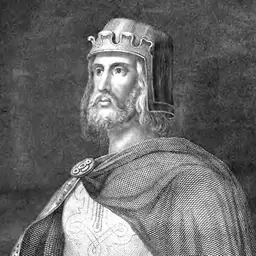
Al-Hakam II, also known as Abū al-ʿĀṣ al-Mustanṣir bi-Llāh al-Hakam b. ʿAbd al-Raḥmān (; 13 January 915 – 1 October 976), was the Caliph of Córdoba. He was the second Umayyad Caliph of Córdoba in Al-Andalus, and son of Abd-al-Rahman III and Murjan. He ruled from 961 to 976.
Rule
Al-Hakam II succeeded to the Caliphate after the death of his father Abd-ar-Rahman III in 961. He secured peace with the Catholic kingdoms of northern Iberia, and made use of the stability to develop agriculture through the construction of irrigation works. Economic development was also encouraged through the widening of streets and the building of markets.
Whilst the internal administration was left increasingly to vizir Al-Mushafi, general Ghālib ibn ʿAbd al-Raḥmān was gradually gaining influence as leader of the army in North Africa. He was chiefly preoccupied with repulsing the last Norman attacks (c. 970), and with the struggle against the Zirids and the Fatimids in northern Morocco. The Fatimids were defeated in Morocco in 974, while Al-Hakam II was able to maintain the supremacy of the caliphate over the Catholic states of Navarre, Castile and León.
Patronage
Literature and science
Hakam himself was well versed in numerous sciences. He had books purchased from Damascus, Baghdad, Constantinople, Cairo, Mecca, Medina, Kufa, and Basra. His status as a patron of knowledge brought him fame across the Muslim world to the point that even books written in Persia, which was under Arab Abbasid control, were dedicated to him. During his reign, a massive translation effort was undertaken, and many books were translated from Latin and Greek into Arabic. He formed a joint committee of Muwallad Muslims and Mozarab Catholics for this task.
His personal library was of enormous proportions. Some accounts speak of him having more than 600,000 books. The catalogue of library books itself was claimed to be 44 volumes long.
The mathematician Lubna of Córdoba was employed as Al-Hakam's private secretary. She was said to be "thoroughly versed in the exact sciences; her talents were equal to the solution of the most complex geometrical and algebraic problems".
The famous physician, scientist, and surgeon Abu al-Qasim al-Zahrawi (Abulcasis) was also active in Al-Hakam's court during his reign, while the leading figures of the Translation movement during the reign of Hakam were Mutazilites and Ibn Masarra.
Construction
Starting in 961, al-Hakam II initiated a major expansion of the Great Mosque of Córdoba. The mosque's prayer hall was extended 45 meters further south. This expansion added several of the building's most architecturally significant features that have survived to the present day, including a richly decorated mihrab, intersecting multifoil arches, and four ornate ribbed domes.
The palace-city of Madinat al-Zahra, first built by his father Abd ar-Rahman III after 936, continued to be built up and renovated under al-Hakam II.
Personal life Al-Hakam married Subh of Cordoba, a Basque concubine. She held sway and strong influence over the court. It is said that al-Hakam nicknamed her with the masculine name Ja'far. They had two sons, the first is Abd al-Rahman (962–970), who died young, and the second is Hisham II (966–1013).
Possible homosexuality According to É. Lévi-Provençal, the phrase Ḥubb al-walad, as found in al-Maqqari's Nafḥ al-ṭayyib, is a reference to al-Hakam's homosexuality or "preference for boys". The fact that he did not produce a suitable heir before the age of 46 has been ascribed either to him being more attracted to men, —although this is only reported euphemistically in the sources, —or because he was too absorbed with his books to care for sensual pleasures.
Death and succession Al-Hakam II suffered a stroke near the end of his life that curtailed his activities and may explain why he was unable to properly prepare his son for leadership. Modern scholars have speculated that, based on the historical descriptions of his death, it was another cerebrovascular stroke, possibly brought on by the cold weather, that claimed his life in October 976. He was succeeded by his son, Hisham II al-Mu'ayad, who was 11 years old at the time and during his minority under regency by General Ghalib al-Nasiri, al-Mushafi, chief administrator of the late caliph, and Subh, his mother, assisted by her secretary Almanzor.
Don’t just read it —
keep it.
Full-length biographies made to live with: read them, listen on the way to work, watch them tonight.
- E-book
- Audio
- Video
Instant download · yours to keep · every purchase keeps this site free
Important facts
Family & relationships
People in Al-Hakam II's life
Named in this biography and alive at the same time


Related people
Same field, nearest in time

Contemporaries
People whose lives overlapped Al-Hakam II's


Frequently asked questions
Who was Al-Hakam II?
Caliph of Córdoba from 961 to 976
When was Al-Hakam II born?
Al-Hakam II was born on 13 January 915 in Córdoba.
When did Al-Hakam II die?
Al-Hakam II died on 16 October 976 in Córdoba.
What was Al-Hakam II's occupation?
Al-Hakam II was a caliph.
What nationality was Al-Hakam II?
Al-Hakam II's recorded nationality: Caliphate of Córdoba, al-Andalus.
Sources & further reading
Cite this page
APA: Biography.guide. (2026). Al-Hakam II. https://biography.guide/al-hakam-ii/
MLA: "Al-Hakam II." Biography.guide, https://biography.guide/al-hakam-ii/.
Chicago: "Al-Hakam II." Biography.guide. https://biography.guide/al-hakam-ii/.
Data last updated: 2026-09-20 · Spot an error? Report a correction.
Page generated 2026-09-27 05:25 UTC