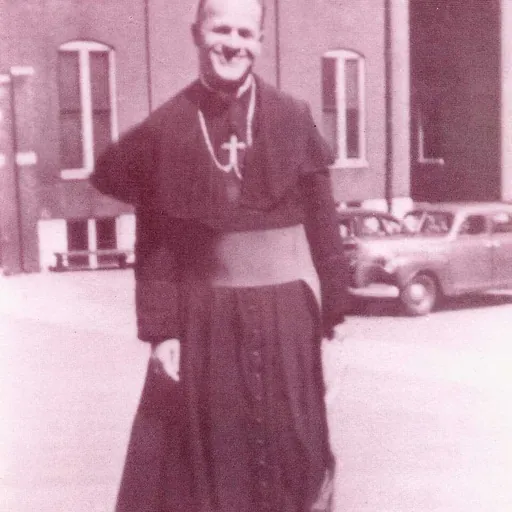
About Adolph John Paschang
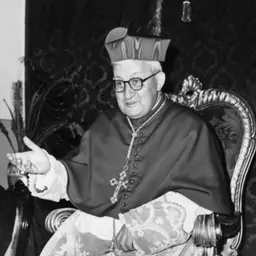
Lived 1895 – 1968 (aged 72). Adolph John Paschang was an American catholic priest, catholic bishop, bishop, educator and missionary.
Immaculate Heart of Mary Cathedral in Jiangmen where Bishop Adolph J. Paschang used to serve. Photo taken on 19 March 2011 Sign at entrance to Immaculate Heart of Mary Cathedral, No.16 Hai Bang Road, Jiangmen. Photo taken on 19 March 2011 Immaculate Heart of Mary Cathedral in Jiangmen (previously known as Kongmoon) (江門). Photo taken on 19 March 2011 Immaculate Heart of Mary Cathedral in Jiangmen where Bishop A.J. Paschang once served as Bishop. Photo taken on 19 March 2011 Photo of staff and alumni of Bishop Paschang Catholic School taken in the Immaculate Heart of Mary Cathedral in Jiangmen where Bishop A.J. Paschang once served as Bishop. Photo taken on 19 March 2011
Adolph John Paschang, MM (, 16 April 1895 – 3 February 1968) was an American Catholic prelate who served as Bishop of Jiangmen from 1946 until his death in 1968. He was a member of the Maryknoll Society and a relief worker and educator in southern China during the early 20th century.
Early life Adolph John Paschang was born in Martinsburg, Audrain County, Missouri. then at St. Louis University High School in St. Louis, then at Kenrick Seminary in St. Louis. He joined the newly founded Catholic Foreign Mission Society of America, commonly known as the Maryknoll Fathers and Brothers, and was ordained a priest on 21 May 1921. After being ordained a priest, Paschang was immediately sent off to Kongmoon (now known as Jiangmen), China. He also worked at Yangjiang (previously known as Yeungkong), Jiaying (previously known as Kaying) Taishan (previously known as Toishan) and Jiangmen. He was appointed vicar apostolic of Kongmoon on 17 June 1937, consecrated bishop on 30 November 1937, and later appointed Bishop of the Catholic Diocese of Jiangmen (previously known as Kongmoon) on 11 April 1946. He lived through the Japanese invasion and occupation of China in the Second World War.
Second World War Japan invaded China in phases in the 1930s, gradually taking southern China towards the end of the decade. Until the attack on Pearl Harbor of 1941, Paschang and his diocese were relatively undisturbed by Japanese forces, given that he possessed American citizenship.
In February 1941, Paschang received a pass from the Japanese occupation forces to visit Hong Kong. The real purpose for his move was to leapfrog over into the unoccupied areas of his Diocese of Jiangmen in order to visit the priests and sisters.
During his stay in Hong Kong, Fr. Joe Sweeney from the Gate of Heaven Leprosarium in Ngaimen arrived, and recounted the adventurous journey he had just made: the motor launch carrying "Fr Big Joe" and other passengers had been attacked by a Japanese patrol boat towards evening, but they escaped capture as darkness descended and allowed them to slip unsighted past the patrol boat. Bishop Paschang would have to take the same route and the same risks on his return visitations. While Bishop Paschang was in Hong Kong, he performed the ordinations at the Dominican Rosary Hill chapel, in the absence of Bishop Enrico Valtorta. by the Chinese Communist authorities. On 5 December 1951, Paschang was forced to contact Stanley House in Hong Kong on three times to relay information that the Chinese Communists were demanding US$22,000. On 7 December 1951, the ransom price was reduced to US$6,000, but nothing was paid. On 19 December 1951, similar news was reported in The New York Times: "December 18 An official Roman Catholic spokesman said today that a 56-year-old Bishop, the Most Rev. Adolph Paschang of Kongmoon (now called Jiangmen), Kwangtung Province (now named Guangdong Province), had been beaten again there following the church's refusal to pay "ransom money" to the Chinese Communists as a means of saving him from the violence of the intensified "land reform" in that southeastern coastal province.". *Bishop Paschang was subsequently severely tortured and broken as a person.
Release by the Communists to Hong Kong Fr. William Downs in his Maryknoll Hong Kong Chronicle recorded on 9 June 1952, "Bishop Paschang, after (being) very badly treated ... was finally expelled from China". They marched Bishop Paschang "from his mission at Pakkai" (now called Beijie, where the Immaculate Heart of Mary Cathedral, i.e. cathedral of the Diocese of Jiangmen, was located), "placed him on a junk and sailed off – he did not know his destination and the thought of Father Sandy Cairns' unhappy ending at the hands of the Japanese must have crossed his mind". On 6 June 1952 Friday night, Paschang crossed the Chinese border into Portuguese Macao. On 9 June 1952, he finally reached Hong Kong. Many reporters anxiously awaited him at the Hong Kong Pier. Upon arrival, Bishop Adolph Paschang recalled that he had been made to kneel on broken bricks in the winter of 1951.
Later life
After his expulsion by the Communist Chinese government, Bishop Paschang stayed in the Maryknoll Stanley House, headquarters of the Maryknoll Fathers and Brothers in Hong Kong, visited the States briefly, but again returned to Hong Kong out of his love of the Chinese people.
In the late 1990s, the Hong Kong SAR Government planned to re-develop the Lower Ngau Tau Kok Estate, where Bishop Paschang Memorial School was situated. In 1997, the headmaster at that time, Leung Kwok Hung, applied for a new school premises from the government and was given a new school building in a "school village" in Kowloon Bay. AM section of Bishop Paschang Memorial School moved to the new campus in Kowloon Bay in 2002. The new school was named Bishop Paschang Catholic School.
The school building of Bishop Paschang Memorial School was finally handed back to the government of Hong Kong in 2008, in line with the plan of demolishing the then remaining portion of the Lower Ngau Tau Kok Estate. The remaining classes of the PM section of Bishop Paschang Memorial School were relocated to Bishop Paschang Catholic School in Kowloon Bay as well.
Don’t just read it —
keep it.
Full-length biographies made to live with: read them, listen on the way to work, watch them tonight.
- E-book
- Audio
- Video
Instant download · yours to keep · every purchase keeps this site free
Important facts
People in Adolph John Paschang's life
Named in this biography and alive at the same time




Related people
Same field, nearest in time


Contemporaries
People whose lives overlapped Adolph John Paschang's

Frequently asked questions
Who was Adolph John Paschang?
Catholic bishop (1895-1968)
When was Adolph John Paschang born?
Adolph John Paschang was born on 16 April 1895 in Martinsburg.
When did Adolph John Paschang die?
Adolph John Paschang died on 3 February 1968 in Hong Kong.
What was Adolph John Paschang's occupation?
Adolph John Paschang was a catholic priest, catholic bishop, bishop, educator and missionary.
What nationality was Adolph John Paschang?
Adolph John Paschang was American.
Sources & further reading
· Wikipedia: Adolph John Paschang
· DBpedia: Adolph John Paschang
Cite this page
APA: Biography.guide. (2026). Adolph John Paschang. https://biography.guide/adolph-john-paschang/
MLA: "Adolph John Paschang." Biography.guide, https://biography.guide/adolph-john-paschang/.
Chicago: "Adolph John Paschang." Biography.guide. https://biography.guide/adolph-john-paschang/.
Data last updated: 2026-09-22 · Spot an error? Report a correction.
Portrait: Wikimedia Commons · author & licence
Page generated 2026-09-27 05:02 UTC