
About Adolfas Ramanauskas
Lived 1918 – 1957 (aged 39). Adolfas Ramanauskas was a Lithuanian and American teacher.
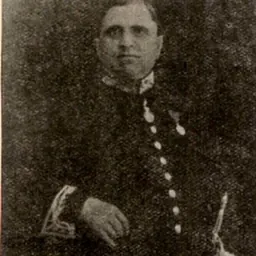
Adolfas Ramanauskas (6 March 1918 – 29 November 1957), code name Vanagas , was one of the leaders of the Lithuanian partisans and the anti-Soviet resistance. In 2018, the Seimas of Lithuania posthumously recognized him as the Head of state of Lithuania.
Ramanauskas was born in the United States to a family of Lithuanian immigrants who returned to Lithuania when he was 3 years old. He worked as a teacher during the Soviet and German occupations of Lithuania in World War II. When Lithuania was re-occupied by the Soviet Union in 1944–45, he joined the anti-Soviet resistance after the NKVD pressured him to spy on his students. Eventually, Ramanauskas climbed the ranks from a platoon commander to the chairman of the Union of Lithuanian Freedom Fighters. Betrayed by a classmate in 1956, he was arrested, brutally tortured, and eventually executed.
The erection of Ramanauskas' memorial in Chicago on May 4, 2019 was protested as "offensive" by Russia, the Simon Wiesenthal Center, the World Jewish Congress, and the Jewish Agency, which made allegations that he collaborated with the Nazis during the Holocaust. This was denied by the Lithuanian government, which summoned the Russian ambassador over these claims, while the Lithuanian Jewish Community stated that there was nothing offensive about the memorial to Ramanauskas "as there are no historical materials testifying to controversial facts, such as complicity in the Holocaust".
Early life Ramanauskas was born to a Lithuanian immigrant family in New Britain, Connecticut, United States. In 1921, his family returned to Lithuania, bought of land in near Rudamina, and took up farming. he continued his studies at the Klaipėda Pedagogical Institute. Just before his graduation the Klaipėda Region was ceded to Nazi Germany due to the 1939 German ultimatum to Lithuania, in fear of full scale German invasion, and the institute was consequently evacuated to Panevėžys. Historian and politician Arvydas Anušauskas has similarly claimed that the allegations have their origins in a "Russian backed anti-Lithuanian disinformation campaign" led by the KGB officer and his torturer Nachman Dushanski. Ramanauskas himself, already in 1952, wrote in his diary that:Soviet occupants called us "German Nationalists". They used this term in order to discredit us inside the country and abroad - hoping that perhaps some people will believe that we were fighting for Nazi affairs, at the same time betraying our homeland".
In autumn 1949, Ramanauskas was further promoted to colonel and chief commander of the defensive forces of the Union of Lithuanian Freedom Fighters. When Žemaitis resigned due to poor health in 1952, Ramanauskas became the leader of the Union. Ramanauskas was betrayed by Antanas Urbonas, a former classmate at Kaunas, and arrested on 11 October 1956.
Capture, torture and death (1956–1957) He was taken to the KGB prison in Vilnius (now the Museum of Genocide Victims) and tortured. On 12 October barely alive, he was transferred to a hospital, where doctors noted his many wounds – his eye was punctured 5 times, he was missing genitals, had a bruised stomach, etc. He was cut alive and then stitched. Scissors were actively used during his torture. This took place despite Nikita Khrushchev having officially claimed to have abolished torture. Sentenced to death on 25 September 1957, Vanagas was executed on 29 November 1957.
His wife Birutė Mažeikaitė was sentenced to 8 years in the Gulag system.
Postmortem On 27 December 1997, Ramanauskas-Vanagas, was granted the status of a "military volunteer," and on 26 January 1998, he was posthumously granted the rank of reserve brigadier general by decree of the President of Lithuania, in addition to being awarded the Order of the Cross of Vytis (second class) and in 1999 the Order of the Cross of Vytis (first class). In 2018, Seimas passed a resolution identifying Ramanauskas as the "highest-ranking Lithuanian official in the fight against Soviet occupation" from 1954 to 1957.
Commemoration
A book of memoirs by Ramanauskas, written between 1952 and 1956 and assembled by his daughter Auksutė Ramanauskaitė-Skokauskienė, was published in 1991 under the title Daugel krito sūnų ("Many sons fell"). In 2018, the Lithuanian Genocide and Resistance Research Centre published an English translation of the work, entitled Many Sons Have Fallen in the Partisan Ranks. Auksutė was also elected to the Seimas in 2008.
In December 2017, Israeli ambassador Amir Maimon visited Ramanauskas's daughter and reportedly "expressed indirect diplomatic support to the memory of the freedom fighter."
Monument in the U.S. In 2017, plans to erect a monument for the 100th anniversary of Ramanauskas's birth in his native New Britain, Connecticut were cancelled following the adoption of a council petition.
On May 4, 2019, a monument to Ramanauskas was unveiled in Chicago, which was criticized by Russia, the Simon Wiesenthal Center, the World Jewish Congress, and the Jewish Agency, which made allegations that he collaborated with the Nazis during the Holocaust.
Other monuments In 2022, a monument for Ramanauskas was unveiled in Merkinė. The monument was soon vandalised, twice – in 2023 and 2024. Three individuals associated with the second incident were arrested in Estonia – two Estonian-Russian citizens and one Russian citizen – and prosecuted in Lithuania, following their extradition.
Grave In 2018, Ramanauskas's grave was found at the Našlaičiai ( Orphans) Cemetery in Antakalnis, Vilnius. The identity was confirmed by anthropological analysis of the skull, DNA investigation, and photographic matching. His death was the result of a gunshot in the vertex of his head. His remains were discovered and reburied in a state funeral among other state leaders in the Antakalnis Cemetery, at which Lithuanian President Dalia Grybauskaitė spoke, diplomats from 30 countries and thousands of ordinary people participated. The Seimas designated 2018 the year of Ramanauskas-Vanagas.
Don’t just read it —
keep it.
Full-length biographies made to live with: read them, listen on the way to work, watch them tonight.
- E-book
- Audio
- Video
Instant download · yours to keep · every purchase keeps this site free
Important facts
People in Adolfas Ramanauskas's life
Named in this biography and alive at the same time



Related people
Same field, nearest in time



Contemporaries
People whose lives overlapped Adolfas Ramanauskas's


Frequently asked questions
Who was Adolfas Ramanauskas?
Lithuanian general (1918–1957)
When was Adolfas Ramanauskas born?
Adolfas Ramanauskas was born on 6 March 1918 in New Britain.
When did Adolfas Ramanauskas die?
Adolfas Ramanauskas died on 29 November 1957 in Vilnius.
What was Adolfas Ramanauskas's occupation?
Adolfas Ramanauskas was a teacher.
What nationality was Adolfas Ramanauskas?
Adolfas Ramanauskas was Lithuanian and American.
Sources & further reading
· Wikipedia: Adolfas Ramanauskas
· DBpedia: Adolfas Ramanauskas
Cite this page
APA: Biography.guide. (2026). Adolfas Ramanauskas. https://biography.guide/adolfas-ramanauskas/
MLA: "Adolfas Ramanauskas." Biography.guide, https://biography.guide/adolfas-ramanauskas/.
Chicago: "Adolfas Ramanauskas." Biography.guide. https://biography.guide/adolfas-ramanauskas/.
Data last updated: 2026-09-25 · Spot an error? Report a correction.
Page generated 2026-09-27 05:11 UTC