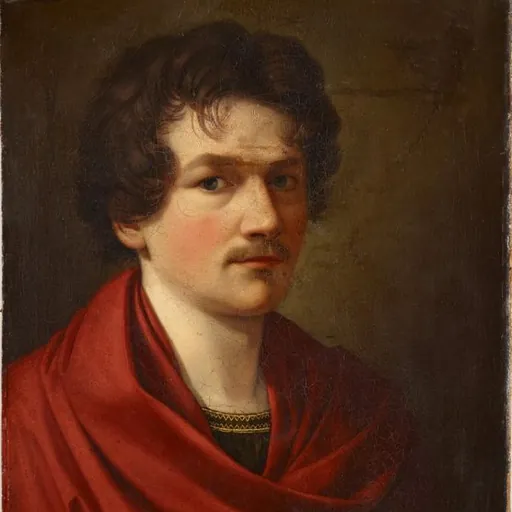
About Adolf Senff
Lived 1785 – 1863 (aged 78). Adolf Senff was a German painter.
Carl Adolf Senff (17 March 178521 March 1863) was a German painter in the Biedermeier style. His works are mostly portraits and still-lifes.
Biography He was born in Halle. He was the thirteenth and youngest child of , a Consistorial Councilor at the Church of St. Moritz, and his wife, Rosina Dorothea née Litzmann. At first, he followed his father's wishes and attended the school at the Francke Foundations to study theology. After he had completed his studies, he worked as a teacher at a public school in Leipzig.
There, he met the writer, , and showed him drawings he had made while studying. Leis was impressed and sent some to the artist, Gerhard von Kügelgen, of Dresden, whose children were attending school in Leipzig. As a result, he decided to pursue a career in art, even though he had already started the ordination process. By 1813, he was working as a freelance portrait painter, and soon began receiving commissions.
In 1816, after a brief period as a volunteer in an infantry unit in France, he used some of his inheritance to travel; visiting Prague, Vienna and Florence before settling in Rome. He was able to find accommodations at the "Casa Buti", a home for artists whose residents included the famous sculptor, Bertel Thorvaldsen. They became friends, and Thorvaldsen helped introduce him into the artistic community of Rome. He would live there for thirty-two years.
He originally made most of his living by copying the Old Masters. In 1820, the Canon Immanuel Christian Leberecht von Ampach commissioned a painting of "Christ and the Canaanite Woman" for the Naumburg Cathedral. The following year, he was admitted to the Accademia di Belle Arti di Perugia. After 1825, he focused on still lifes with flowers and fruits, eventually becoming known as the "Raphael of Flowers". Occasionally, he would include portraits of Italian women in various regional costumes. His clients included King Frederick William II of Prussia and members of the Romanov family.
During the Revolutions of 1848, he returned to Germany. After a short stay in Berlin, he settled in Ostrau, where his eldest brother, Carl Wilhelm (1767–1850), was a pastor. Following his wife's death, in 1852, he married their adopted daughter, Auguste Charlotte Franziska Held (1811–1898).
He continued to paint prolifically until his death in 1863, shortly after his seventy-eighth birthday. As requested in his will, a linden tree was planted on his grave. It has survived and is now known as the "Professorenlinde".
Selected paintings
Don’t just read it —
keep it.
Full-length biographies made to live with: read them, listen on the way to work, watch them tonight.
- E-book
- Audio
- Video
Instant download · yours to keep · every purchase keeps this site free
Important facts
People in Adolf Senff's life
Named in this biography and alive at the same time



Related people
Same field, nearest in time


Contemporaries
People whose lives overlapped Adolf Senff's


Frequently asked questions
Who was Adolf Senff?
German painter (1785–1863)
When was Adolf Senff born?
Adolf Senff was born on 17 March 1785 in Halle (Saale).
When did Adolf Senff die?
Adolf Senff died on 21 March 1863 in Ostrau.
What was Adolf Senff's occupation?
Adolf Senff was a painter.
What nationality was Adolf Senff?
Adolf Senff was German.
Sources & further reading
Cite this page
APA: Biography.guide. (2026). Adolf Senff. https://biography.guide/adolf-senff/
MLA: "Adolf Senff." Biography.guide, https://biography.guide/adolf-senff/.
Chicago: "Adolf Senff." Biography.guide. https://biography.guide/adolf-senff/.
Data last updated: 2026-09-20 · Spot an error? Report a correction.
Page generated 2026-09-27 05:09 UTC