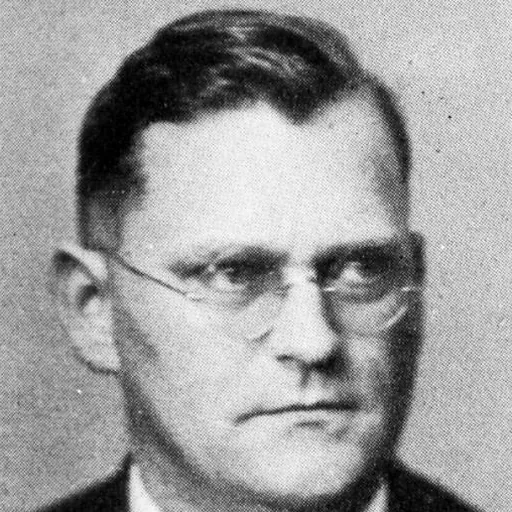
Adolf Grimme
German politician, Lower Saxony Landtag member
About Adolf Grimme
Lived 1889 – 1963 (aged 73). Adolf Grimme was a German politician, resistance fighter, pedagogue and broadcasting director.
Adolf Berthold Ludwig Grimme (31 December 1889 – 27 August 1963) was a German politician, a member of the Social Democratic Party (SPD). He was the cultural minister in the Free State of Prussia during the later years of the Weimar Republic and after World War II, during the early years of the Federal Republic of Germany. During Nazi Germany, he was arrested as a member of the German Resistance and sentenced to prison. After the war, he filed a legal complaint against the judge who had condemned him and others. After years of delays, the case was dropped by the prosecutor.
Life before 1945
Grimme was born in Goslar, Prussian Hanover, the son of Louise, née Sander (1858–1952) and Adolf Grimme (1854–1906), a train station master. In 1908, he began studying philosophy and German studies, attending the University of Halle, the Ludwig-Maximilians-Universität München and the University of Göttingen. In 1922, he became a member of the SPD. He began teaching in 1924. He then became a senior teacher (Oberstudienrat) in Hanover and in 1925, he became the superintendent in Magdeburg.
Grimme became the assistant minister at the Prussian Ministry of Culture (officially, the Ministry of Science, Art and Education, and a year later, the vice president of the provincial school council of Berlin and Mark Brandenburg.
Grimme belonged to the Covenant of Religious Socialists. In 1942, his house was searched because of his connections to the Red Orchestra and he was arrested by the Gestapo. In 1943, he was brought before the Reich court martial. A good defense strategy, which mainly consisted of informing on his fellow Red Orchestra members, enabled him to avoid the death penalty facing him and he was sentenced to three years in a labor prison (Zuchthaus), condemned for "failure to report an attempt at high treason". The Gestapo failed to uncover his participation in the German Resistance as author of many fliers then in circulation. Under the Third Reich, the crime of Wehrkraftzersetzung was punishable by death. Grimme's prison term was spent at the prisons in Luckau and Fuhlsbüttel. "The basis of the 'Red Orchestra'... was treason. Treason... has ever and in all ages been regarded as the most ignominious crime. ... Also, the 20 July Plot was in profound measure fueled by treason and espionage." The report further stated that the military opposition had "assumed... an enormous amount of guilt". Other German men disagreed with Hitler and the war, but nonetheless "did their duty as soldiers and in administration and the economy... [and] certainly would have rejected with outrage... being placed in the same league with men like Beck, Canaris, Oster [and] von Dohnanyi." |group=note
The case, also pursued by Weisenborn and Greta Kuckhoff, was delayed by the state's attorney in Lüneburg until the end of the 1960s, when it was dropped.
Grimme was a member of the postwar "appointed Landtag" organized by the British military government in their occupation zone. It existed for just a few months, from 23 August 1946 to 8 December 1946. After the British created the German state of Lower Saxony, he became a member of the appointed Landtag of Lower Saxony, which existed from 8 December 1946 to 28 March 1947. When the elections were held, he became a member of the first elected Landtag, later becoming the first Minister of Culture of Lower Saxony. On 15 November 1948, Grimme was named the first General Manager of Nordwestdeutscher Rundfunk.
Legacy Over the decades since his death, Grimme has become a "name without a history". An annual television prize, the most prestigious in Germany, is named for him, the Adolf Grimme Award. Known since 2010 as the Grimme Award, it was first awarded by the City of Marl training institute in 1964. In 1973, a media institute named after Grimme was founded in Marl, and has given out the Grimme Award since 1977, expanded in 2001 to include new media. A biography about Grimme was published in 2008, helping to "return the missing history" to Grimme's name.
Footnotes
Don’t just read it —
keep it.
Full-length biographies made to live with: read them, listen on the way to work, watch them tonight.
- E-book
- Audio
- Video
Instant download · yours to keep · every purchase keeps this site free
Important facts
People in Adolf Grimme's life
Named in this biography and alive at the same time

Related people
Same field, nearest in time






Contemporaries
People whose lives overlapped Adolf Grimme's


Frequently asked questions
Who was Adolf Grimme?
German politician, Lower Saxony Landtag member (1889-1963)
When was Adolf Grimme born?
Adolf Grimme was born on 31 December 1889 in Goslar.
When did Adolf Grimme die?
Adolf Grimme died on 27 August 1963 in Brannenburg.
What was Adolf Grimme's occupation?
Adolf Grimme was a politician, resistance fighter, pedagogue and broadcasting director.
What nationality was Adolf Grimme?
Adolf Grimme was German.
Sources & further reading
Cite this page
APA: Biography.guide. (2026). Adolf Grimme. https://biography.guide/adolf-grimme/
MLA: "Adolf Grimme." Biography.guide, https://biography.guide/adolf-grimme/.
Chicago: "Adolf Grimme." Biography.guide. https://biography.guide/adolf-grimme/.
Data last updated: 2026-09-24 · Spot an error? Report a correction.
Portrait: Wikimedia Commons · author & licence
Page generated 2026-09-27 05:09 UTC