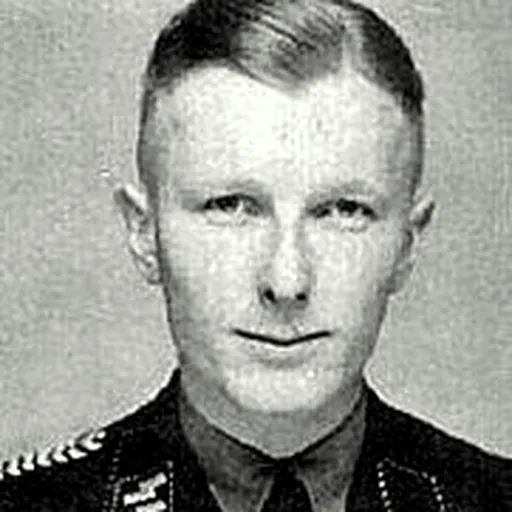
About Adolf Diekmann
Lived 1914 – 1944 (aged 29). Adolf Diekmann was a military personnel.
Adolf Rudolf Reinhold Diekmann (18 December 1914 – 29 June 1944) was a Nazi officer and war criminal in the Waffen SS during World War II who orchestrated the Oradour-sur-Glane massacre in France on 10 June 1944. Under Diekmann's command, troops from the SS Division Das Reich killed 643 inhabitants in the village, most of whom were women and children. He said he committed the war crime in retaliation for the killing of fellow SS officer Helmut Kämpfe by the French Resistance. Diekmann died in combat in Normandy a few weeks later.
Early life and early Nazi Party involvement Adolf Diekmann was born on 18 December 1914 in Magdeburg, Prussia, in the German Empire to Heinrich and Anna Diekmann. Adolf was the second of four children, two girls and two boys. Heinrich was a primary school teacher. Adolf left school in 1932 at age 17.
On 1 April 1933, Diekmann joined the Nazi Party, one week after the Reichstag passed the Enabling Act of 1933, essentially granting Adolf Hitler dictatorial powers. He received membership number 1,752,411. Diekmann completed his Nazi work service between 18 May and 13 November in Burg, about from his home town. He then completed his high school education at a Nationalpolitischen Erziehungsanstalt, a Nazi secondary boarding school, in Naumburg, earning his degree on 12 December 1935. While in southern France, Diekmann was promoted on 8 June 1944two days after the Normandy landingsto SS-Sturmbannführer. Canou handed Kämpfe over to Guingouin. The following day, the highly-decorated SS officer was executed on the orders of Guingouin or killed during an attempt to escape. His body was burned although some reports say he was burned alive.
When the SS Division discovered that Kämpfe had been kidnapped, Diekmann led troops from the 3rd Company, 1st Battalion, 4th SS Panzer Grenadier Regiment and members of the Milice on a search of the surrounding area. Two local men were shot dead east of Saint-Léonard-de-Noblat by SS men under Diekmann's command. Diekmann reached the outskirts of Oradour-sur-Glane. He told his superiors that he had ordered his men to raze the village and kill the inhabitants (245 women, 207 children and 190 men) because he had become enraged after he had found Kämpfe's handcuffed body inside a German field ambulance with the remains of other German soldiers. He believed that the vehicle had been set alight and burned alive everyone inside. All charges against Diekmann were dropped after he was killed near Noyers-Bocage while fighting in Normandy against British troops on 29 June 1944. Diekmann, who was not wearing a helmet at the time of his death, was killed by shrapnel to his head from a British artillery shell. He was buried at La Cambe German war cemetery in block 25, row 4, grave 121.
Legacy On 12 January 1953, a military tribunal in Bordeaux heard the charges against the surviving 65 of the 200 or so SS men who had been involved in the Oradour-sur-Glane massacre. 20 defendants were convicted of war crimes. Diekmann was dead but the tribunal found him responsible for ordering the killings. Almost 70 years after the massacre, former soldiers from Diekmann's command were still being investigated over the killings. On 8 January 2014, Werner Christukat, an 88-year-old former member of the 3rd Company of the 1st Battalion of the 4th SS Panzer Grenadier Regiment was charged, by the state court in Cologne, with 25 charges of murder and hundreds of counts of accessory to murder in connection with the massacre in Oradour-sur-Glane. The suspect, who was identified only as Werner C., had until 31 March 2014 to respond to the charges. If the case had gone to trial, it might have been held in a juvenile court because the suspect was only 19 at the time the crime occurred. According to his attorney, Rainer Pohlen, the suspect acknowledged being at the village but denied being involved in any killings. On 9 December 2014, the court dropped the case, citing a lack of witness statements or reliable documentary evidence able to disprove the suspect's contention that he was not a part of the massacre.
Personal life Diekmann met Hedwig Meindle, a medical student, when Germany invaded Czechoslovakia. They were married on 12 February 1940 and had sons Rainer (born 11 March 1942) and Uwe Rudolf (born 1943). The family lived in Elbogen, near Hedwig's parents. Diekmann was sent to France shortly after the wedding. After Adolf's death, Hedwig remarried and the children left Elbogen to live in the Bavarian Forest. Hedwig later joined them and opened a medical practice in Monheim, Swabia. According to her son Rainer, her first husband's name was taboo to mention. According to a 2014 interview, Diekmann's eldest son Rainer had heard from his maternal grandfather's wife that his father Adolf had done "something very serious over there [Oradour] during the war." Several years later, Rainer learned of his father's culpability for the massacre.
Don’t just read it —
keep it.
Full-length biographies made to live with: read them, listen on the way to work, watch them tonight.
- E-book
- Audio
- Video
Instant download · yours to keep · every purchase keeps this site free
Important facts
People in Adolf Diekmann's life
Named in this biography and alive at the same time

Related people
Same field, nearest in time


Contemporaries
People whose lives overlapped Adolf Diekmann's


Frequently asked questions
Who was Adolf Diekmann?
SS officer (1914–1944)
When was Adolf Diekmann born?
Adolf Diekmann was born on 18 December 1914 in Magdeburg.
When did Adolf Diekmann die?
Adolf Diekmann died on 29 June 1944 in Normandy.
What was Adolf Diekmann's occupation?
Adolf Diekmann was a military personnel.
What nationality was Adolf Diekmann?
Adolf Diekmann's recorded nationality: German Reich.
Sources & further reading
Cite this page
APA: Biography.guide. (2026). Adolf Diekmann. https://biography.guide/adolf-diekmann/
MLA: "Adolf Diekmann." Biography.guide, https://biography.guide/adolf-diekmann/.
Chicago: "Adolf Diekmann." Biography.guide. https://biography.guide/adolf-diekmann/.
Data last updated: 2026-09-22 · Spot an error? Report a correction.
Portrait: Wikimedia Commons · author & licence
Page generated 2026-09-27 05:03 UTC