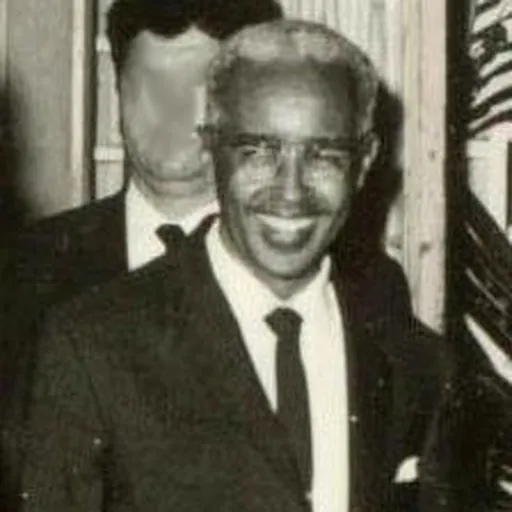
About Aden Abdullah Osman Daar
Lived 1908 – 2007 (aged 98). Aden Abdullah Osman Daar was a Somali politician, freedom fighter and nationalist.
Early life and career Daar was born on 9 December 1908 in Beledweyne, situated in the south-central Hiraan region of Somalia. He hailed from the Udejeen, Abdile Afarah clan of Hawiye. He was an orphan, who lost his parents at a young age. Daar, was an avid reader, and self taught on many subjects. He spoke Arabic, Somali, Italian and English.
Political career Somali Youth League Daar joined the incipient Somali Youth League (SYL) political party in 1944, a nationalist organization that campaigned for an independent Somalia. Quickly rising through the ranks, he became the local secretary of the SYL's Beledweyne branch in 1946. A decade later, he became Chairman of the National Legislative Assembly, and would eventually lead the SYL itself two years afterwards.
Presidency By the time Somalia gained its independence in 1960, Daar had attained widespread prominence as a nationalist figure. In short order, he was elected the country's first President, a position he would assume from 1960 to 1967. During his tenure, he proactively pursued an irredentist national policy for the restoration of lost Somali territories. Notable incidents include the 1964 Ethiopian–Somali Border War, the Shifta War of Kenya, the Front de Libération de la Côte des Somalis battle for Djiboutian Independence as well as support for the ELF in Eritrea and the Bale Revolt of the Oromo in Ethiopia. His rivals in Kenya and Ethiopia had subsequently signed a defence pact in 1965 in order to curb what they deemed as expansion on their doorstep. In line with these policies, President Aden also enrolled Somalia into a number of organisations to advocate for the freedom and liberties of all colonised nations such as the Non-Aligned Movement, the Organisation of African Unity and the World Muslim Congress in which Somalia hosted the Congress' 6th conference in 1966. Notable countries which Somalia in his time advocated for and supported with men or material include South Africa and Palestine during the Six Day War.
Somalia under President Aden pursued modest economic planning to improve domestic revenue. His publicised First Five Year Plan (1963-1967) demonstrated its simple development strategy concentrated on a handful of projects: an increased output of sugar through expanding the productive capacity of the existing factory at Jowhar; the development of meat packing, fish processing, milk and dairy products, textiles, and a few other industries; the construction or improvement of a number of roads; building three seaports at Kismayo, Berbera, and Mogadiscio; the expansion of irrigation for crops and fodder; the formation of a number of state farms; certain improvements in social services, including education and health. Sectoral allocations of planned investment outlays reflected a greater priority for physical infrastructure than agricultural development or population settlement. Though the Plan was essentially a public expenditure programme, it also gave considerable encouragement to private enterprise, offering incentives in the form of protection, exemption from certain taxes for a limited period and the grant of loans on favourable terms to those firms prepared to invest in industries which have a reasonable scope for becoming profitable and the establishment of which is desirable in the national interest.
In the 1967 presidential election, Aden was defeated by Abdirashid Ali Shermarke, his former Prime Minister. His term as president ended on July 6, 1967. Aden accepted the loss graciously, making history as the first head of state in Africa (excluding Liberia) to peacefully hand over power to a democratically elected successor.
Shermarke was assassinated two years later by one of his own bodyguards. The slaying led to an unopposed, bloodless coup d'état by the Somali Army on 21 October 1969, the day after Shermarke's funeral. Spearheading the putsch was Major General Muhammad Siad Barre, who at the time commanded the army.
Manifesto In 1990, with the start of the civil war, Daar along with former Minister of Information Ismail Jim'ale Osoble, former Minister of Education Hassan Ali Mire, former Minister of Interior Haji Muse Boqor and about 100 other Somali politicians signed a manifesto expressing concern over the violence and advocating reconciliation. Daar was summarily arrested, and remained imprisoned until the ultimate collapse of Barre's regime the following year.
Later years After his release, Daar spent the better part of his later years on his farm in Janale, in southern Somalia.
On 22 May 2007, it was erroneously reported that he had died in a hospital in Nairobi, Kenya. He was, however, in critical condition and on life support. Daar died in hospital on 8 June 2007, at the age of 98.
The Transitional Federal Government, then headed by former President of Somalia Abdullahi Yusuf Ahmed, declared 21 days of mourning, complete with a national memorial service, and issued a statement that Daar would receive a state funeral. It also renamed Mogadishu International Airport to Aden Adde International Airport in his honor.
Don’t just read it —
keep it.
Full-length biographies made to live with: read them, listen on the way to work, watch them tonight.
- E-book
- Audio
- Video
Instant download · yours to keep · every purchase keeps this site free
Important facts
People in Aden Abdullah Osman Daar's life
Named in this biography and alive at the same time
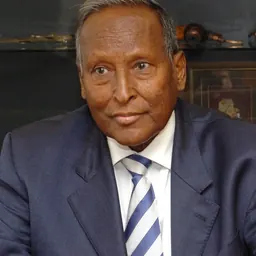

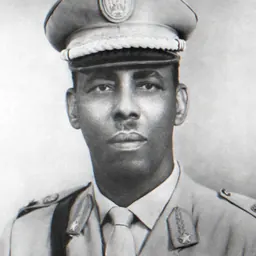



Related people
Same field, nearest in time




Contemporaries
People whose lives overlapped Aden Abdullah Osman Daar's



Frequently asked questions
Who was Aden Abdullah Osman Daar?
Somali politician (1908-2007)
When was Aden Abdullah Osman Daar born?
Aden Abdullah Osman Daar was born on 9 December 1908 in Beledweyne.
When did Aden Abdullah Osman Daar die?
Aden Abdullah Osman Daar died on 8 June 2007 in Nairobi.
What was Aden Abdullah Osman Daar's occupation?
Aden Abdullah Osman Daar was a politician, freedom fighter and nationalist.
What nationality was Aden Abdullah Osman Daar?
Aden Abdullah Osman Daar was Somali.
Sources & further reading
· Wikipedia: Aden Abdullah Osman Daar
Cite this page
APA: Biography.guide. (2026). Aden Abdullah Osman Daar. https://biography.guide/aden-abdullah-osman-daar/
MLA: "Aden Abdullah Osman Daar." Biography.guide, https://biography.guide/aden-abdullah-osman-daar/.
Chicago: "Aden Abdullah Osman Daar." Biography.guide. https://biography.guide/aden-abdullah-osman-daar/.
Data last updated: 2026-09-21 · Spot an error? Report a correction.
Portrait: Wikimedia Commons · author & licence
Page generated 2026-09-27 05:00 UTC