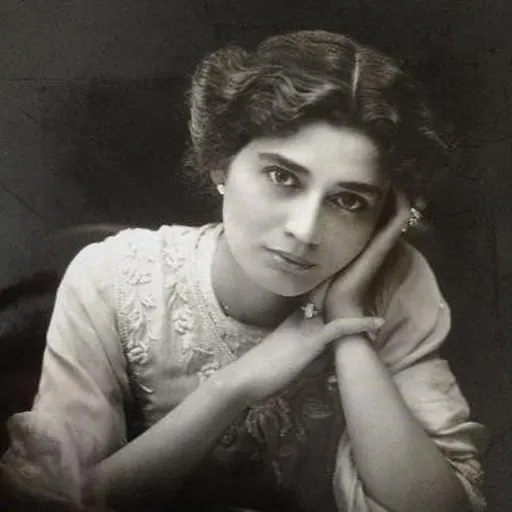
About Adeline Bourne
Lived 1873 – 1965 (aged 91–92). Adeline Bourne was an actor and suffragist.
Adeline Bourne (8 January 1873 – 8 February 1965) was a British Anglo-Indian actress, suffragette and charity worker.
Early life Bourne was born Selina "Lena" Manson in British India in 1873. She was sent to private schools in Eastbourne and Blackheath, though after expulsion from three schools was educated by a governess.
Acting career She studied drama under Sarah Thorne and adopted the stage name Adeline Bourne.
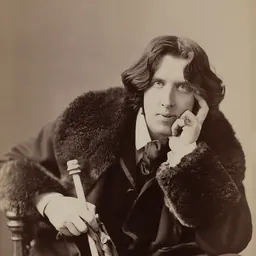
At the start of the 20th century Bourne appeared in avant-garde and feminist plays. such as titular character Salome in Oscar Wilde's play, who she played as an "emancipated virago" and "political princess"; Antistia in John Masefield's The Tragedy of Pompey the Great; and Ftatateeta and later Cleopatra in George Bernard Shaw's Caesar and Cleopatra. Other roles included Gertrude in Hamlet.
Activism
Bourne was interested in the women's suffrage movement and attended some early National Union of Women Suffrage Societies (NUWSS) meetings, but was initially "frightened of the militants" and concerned about how activism could impact her acting career.
In 1908 she founded the Actresses' Franchise League (AFL) with Gertrude Elliott, Winifred Mayo and Sime Seruya. She served as the League's honorary secretary, until resigning in 1912 due to travelling to America. When in England, she was often seen advertising AFL performances on the streets of the West End. Bourne also set up the New Players Society in 1911.
In 1915, Bourne founded the British Women's Hospital, which raised £150,000 to establish the Royal Star and Garter Home for disabled soldiers. During World War I she served abroad as an officer in Queen Mary's Army Auxiliary Corps,
Between 1915 and 1963 Bourne raised over £750,000 for different causes. For example, she raised £37,500 for the Elizabeth Garrett Anderson Hospital. In 1928 she was Vice President of the Association for Moral and Social Hygiene's Josephine Butler Appeal Fund. After World War II she started a women's employment organization to help women return to civilian jobs. In the mid-1950s she established the Wayfarers' Trust, a nursing home and hospital for older people.
In 1965 a fire destroyed her former home in Thurston. Though her papers were rescued from the fire, they were subsequently destroyed in 2013.
In 2018, Helen Geake, former Time Team presenter and Green Party candidate for Bury St Edmunds, tracked down her grave and planted violet primroses with local residents for International Women's Day.
Don’t just read it —
keep it.
Full-length biographies made to live with: read them, listen on the way to work, watch them tonight.
- E-book
- Audio
- Video
Instant download · yours to keep · every purchase keeps this site free
Important facts
People in Adeline Bourne's life
Named in this biography and alive at the same time




Related people
Same field, nearest in time


Contemporaries
People whose lives overlapped Adeline Bourne's


Frequently asked questions
Who was Adeline Bourne?
Anglo-Indian actress, suffragette and charity worker
When was Adeline Bourne born?
Adeline Bourne was born in 1873 in presidencies and provinces in British India.
When did Adeline Bourne die?
Adeline Bourne died on 8 February 1965.
What was Adeline Bourne's occupation?
Adeline Bourne was an actor and suffragist.
Sources & further reading
Cite this page
APA: Biography.guide. (2026). Adeline Bourne. https://biography.guide/adeline-bourne/
MLA: "Adeline Bourne." Biography.guide, https://biography.guide/adeline-bourne/.
Chicago: "Adeline Bourne." Biography.guide. https://biography.guide/adeline-bourne/.
Data last updated: 2026-09-21 · Spot an error? Report a correction.
Portrait: Wikimedia Commons · author & licence
Page generated 2026-09-27 05:00 UTC